
Why It Matters
A frequent question that comes up in medical and scientific translation projects is:
Can we harmonize this into a single translation?
The usual answer is: “It depends…”
It depends on the language pair, the purpose of the information the document conveys, the consequence of the end user misinterpreting the translated content, and what you’re actually trying to achieve. My goal with this piece is to give translators, localization project managers, clinicians, scientists, coders and execs a practical framework for thinking through that question.
Harmonization, when applied correctly, is a powerful tool. When applied incorrectly, it produces translations that are linguistically flat and unnatural, scientifically or medically compromised, and potentially unusable in the real world because they cause too much cognitive friction for its end users.
One definite thing is: harmonization should never be a strategy to reduce licensing paperwork, translation maintenance, or translation costs because the client wants fewer files or faster delivery. It must always be all about the intended usability of the translation and the intended comprehension of its end user.
Let’s start from first principles and then go over examples of major languages commonly used in medical and scientific contexts…
What is Harmonization?
Harmonization is a term that the Life Sciences industry gave to a process that is referred to as standardization in sociolinguistics and dialectology, and normalization in translation theory. Harmonization is more or less a middle ground between the two, leaning more toward normalization.
Translation theory is highly specific in how it approaches the smoothing of dialectal variation, hence no single term exists to describe it. I suppose the Life Sciences industry needed an umbrella term to just get on with it. Fair enough.
Clinical research industry publications, promoted as guidelines and published around the concept of harmonization, were developed by clinical outcomes researchers through literature reviews, without translation peer review or direct input from linguistics experts. As such, the harmonization guidance body is highly generalized and not very helpful in practice when concrete decisions need to be made, resulting in harmonized versions of clinical outcome assessments in registers that should not have been harmonized. Please bear with me on this pointed view; I will explain why.
In the context of translation, harmonization refers to a consensus-based process of aligning terminology, phrasing, or conceptual expression across multiple language versions of some type of content. The goal is to generate a single language variant that reflects consistency with the source and also with the regional comprehension of its target audience.
Just to be clear, harmonization is not the same as using a single translation from a specific country across multiple countries that share the same parent language. For example, using a Mexican Spanish translation across the United States and Central America.
A harmonized translation is stripped of regional identity, which includes national idioms, country-specific terminology, and locally marked expressions.
What Makes Two Language Variants Harmonizable?
Linguistic compromises are always a part of the harmonization consensus across regions, and whenever such a consensus cannot be reached, harmonization fails.
What are those compromises? How will they impact the target subject’s comprehension and practical usability of the harmonized version? Does it make sense to harmonize for this target group?
The most common compromise is that it will not sound natural within any one country. Despite that, it must be fully comprehensible without the end user struggling to understand its content.
The decision about whether to harmonize must be centred on the end user’s register, not only on intelligibility within the language group.
At the end user’s literacy level, for two language variants to be candidates for harmonization, they must share enough structural, lexical, and conceptual overlap that a common rendering is linguistically natural and culturally resonant in both. This criterion rules out a surprisingly large number of language pairs.
The criteria we use are:
Mutual intelligibility
Can a native speaker of one variety read the other with full comprehension and without a sense of foreignness? Partial intelligibility is not enough, especially when the consequences are dire.
Lexical overlap in register
Everyday vocabulary diverges significantly in some language variants, while specialized terminology tends to diverge less. A harmonized version is sometimes achievable in a technical domain even when it is not possible to reach consensus at the general public level.
Shared pragmatic norms
Does the same phrasing carry the same social weight? Formal register in two variants of the same language sometimes differs in ways that affect how the general public interprets instructions and response options.
Regulatory and market precedent
To your best knowledge, has a harmonized version of this language pair been accepted in prior regulatory submissions, especially by regional review boards? This is a risk that needs to be addressed with the customer before a harmonization project begins.
When is Harmonization Appropriate?
Harmonization makes sense when all of the following three conditions are met:
1. The language varieties in question share a recognized written standard that functions across all of the relevant markets (e.g., Standard German across the DACH region, or Latin American Spanish across the Americas).
2. The document type supports it.
Technical and professional-facing documents (e.g., installation instructions, educational materials, marketing copy, adult clinical outcomes assessments, etc.) are more amenable to harmonization than content for the general public, where literacy may vary. Register variation is an important consideration when the consequences of misunderstanding a harmonized language variant are elevated.
3. The harmonization decision is documented and justifiable.
Regulatory agencies do not object to harmonization when applicants can demonstrate that the shared version was reviewed by linguists from both target populations, that discrepancies were identified and resolved, and that the resulting version reached an acceptable consensus from relevant participants in each target market.
When Not to Harmonize
There are boundaries that we consider non-negotiable, especially in safety instructions and medical translations, like COA work.
1. Do not harmonize across scripts.
For example, Simplified Chinese and Traditional Chinese are not interchangeable, and treating them as such invalidates the content for one population or the other. The same applies to any other language pair where the writing system is designed in a way that encodes social and cultural meaning.
2. Do not harmonize varieties that do not have mutual intelligibility in lay register.
A well-documented example is that Brazilian Portuguese and European Portuguese are the most common cases of this error. Native speakers in Lisbon reading a Brazilian Portuguese text, or native speakers in São Paulo reading a European Portuguese text, may struggle too much to get the intended meaning and are more likely to misinterpret something important. This is even more pronounced in individuals whose first language is not Portuguese and in individuals who are still learning it. The use case of second-language speakers applies to any second language and its variants.
3. Do not harmonize under time or budget pressure without the client’s acknowledgment and sometimes even the content developer’s.
If the rationale for harmonization is cost rather than linguistic evidence, that decision belongs to the client, not to the LSP or any other subcontractor. Document it, flag the risk, and make the decision clear in your final project reporting or on the translation certificate, whichever is appropriate in your workflow.
4. Do not skip cognitive debriefing and/or usability testing in a harmonization project.
For linguistic validation projects, remember that if cognitive debriefing doesn’t take place, then the translation is not linguistically validated. Linguistic validation consists of translation plus cognitive debriefing. Otherwise, it’s just a classic translation with linguistic reconciliation.
Harmonization consensus is purely linguistic and does not include exposure to the intended target groups. Be sure to test it before you use it. You may have linguistic consensus, but it can still fall apart in real-world practice. It’s not always necessary to test specifically the target (patient) group; in fact, it’s sometimes impossible given the project timelines, but it’s always important to test native speakers in the target age group and literacy level.
Major Languages: Group Overview
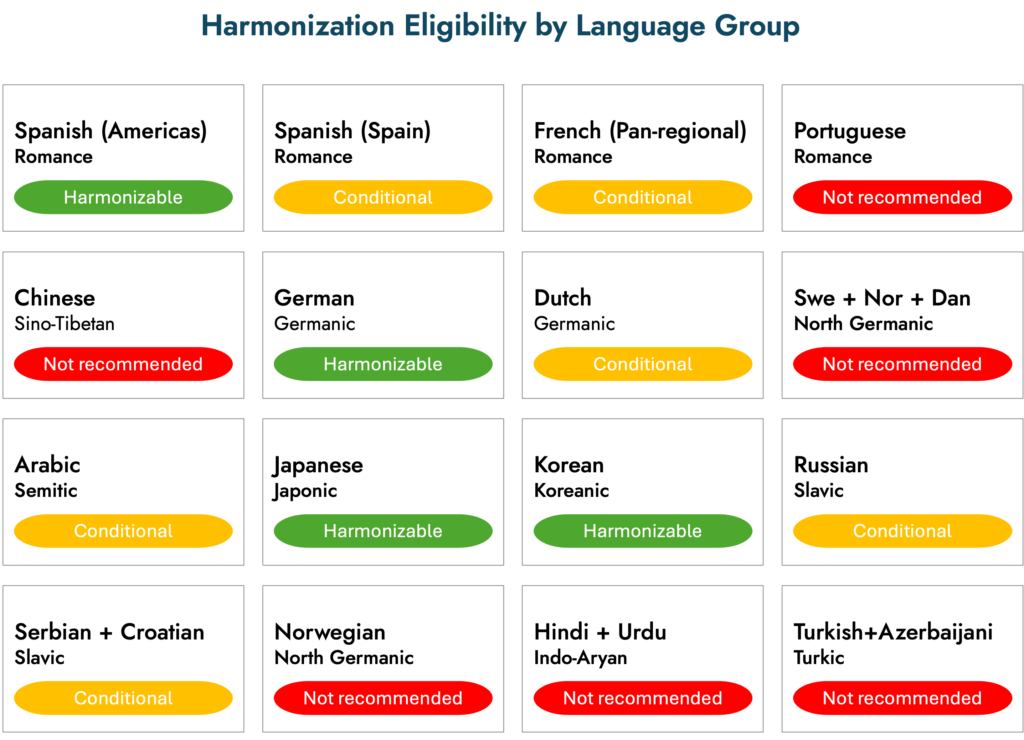
The list below summarizes the major language groups commonly requested in medical, scientific and technical translation projects. The assigned labels are tied to the language variants meeting the harmonization-eligibility criteria described above.
- Harmonizable = compatible with identified varieties; pay attention to literacy level
- Conditional = context-dependent across industries and target groups; needs justification; pay very close attention to literacy level
- Not recommended = keep as separate target languages
Common Examples
Spanish (Americas)
Varieties: Colombian, Mexican, Argentinian, Chilean, Peruvian and others within the Americas.
Can harmonize with: Other Spanish varieties spoken across Latin America; produces Latin American Spanish variant (LatAm Spanish).
Cannot harmonize with: European Spanish (Castilian); LatAm Spanish can be usable in Spain, but only in low-consequence use cases.
- FDA accepted
- EMA accepted
- Commonly used in pan-regional contexts
- Reconciliation is required
Latin American Spanish varieties share enough lexical and structural overlap to support a single harmonized version for pan-regional studies. However, significant dialectal differences exist, especially between River Plate Spanish (Argentina, Uruguay) and the rest, in pronoun use (voseo vs. tuteo), intonation, and informal register.
In medical contexts, lay-language content requires careful review. A harmonized Latin American Spanish version is widely accepted by regulatory agencies, provided a reconciliation rationale is documented. Do not extend the harmonization to Spain.
Spanish (Spain)
Varieties: Castilian (Spain)
Can harmonize with: Some African varieties; better to use Standard Spanish (Castilian).
Cannot/should not harmonize with: Latin American Spanish varieties.
- A standardized language
- COA validation risk
- Regulatory agency scrutiny
European Spanish (Castilian) differs from Latin American Spanish in vocabulary, pronoun use, and cultural reference enough to affect how native speakers interpret and respond to lay-language content.
Regulatory agencies typically expect a separate Spanish version for Spain. Harmonizing Spanish for Spain with Mexican Spanish is an unfortunately common practice that should not be done. A very careful substantive edit will result in a retranslation. A standard linguistic review/edit will remain highly marked, and should be challenged. Across Spain, there is too much dialectal variation in lay register that can easily turn a linguistic shortcut into a very costly mistake.
French (Pan-regional)
Varieties: France, Belgium, Switzerland, Canada (Quebec), African varieties
Can harmonize with: France, Belgium, Switzerland
Cannot harmonize with: Canadian French (Quebec), French spoken across Africa and other parts of the world.
- Within-Europe harmonizable
- Canada always separate
- African varieties most of the time separate, or often better in English for high-register content in diglossic countries
In theory, European French varieties (France, Belgium, Switzerland) are close enough for harmonization in technical and medical registers.
In practice, harmonizing French produces Standard French (for France). Unless there is a justifiable reason for harmonizing French variants, save your time and money and use French for France. Otherwise, default to regional dialects and let your end users navigate your task through the language they speak on a daily basis.
Canadian French is substantially distinct and an independently standardized variety that significantly diverges in vocabulary and in pragmatic and syntactic norms. Hence, it must be treated as a separate target language for any type of content. You may be able to get away with using Standard French across Canada when the stakes are low, but avoid doing so, especially in the province of Quebec. They won’t like it.
Serbian, Croatian, Bosnian and Montenegrin
Varieties: Serbian, Croatian, Bosnian, Montenegrin
Can harmonize with: Any combinations of the four, though the opinion will vary. The most common was Serbo-Croatian. Proceed conditionally, pay attention to politics, and reserve for technical and professional registers.
Cannot/should not harmonize with: Lay language without country-specific review with special attention to age group and literacy.
- Harmonized base is feasible, with labelling conditions
- Script choice: Latin preferred
- Political sensitivity is high
- Country-specific terminology review is always required
Serbian, Croatian, Bosnian, and Montenegrin are all derived from a common linguistic base, sometimes called BCMS (Bosnian-Croatian-Montenegrin-Serbian) and are mutually intelligible to a high degree. In academic linguistics, this group is also known as Serbo-Croatian. The differences are more pronounced in vocabulary choices, orthographic conventions (Serbian uses both Cyrillic and Latin script; Croatian and Bosnian use Latin only), and politically sensitive terminology than in grammar or core structure.
In medical and technical registers, a harmonized version is linguistically defensible and is common practice across industries. However, lay language, and even some medically relevant vocabulary, such as terms for body parts, symptoms, and emotional states, can differ enough to warrant country-specific review.
The greater risk is political. The designation of four separate standard languages is an outcome of the dissolution of Yugoslavia in the 1990s. Croatian and Serbian linguistic communities have strong institutional preferences for their own standard, and submitting a Serbian version to Croatia, or even a Serbo-Croatian version, or vice versa, will sooner or later draw user objection regardless of the linguistic overlap.
Best practice is a harmonized base text with country-specific terminology review and appropriately neutral labelling (e.g., ‘BCS version’ or ‘BCMS version’ rather than naming the individual languages).
A Note for Project Managers
Given your enrolled markets, the content type and regulatory context, the better question to whether or not a harmonization should be done is:
Is there a linguistically defensible harmonization strategy for our project?
In many cases, the answer is yes, and the savings in project cost and timeline tend to be significant. In others, the apparent savings generate downstream risk that is far more expensive to resolve during regulatory review or data analysis, and usually just not worth it.
Getting your harmo strategy right at project start is almost always faster, significantly less expensive and also comes bundled with lower risk.
If you’ve missed previous editions of the Santium Language Series, you’ll find them here – catch up!
How Santium contributes to this space
Curious About the World’s Languages?
If you found this article interesting, follow me on LinkedIn and subscribe to this series to receive future editions. In the Santium Language Series, I explore interesting traits of the world’s languages, from the most widely spoken to obscure, introducing their structure and word formation to cultural nuance and their role in social norms.
Stay connected and don’t miss the next edition!

|
Thank you for signing up. |



Monika Vance
Managing Director | SANTIUM
My work sits at the intersection of linguistics, scientific and medical translation, psychometric measurement, and multilingual operations, where terminology, usability, and regulatory context must align. I write about scientific and medical translations, psychometrics, languages, and the operational challenges that inevitably come with them. I also teach translators how to properly translate and validate complex psychometric instruments to hone their expertise in linguistic validation.