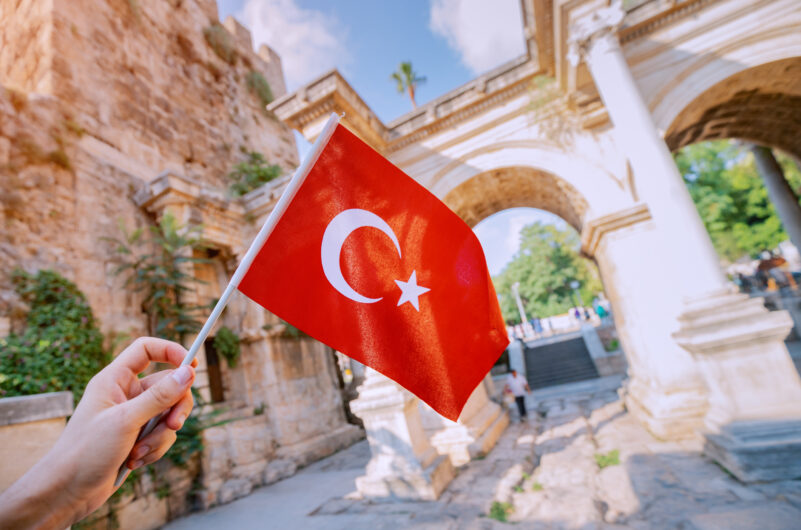
Despite its ancient origins, the Turkish language underwent one of the most dramatic transformations in modern linguistic history in the span of a single century. Today, it stands as one of the most structurally distinct major languages in Europe and the Middle East, while markedly different from the Indo-European and Semitic languages surrounding it. Highly systematic, phonetic, and internally logical, modern Turkish is also far easier for learners than its Ottoman predecessor.
A Brief History of Turkish
The Turkish language, or Türkçe in Turkish (pronounced “turk-cheh”), journeyed to Anatolia over many centuries.
Turkish belongs to the Oghuz branch of the broader Turkic language family. Its roots lie in Central Asia, where early Turkic-speaking nomadic societies lived across the steppe, a vast treeless grassland stretching from eastern Europe into Mongolia. The earliest written evidence appears in the 8th-century Orkhon inscriptions in present-day Mongolia, showing that the language was already well developed long before it reached modern Turkey. Beginning in the 11th century, Seljuk migrations brought Turkish into Anatolia, where it gradually reshaped the region’s linguistic landscape.
Under the Ottoman Empire, Turkish became the administrative and literary language of a vast, multi-continental state. Ottoman Turkish, written in Arabic script and heavily influenced by Persian and Arabic, differed significantly from everyday speech. The most dramatic shift came in the 20th century. After the founding of the Republic in 1923, Mustafa Kemal Atatürk introduced sweeping reforms, replacing the Arabic script with a Latin-based alphabet in 1928 and systematically simplifying vocabulary.
Within a single generation, Turkish transitioned from an imperial written tradition to a standardized, phonetic national language, while still preserving its core structure. It is, and it always has been, a major world language. Turkish is spoken by over 85 million people in Turkey and by millions more across Europe, making it demographically significant.
Unlike Any Neighboring Languages
Look at Turkey on a map. It bridges Europe with the Middle East, surrounded by languages that belong mostly to the Indo-European family, like Greek, Armenian, Persian, and Kurdish, and also Arabic from the Semitic family.
Turkish grammar works on a completely different blueprint. Its nearest linguistic cousins are Azerbaijani and Turkmen.
Turkish Grammar Structure
Turkish Subject–Object–Verb word order and vowel harmony are its star linguistic features and here I will show you what they look like and how they work. They enable suffixes to adjust their vowels to match the sound pattern of the root word. This gives Turkish its superb efficiency and a distinctive rhythm.
It is agglutinative, which means words are built by stacking suffix after suffix in a logical sequence. Instead of using separate words or changing internal word forms, Turkish attaches endings to express possession, tense, case, and nuance. A single Turkish word can carry what requires an entire phrase in English.
Let’s look at some examples.
Agglutination: Words Stack Like Lego
Turkish builds meaning by attaching suffixes one after another in a fixed order. Each suffix adds a clear piece of information.
Take the word ev (house) for example:
ev = house (root)
evler = houses (1st suffix)
evlerim = my houses (2nd suffix)
evlerimde = in my houses (3rd suffix)
evlerimdekiler = those who are in my houses (4th suffix)
This stacking system is called agglutination. Instead of rearranging words or inserting helper verbs like in English, Turkish keeps attaching meaningful endings. This makes it practically compact, efficient, highly structured and predictable.
However, when you attach suffix after suffix, you could easily end up with awkward sound combinations and transitions. Turkish solves that problem through a built-in sound system called vowel harmony.
Vowel Harmony
Vowel harmony ensures that suffixes adjust to match the vowels in the root word. In other words, suffixes are flexible so they “blend in” with the word they attach to.
Rule 1: Basic Vowel Harmony Rule
A suffix vowel must match the front/back quality of the last vowel in the root word.
Turkish vowels are grouped like this:
Front vowels: e, i, ö, ü
Pronounced with tongue closer to teeth; English example for “a”, as in “father”.
Back vowels: a, ı, o, u
Pronounced with tongue pulled toward the back of the mouth; English example for “o”, as in “or”.
Rounded vowels: o, u, ö, ü (lips round to produce the sound)
Unrounded vowels: a, ı, e, i
Rule 2: Two-way Vowel Harmony (Plural Example)
The plural suffix has two common forms:
-ler (front vowel)
-lar (back vowel)
Which one do you use?
It depends on the last vowel inside the root word:
ev → last vowel = e (front) → evler
şehir → last vowel = i (front) → şehirler
kitap → last vowel = a (back) → kitaplar
okul → last vowel = u (back) → okullar
The vowel in the suffix changes to match the vowel pattern of the root. It’s highly systematic and rule-based.
Rule 3: Four-way Vowel Harmony (Possession Example)
Some suffixes adjust even more precisely. Let’s take the possessive suffix meaning “my”.
“My” has four forms:
-ım (back unrounded) works with last back vowels a, ı
-im(front unrounded) works with last front vowels e, i
-um (back rounded) works with last back vowels o, u
-üm(front rounded) works with last front owels ö, ü
Refer to the front/back and rounded/unrounded vowels under Rule 1, and to the vowels in the suffixes listed here in Rule 3. Do you see the pattern? Now we match both front/back and rounded/unrounded vowels.
Examples:
ev → last vowel = e (front unrounded) → evim (my house)
kitap → last vowel = a (back unrounded) → kitapım (my book)
okul → last vowel = u (back rounded) → okulum (my school)
gül → last vowel = ü (front rounded) → gülüm (my rose)
Based on the rule, you choose the suffix that best matches the final vowel in the root word.
Because Turkish relies so heavily on agglutination, vowel harmony is essential. Without it, long stacked words would sound clunky. With it, even multi-syllable constructions flow naturally.
Dialects and Regional Varieties
Modern Standard Turkish is based largely on the Istanbul dialect. This variety became the foundation for education, media, government, and literature after the language reforms of the 20th century. When you hear Turkish on national television or read it in newspapers, you are hearing the standardized Istanbul-based form.
That said, Turkey is geographically large and culturally diverse.
Anatolian Dialects
Across Anatolia, speech patterns shift noticeably from region to region. Eastern Anatolia, the Black Sea region, Central Anatolia, and the Aegean each have distinctive pronunciation habits and vocabulary preferences.
In some regions, consonants soften or harden. Vowel lengths may change. Certain older Turkic words survive locally even if they are rare in standard usage. You may also hear simplified grammatical constructions in everyday speech, particularly in rural areas.
Despite these differences, Anatolian dialects remain mutually intelligible with Standard Turkish. A speaker from Istanbul and one from eastern Turkey may immediately recognize each other’s regional accents, but communication is not fundamentally impaired.
Cypriot Turkish
Cypriot Turkish is spoken in Northern Cyprus and reflects centuries of contact with Greek. The influence appears in pronunciation, intonation, and some borrowed vocabulary.
Certain sounds are produced differently, and the rhythm of speech can feel distinct from mainland Turkish. To a listener from Turkey, Cypriot Turkish is clearly recognizable but marked as regional. Mutual intelligibility remains high, though the accent is unmistakable.
Balkan Turkish
Balkan Turkish is spoken by Turkish minority communities in countries such as Bulgaria, Greece, and North Macedonia. These varieties developed under prolonged contact with Slavic and Balkan languages.
Loanwords, pronunciation patterns, and subtle structural shifts reflect that influence. In some communities, Turkish has also preserved older features that have faded in modern Turkey.
As with other regional varieties, Balkan Turkish remains intelligible to Standard Turkish speakers, though it carries a clear regional identity shaped by its historical surroundings.
Overall, Turkish dialect variation is not extreme. The standardized Istanbul form functions as a the linguistic anchor, but regional speech expresses local subculture and identity.
Linguistic Wit, Warmth and Deep Expression
Turkish speakers describe their language as warm, playful, and emotionally expressive. Everyday speech is rich with diminutives, affectionate suffixes, and softeners that add tone without changing the core meaning. A simple suffix like –cık or –cik (implying little or cute somehow) turns something small into something endearing. In English, a mom could affectionately call her child a “little bug”. In Turkish it’s one word with the “little” part living in the suffix.
Hospitality and relational closeness are deeply embedded in the way people speak. Terms like abi (older brother), abla (older sister), or hocam (my teacher) are used beyond literal family meaning. They instantly create a social connection laced with familiarity.
Humor, of course, is another defining feature. Turkish wordplay thrives on suffix manipulation, exaggeration, and creative compounding. Because the language is so structurally flexible, speakers can stretch words for comic effect. Irony and subtle sarcasm often ride on tone and suffix choice rather than explicit wording. Even bureaucratic phrases can be quickly turned into jokes.
Proverbs also play a central role in communication. Turkish is dense with short, sharp sayings that capture practical wisdom in a few rhythmic words. They are used casually in conversation and in literature. The language carries cultural memory in a rhythmic, compact, and repeatable form.
Turkish is socially warm. It is rich with emotional nuance which is the quality that its speakers most love about it.
Mutual Intelligibility
Turkish and Azerbaijani are highly mutually intelligible. Speakers can often understand one another with little extra effort, especially in spoken conversation. Vocabulary, grammar, and core structure align closely, even if pronunciation and certain word choices differ.
Turkmen is also related, though intelligibility drops somewhat compared to Azerbaijani.
Beyond the Oghuz branch, the Turkic family expands across Central Asia. Languages such as Kazakh, Uzbek, Kyrgyz, and Uyghur share the same agglutinative structure, vowel harmony system, and overall grammatical logic. However, mutual intelligibility becomes more limited the farther you move from the Oghuz subgroup. The structure remains familiar, but vocabulary diverges, and centuries of regional influence shifted pronunciation.
Turkish Machine Translation and Neural Language
Turkish presents well-documented challenges for machine translation systems, largely due to its agglutinative structure and rich morphology. Meaning is built through chains of suffixes, so a single word can simultanously encode tense, possession, case, plurality, and evidential nuance. If a system misidentifies even one suffix, the entire meaning can shift.
Data availability has historically compounded the issue. Compared to major European languages, Turkish has had fewer large, clean parallel corpora for training. Turkey’s non-membership in the EU limits the volume of multilingual legislative data, and much high-quality medical, technical and legal translation remains proprietary. At the same time, the sheer number of possible word forms in Turkish means models need significantly more data to achieve stable coverage. In morphologically rich languages, this becomes a significant achitectural barrier.
Additional grammatical features increase complexity. Turkish builds relationships through case suffixes instead of fixed word order and grammatically distinguishes between directly witnessed and indirectly reported information. Systems trained primarily on Indo-European languages do not always handle these distinctions in a consistent way.
Modern neural MT performs adequately for everyday Turkish, but accuracy declines in legal, medical, and technical contexts where morphological precision and contextual nuance are essential.
Learning Turkish
The learning curve of course depends on what language you already speak. Since English is the world’s lingua franca I will relate this to English speakers.
For English speakers, Turkish will present a noticeable challenge with its word order. Turkish follows Subject–Object–Verb (SOV), so the verb comes at the end of the sentence. Add to that agglutination, where multiple suffixes stack onto a single word, and sentences can look intimidating on the page. Vowel harmony introduces another layer of phonetic rules that English simply doesn’t have.
However, Turkish grammar is highly consistent and once you understand the underlying patterns, it becomes logical. It also removes some headaches English speakers struggle with in other languages, such as French or Spanish for example. There is no grammatical gender to memorize. No masculine or feminine noun classes. No articles like “the” or “a.” Verb conjugations follow consistent, logical patterns and spelling is almost perfectly phonetic.
Turkish is an ancient language shaped by distant migration, influences from other languages, centuries of empires, and a protective reform. It is carried forward by millions of speakers for whom it is deeply personal, playfully funny and socially embracing.
How Santium contributes to this space
Santium delivers precision-driven Turkish translation and validation built for complexity. We ensure structural accuracy, conceptual alignment, and functional clarity, so your content functions exactly as intended, whether in highly regulated contexts, or in technical manuals, research instruments, legal frameworks, or mission-critical communications.
Follow Santium to stay connected
If you found this article interesting, follow me on LinkedIn or subscribe to our newsletter. In our language series, I explore interesting traits of the world’s languages, from the most widely spoken to obscure, introducing their structure and word formation to cultural nuance and their role in social norms.
Stay connected and don’t miss the next edition!

|
Thank you for signing up. |


References
Aksan, D. (2007). Her yönüyle dil: Ana çizgileriyle dilbilim. Türk Dil Kurumu.
Comrie, B. (1997). Turkish. In B. Comrie (Ed.), The world’s major languages (2nd ed., pp. 820–836). Routledge.
Göksel, A., & Kerslake, C. (2005). Turkish: A comprehensive grammar. Routledge.
Johanson, L. (1998). The history of Turkic. In L. Johanson & É. Á. Csató (Eds.), The Turkic languages (pp. 81–125). Routledge.
Kornfilt, J. (1997). Turkish. Routledge.
Lewis, G. L. (1999). The Turkish language reform: A catastrophic success. Oxford University Press.
Özsoy, A. S. (2004). Turkish as a (non-)configurational language. In L. Kornfilt & C. K. Lewis (Eds.), Turkish linguistics today. Harrassowitz.
Oflazer, K., & Durgar El-Kahlout, I. (2007). Exploring different representational units in English-to-Turkish statistical machine translation. Proceedings of the Second Workshop on Statistical Machine Translation, 25–32.
Sak, H., Güngör, T., & Saraçlar, M. (2007). Morphological disambiguation of Turkish text with perceptron algorithm. Proceedings of CICLing, 107–118.
Underhill, R. (1976). Turkish grammar. MIT Press.

Monika Vance
Managing Director | SANTIUM
My work sits at the intersection of linguistics, scientific and medical translation, psychometric measurement, and multilingual operations, where terminology, usability, and regulatory context must align. I write about scientific and medical translations, psychometrics, languages, and the operational challenges that inevitably come with them. I also teach translators how to properly translate and validate complex psychometric instruments to hone their expertise in linguistic validation.