
In a previous article of the Santium Language Series, we looked at German as a dialect continuum: a language spread throughout powerful empires, across linguistically variable regional varieties, and jagged topography. Beneath the enormous range of dialects remains a highly efficient language, born in the German Empire, that builds meaning with remarkable precision: Standard German.
This fits with the world’s general perception of the German people. Germans are known for a strong culture of procedure, planning, vocational competence, and organizational reliability, reinforced by its federal institutions, apprenticeship system, research base, and industrial economy. They are also known internationally for state-of-the-art engineering, manufacturing, the Mittelstand of highly specialized small and mid-sized firms, and a research culture that places real value on technical depth and long-term competence.
Broadly, German speakers as a collective from across Germany, Austria and Switzerland, are often described as more explicit and low-context in conversation. A German speaker may sound blunt to a Briton or overly formal to a Canadian, while, from their own perspective, they are simply being clear, efficient, and respectful of everyone’s time.
When I converse with them in English, I notice that when they talk through an idea, they often begin a follow-up sentence with “Also,…” and then close the thought with “therefore,…”, instead of the expected “so,…” or simply leaving the conclusion to context. To a Canadian English speaker, this sounds like being handed a mathematical proof of the point being made: to be there at thirteen hundred hours instead of later.
This partly reflects word transfer into English while also retaining German. When we speak a foreign language but don’t use it daily, we tend to organize our thoughts in conversation according to our native language and some of its shared vocabulary, despite differences in meaning. In fact, it was this observation that prompted me to explore the grammatical structures of languages with which I work regularly during office hours.
German is a true pain in the butt to translate into really well; at least from the English content we work with. Exploring foreign grammatical systems has opened up a fascinating world of logic that I previously did not have the insight to truly appreciate.
Join me in looking into this precision-centred linguistic machine, see how it works and maybe learn a little bit of it while we’re at it!
The German Sound System
Before we get into grammar, let’s practice some pronunciation. You don’t need a full phonetic practice since you’re reading this in English, and therefore, you likely also speak it. However, English does not use the same phonetics for some of the consonantal combinations, so let’s practice the main German sound patterns. This will allow you to pronounce most words correctly.
The main traps for English speakers are these: German vowels are cleaner, consonants are tight, r at the end of a word is nearly or completely silent, and familiar letter combinations are pronounced differently. For a short while, forget English pronunciation and start from scratch when learning the German sound system.
The German Alphabet
The German alphabet has 26 latin letters, plus three umlauted vowels, ä, ö, and ü, and the special letter ß (which is the same as “ss”). In practical terms, that gives written German 30 regularly used letter forms.
One nuance: ä, ö, ü are usually treated as variants of a, o, u, not fully separate alphabetic letters in every technical sense, but for a learner, they function like distinct letters because they change pronunciation and meaning.
Most of the letters, alone and in combinations, are pronounced like those in English, with the following exceptions (German letter on the left, phonetic pronunciation on the right).
If you remember nothing else, try to remember these for the grammar section:
a = a (“ah”)
e = flat short eh (as in “enter”)
j = y (“yot”)
v = often sounds like f
w = v (“vay”)
y = flat short ee (as in “ill”; mostly used in loanwords)
z = ts
ä = eh or ay (easy for Canadians!)
ö = roughly er with rounded lips as if you want to say “o”; the helper r is silent
ü = roughly ee with rounded lips as if you want to say “u”
ß = ess (ess-tsett when naming the letter)
ei = eye
eu/äu = oy
ie = ee
st = sht at the start of a word
sp = shp at the start of a word
sch = sh
ch = rough h and kh at the end of a word
As with the umlauts, the German “ch” sound doesn’t exist in the English sound system. English speakers tend to pronounce Bach, like Bakh. That’s close, but no cigar. It’s a rougher, throatier version of h.
Start by saying hee. Now focus on the area just behind the hard palate, and raise the back of the tongue to nearly close the airway. Force a soft stream of air through that narrow space. It should sound like a rough hiss. Arabic and Hebrew speakers use this sound when they say words like Khan. The h is heavy but much softer than k.
Let’s practice…
Pronunciation
Vowels: keep them pure
English vowels often drift off at the end. German vowels usually do not. Hold them steady all the way to the end.
Also, notice how phonetically similar German is to English.
a is usually like ah
Mann
Pronunciation: mahn
Natural translation: man
e is often like eh or a short clipped e
Bett
Pronunciation: bet
Natural translation: bed
i is usually ee when long, ih when short
ihn
Pronunciation: een
Natural translation: him
mit
Pronunciation: mit
Natural translation: with
o is usually a pure oh
rot
Pronunciation: roht
Natural translation: red
u is usually ooh
gut
Pronunciation: goot (German g is always hard)
Natural translation: good
Long and short vowels matter
German often distinguishes meaning by vowel length.
bieten
Pronunciation: BEE-ten
Natural translation: to offer
bitten
Pronunciation: BIT-ten
Natural translation: to request, ask
The doubled consonant in bitten shows us that the vowel before it is short. In German, the “ie” combination provides the long sound.
Umlauts: ä, ö, ü
These matter because how you say them changes meaning.
ä is often close to clipped eh
Mädchen
Pronunciation: MED-chen
Natural translation: girl
ö has no exact English equivalent. Start with ay as in say, but round your lips as if to say oh.
schön
Pronunciation helper: shurn or shern, but with rounded lips; the r is silent
Natural translation: beautiful, pretty
ü also has no exact English equivalent. Start with ee as in see, then round your lips tightly.
Tür
Pronunciation helper: roughly tewr, but with rounded lips; the r is nearly silent
Natural translation: door
English speakers usually replace ö with o and ü with oo or you. That is understandable, though wrong. If you at least round the lips properly, you will sound much closer.
Practice Words
Halo
Pronunciation: ahlo
Natural translation: Hi / Hello
Wasser
Pronunciation: VAH-sehr (nearly silent r)
Natural translation: water
Vater
Pronunciation: FAH-tehr (nearly silent r)
Natural translation: father
Zeit
Pronunciation: tsayt
Natural translation: time
Straße (also Strasse)
Pronunciation: SHTRAH-seh
Natural translation: street
mein
Pronunciation: mayn
Natural translation: mine, my
Licht
Pronunciation helper: likht, soft front ch
Natural translation: light
heute
Pronunciation: HOY-teh
Natural translation: today
Tag
Pronunciation: tagh
Natural translation: day
Ja
Pronunciation: yah
Natural translation: yes
Nein
Pronunciation: nayn
Natural translation: no
und
Pronunciation: oond
Natural translation: and
Liebe
Pronunciation: LEE-beh
Natural translation: love
Arzt
Pronunciation: ahrtst
Natural translation: doctor
Patient
Pronunciation: pah-tsee-ENT (the tsee sound is an adoption from words originating in Latin)
Natural translation: patient
Krankenhaus
Pronunciation: KRAN-ken-house
Natural translation: hospital
The Basic Logic of German
German conveys meaning through articles, cases, clauses (verb position), and particles. Its grammar follows the subject-verb-object (SVO) pattern, but this is not always obvious, because case marking carries part of the meaning. So, German elements move around more freely in contrast to English, which uses case markings differently and is heavily dependent on word order and prepositions to convey the same thing.
Here is a simple example that demonstrates the flexibility of German word order:
Example
English
I am reading the book.
The book is reading I. (not acceptable)
German
Ich lese das Buch.
Pronunciation: eeh LAY-zeh dahs bookh
Literal translation: I read the book. (present tense)
Natural translation: I am reading the book.
Das Buch lese ich.
Pronunciation: dahs bookh LAY-zuh ikh
Literal translation: The book read I. (present tense)
Natural translation: It is the book that I am reading.
In addition to the word order pattern, the following 11 characteristics form the structural basis of the language:
1. Nouns and formal pronouns must be capitalized
German sentences can become long, and a great deal of meaning is packed in through case, word order, and clause structure. Capitalizing nouns developed as a writing convention to give the reader an immediate visual cue: this word is a noun, and it is likely to be one of the main structural anchors of the sentence. Even when a verb acts as a noun in the sentence, it must be capitalized.
Formal address pronouns are also capitalized. German differentiates between informal you (du) and formal you (Sie), similarly to French (tu/vous) or Spanish (tú/usted).
By default, all adults should be addressed with formal you, until an informal address is explicitly and mutually agreed on.
Sie = you (formal singular or plural)
Ihnen = to you / for you (singular)
Ihr = your (singular)
Ihres, Ihrer, Ihrem, Ihren and related forms in the formal system
Examples
Informal address:
Wie heißt du?
Pronunciation: WEE HAY-st du?
Literal translation: How are-called you?
Natural translation: What is your name?
Formal address:
Wie heißen Sie?
Pronunciation: WEE HAY-sen ZEE?
Literal translation: How are-called you?
Natural translation: What is your name?
Capitalized nouns:
Mein Name ist ___.
Pronunciation: mine NAH-muh ist ____
Literal translation: My name is ___.
Guten Tag.
Pronunciation: GOO-ten tag.
Literal translation: Good day.
Vielen Dank.
Pronunciation: FEE-len dahnk
Literal translation: Many thanks.
Natural translation: Thank you very much.
Das Essen ist gut.
Pronunciation: dahs ESS-en ist goot
Literal translation: The eating is good.
Natural translation: The food is good. / The meal is good.
2. Every noun has a gender and its own article
German nouns come with a grammatical gender. There is no special reason why some are masculine while others are feminine. You just have to learn them with the article.
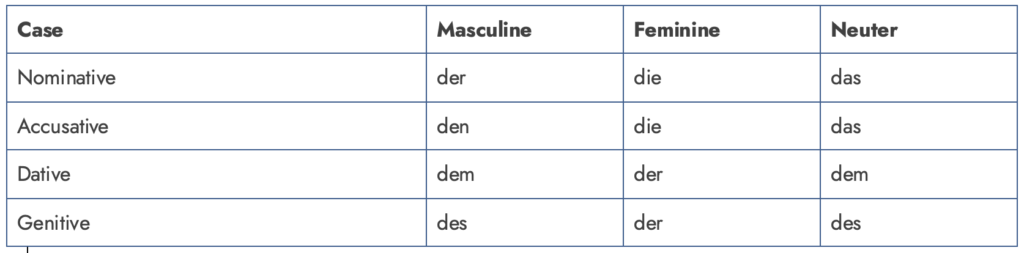
English has one definite article, the. German has three basic singular/plural ones: der, die and das (masculine, feminine and neuter), and plural ones: they change when the case changes. Das carries two meanings in German: the and that.
The table below shows the singular forms:
Example
der Tisch
Pronunciation: dair tish
Literal translation: the table
die Sprache
Pronunciation: dee SHPRAH-khuh
Literal translation: the language
das Buch
Pronunciation: dahs bookh
Literal translation: the book
3. Cases show what the noun is doing
This is a big structural difference from English. German changes articles depending on the role of the noun in the sentence. A case is a grammatical role: a job. An article is a word form that clarifies the grammatical role of the case.
The first three cases you need are:
Nominative = subject
Accusative = direct object
Dative = indirect object/recipient
In the previous section, you saw the 3 basic articles: der, die and das. The case changes the article when the case’s job changes in the sentence. For example, when the noun with its article represents a direct object, the article will be different than when the noun represents a subject.
Here is a quick overview of how the forms change with a couple of examples:
Nominative and accusative cases
Der Arzt sieht den Patienten.
Pronunciation: dair ahrtst zeet dayn pah-tsee-EN-ten
Literal translation: The doctor sees the patient.
Here:
der Arzt = subject, nominative singular
den Patienten = object, accusative singular
English usually shows this through word order. German uses word order too, though it also marks it in the article. They always work together.
Remember the tsee pronunciation in Patient? This is common in German words of Latin origin. No one is expected to know the origin of words. It is simply one of those irregular characteristics of the language that clear up with practice and memorization.
Now look at this:
Den Patienten sieht der Arzt.
Pronunciation: dayn pah-tsee-EN-ten zeet dair ahrtst
Literal translation: The patient sees the doctor.
Natural translation: The patient is seeing the doctor.
Dative case
Der Arzt gibt dem Patienten das Medikament.
Pronunciation: dair ahrtst gheebt daym pah-tsee-EN-ten dahs meh-dee-kah-MENT
Literal translation: The doctor gives the patient the medication.
Here:
der Arzt = subject
dem Patienten = recipient, dative singular
das Medikament = thing being given
4. Clauses determine word order
This is another important structural biggie, so I’ll provide examples for each. A clause is a verb-based unit inside a sentence. Some clauses can stand alone as full statements, while others depend on a larger sentence. In German, this difference is important because clause type directly affects word order. If the verb is missing from the sentence, it’s not a clause; it’s a phrase.
German clause rules are simple. Try to follow the pattern in the examples. Once you see it, long German sentences become easier to decipher.
Rule 1: Yes/no question = verb is in first position
Rule 2: Main clause = verb is usually in second position
Rule 3: Subordinate clause = verb is usually at the end
Rule 4: Relative clause = verb also at the end
Rule 5: Infinitive Clause = verb at the end, often with zu before it (zu can mean: to a place/person, to before a verb, too as in too much or too little, or shut/closed)
Example: Question Clause
English
Are you coming today?
Remember, the question clause rule only applies to Yes/No questions. The verb is placed in the first position.
German
Kommst du heute?
Pronunciation: komst doo HOY-tuh
Literal translation: Come you today?
Natural translation: Are you coming today?
Example: Main Clause
English
I am learning German.
This is a clause, because it contains a subject (I) and a verb (learning). It is also a standalone sentence. Therefore, it’s a “main clause”.
German
Ich lerne Deutsch.
Pronunciation: ikh LAIR-nuh doytsh
Literal translation: I learn German.
Heute lerne ich Deutsch.
Pronunciation: HOY-tuh LAIR-nuh ikh doytsh
Literal translation: Today learn I German.
Natural translation: Today I am learning German.
Both are main clauses, so the verb is in the second position.
Example: Subordinate Clause
English
I am staying home because I am sick.
This sentence has two clauses:
I am staying home
because I am sick
The first part is a main clause. Both parts have a verb, but the second part depends on the first. The second part cannot be a standalone sentence as it is. This dependency makes the second part a “subordinate clause”.
German
Common subordinate-clause starters are:
weil = because
dass = that
wenn = if/when
obwohl = although
Ich bleibe zu Hause, weil ich krank bin.
Pronunciation: ikh BLY-buh tsoo HOW-zuh, vayl ikh krangk bin
Literal translation: I stay at home, because I sick am.
The verb bleibe in the main clause stays in second position, while the verb bin in the subordinate clause moves to the end.
Example: Relative Clause
English
The book I am reading is interesting.
A relative clause adds information about a noun. In English: is, who, which, or that. In German, relative clauses also push the verb to the end.
German
Das Buch, das ich lese, ist interessant.
Pronunciation: dahs bookh, dahs ikh LAY-zuh, ist in-teh-res-SAHNT
Literal translation: The book that I read is interesting.
Example: Infinitive Clause
English
I am trying to learn German.
In this clause, the verb is again at the end, with zu in front of it.
German
Ich versuche, Deutsch zu lernen.
Pronunciation: ikh fer-ZOO-khuh, doytsh tsoo LAIR-nen
Literal translation: I try German to learn.
5. Many verbs split
German has many separable verbs. These are verbs made of a base plus a particle. In a main clause, the particle often goes to the end. The meaning of the verb is incomplete until the particle appears.
aufstehen = to get up
Ich stehe um sieben Uhr auf.
Pronunciation: ikh SHTAY-uh oom ZEE-bən oor owf
Literal translation: I stand at seven o’clock up.
Natural translation: I get up at seven o’clock.
6. Present tense and perfect tense patterns
Present tense
German present tense often covers both English simple present and present progressive, depending on context.
Ich arbeite heute.
Pronunciation: ikh AR-by-tuh HOY-tuh
Literal translation: I work today.
Natural translation: I am working today.
Perfect tense
In everyday spoken German, this perfect form is used a lot where English might just use simple past.
Ich habe heute gearbeitet.
Pronunciation: ikh HAH-buh HOY-tuh guh-AR-bay-tet
Literal translation: I have today worked.
Natural translation: I was working today. / I have worked today.
7. Adjectives change form
English adjectives don’t change form. German adjectives change because of the noun’s gender and grammatical role. At the beginning, you do not need to master every adjective table. You just need to understand that the ending is carrying information.
ein gutes Buch
Pronunciation: ine GOO-tes bookh
Literal translation: a good book
ein guter Arzt
Pronunciation: ine GOO-ter ahrtst
Literal translation: a good doctor
eine gute Sprache
Pronunciation: EYE-nuh GOO-tuh SHPRAH-khuh
Literal translation: a good language
8. Pronouns change too
German pronouns also reflect case. English distinguishes I from me, but German keeps more of this system active throughout the sentence.
ich = I
mich = me
mir = to me / for me
Example
Er sieht mich.
Pronunciation: air zeet mikh
Literal translation: He sees me.
Er gibt mir das Buch.
Pronunciation: air gheebt meer dahs bookh
Literal translation: He gives to me the book.
9. Prepositions matter because they control case
Prepositions are words like in, on, with, to, from, for. In German, many prepositions force a certain case after them.
mit dem Arzt
Pronunciation: mit daym ahrtst
Literal translation: with the doctor
für den Patienten
Pronunciation: fyoor dayn pah-tsee-EN-ten
Literal translation: for the patient
Here:
mit takes dative
für takes accusative
10. Some prepositions change meaning with motion vs. location
This is a useful and logical concept to learn as a beginner.
in dem Haus
Pronunciation: in daym hows
Literal translation: in the house
in das Haus
Pronunciation: in dahs hows
Literal translation: into the house
Same preposition family, different case, different meaning:
– location tends to take dative case
– direction/movement toward tends to take accusative case
11. Negation doesn’t need a verb
German negates with variations of nicht or kein without using a support verb like English does.
Ich verstehe nicht.
Pronunciation: ikh fer-SHTAY-uh nikht
Literal translation: I understand not.
Natural translation: I do not understand.
Kein means “no” or “not any” and is used with nouns.
Ich habe kein Buch.
Pronunciation: ikh HAH-buh kine bookh
Literal translation: I have no book.
Natural translation: I do not have a book.
Building the Word: How German Compounds Work
Now that you’ve pulled through the basics of German grammar, let’s end by having some fun with word formation. German has some super-long compound words that are built with a very logical system.
Here is a famous monster:
Donaudampfschifffahrtsgesellschaft
This is its structural logic:
Donau = Danube
dampf = steam
schiff = ship
fahrt = travel/navigation
gesellschaft = company
Literal translation: Danube-steam-ship-travel-company
Natural translation: Danube steamship company
In German compounds, the final element is usually the key subject or object being specified. The longer the word, the more precision and detail. Think of it as having to read it from right to left.
So, in this example, moving to the end of the word, we’re talking about a company. What kind? Travel. What kind of travel? Ship. What kind of ship? Steamship. Donau offers the company’s location: the river Danube. Without Donau, it would still be a valid compound word, Dampfschifffahrtsgesellschaft, meaning “steamship company”.
The following may not be actual words used by German speakers, but they are grammatically correct and valid for demonstration purposes. The same logic applies to all of them.
Japankirschblütenfest
Breakdown: Japan-kirsch-blüten-fest
Literal translation: Japan-cherry-blossom-festival
Natural translation: Japanese cherry blossom festival
Great-Barrier-Rifftauchschullehrerausbildung
Breakdown: Great-Barrier-Riff-tauschul-lehrer-ausbildung
Literal translation: Great-Barrier-Reef-dive school-teacher-training
Natural translation: Instructor training at a Great Barrier Reef dive school
Islandstrandsonnenuntergangsfoto
Breakdown: Island-strand-sonnenuntergangs-foto
Literal translation: Island-beach-sunset-photo
Natural translation: Photo of a sunset on an island beach
Klinischergebnisbewertungsübersetzung
Breakdown: Klinischer-gebnisbewertungs-übersetzung
Literal translation: clinical-outcome assessment-translation
Symptomschwerebewertungsskalen
Breakdown: Symptom-schwerebe-wertungs-skalen
Literal translation: symptom-severity-rating-scale
German is a highly structured and logical language. It classifies things, arranges them, and every word in the sentence has a designated spot to convey its meaning in a precise way. It is more verbose than English because, in its designed standardized form, it leaves little to context.
Translation from English, in contrast to most other languages, can be challenging because English is not as strict with form, emphasis and internal architecture. This is especially true when the source content is not clear in context, or it’s written in colloquial style and/or in poor grammar. This leaves translators with having to make interpretation choices that can miss the mark, which can go unnoticed until it’s in the hands of the user and the intended setting.
It is one of the best-governed world languages, and well worth learning if you plan to build a life and/or career in Central Europe, or if you want access to a very large body of philosophy, musicology, psychoanalysis, literature, critical theory, philology, and technical writing. Some translations are available, but not all and definitely not in all languages, and no matter how technically perfect, a non-literary translation will be like the C2-level fluency in a second language – always missing the authentically exact emotional feel in expression of the thought.
If you’ve missed previous editions of the Santium Language Series, you’ll find them here – catch up!
How Santium Contributes to This Space
Santium specializes in translating and adapting complex, high-stakes content where precision matters. We ensure that meaning is preserved across languages, dialects, and contexts. Our workflows combine subject-matter expertise, structured review, and in-country validation to align language with how it is actually used and understood. This is particularly important in environments where small shifts in wording can affect interpretation, usability, or outcomes. Santium’s role is to manage that complexity so that translated language remains reliable, consistent, and fit for purpose.
Curious About the World’s Languages?
If you found this article interesting, follow me on LinkedIn and join this newsletter to receive future editions. In the Santium Language Series, I explore interesting traits of the world’s languages, from the most widely spoken to obscure, introducing their structure and word formation to cultural nuance and their role in social norms.
Stay connected and don’t miss the next edition!

|
Thank you for signing up. |


References
Amunts, J., Camilleri, J. A., Eickhoff, S. B., Heim, S., & Weis, S. (2020). Executive functions predict verbal fluency scores in healthy participants. Scientific Reports, 10, 11141. https://www.nature.com/articles/s41598-020-65525-9
Braun, D., Klimt, K., & Schneider, D. (2019). Adapting SimpleNLG to German. In Proceedings of the 5th International Workshop on Natural Language Generation from the Semantic Web. https://aclanthology.org/W19-8651.pdf
Dudenredaktion. (2022). Duden: Die Grammatik (sample pages). Duden. https://shop.duden.de/media/99/0a/03/1687343937/Leseprobe_9783411040506_Duden_Die_Grammatik.pdf
Encyclopaedia Britannica. (2026). German language. https://www.britannica.com/topic/German-language
Encyclopaedia Britannica. (2026). West Germanic languages: German. https://www.britannica.com/topic/West-Germanic-languages/German
Goethe-Institut. (n.d.). The history of the German language. https://www.goethe.de/ins/ae/en/kul/sup/edl/ger.html
Schmidt, C. S. M., Schumacher, L. V., Römer, P., Leonhart, R., & Münte, T. F. (2017). Are semantic and phonological fluency based on the same or distinct sets of cognitive processes? Brain and Cognition, 113, 18–32. https://pubmed.ncbi.nlm.nih.gov/28257876/
Wells, C. J., & Fox, P. (2004). Using German: A guide to contemporary usage. Cambridge University Press. https://assets.cambridge.org/97805215/30002/frontmatter/9780521530002_frontmatter.pdf

Monika Vance
Managing Director | SANTIUM
My work sits at the intersection of linguistics, scientific and medical translation, psychometric measurement, and multilingual operations, where terminology, usability, and regulatory context must align. I write about scientific and medical translations, psychometrics, languages, and the operational challenges that inevitably come with them. I also teach translators how to properly translate and validate complex psychometric instruments to hone their expertise in linguistic validation.