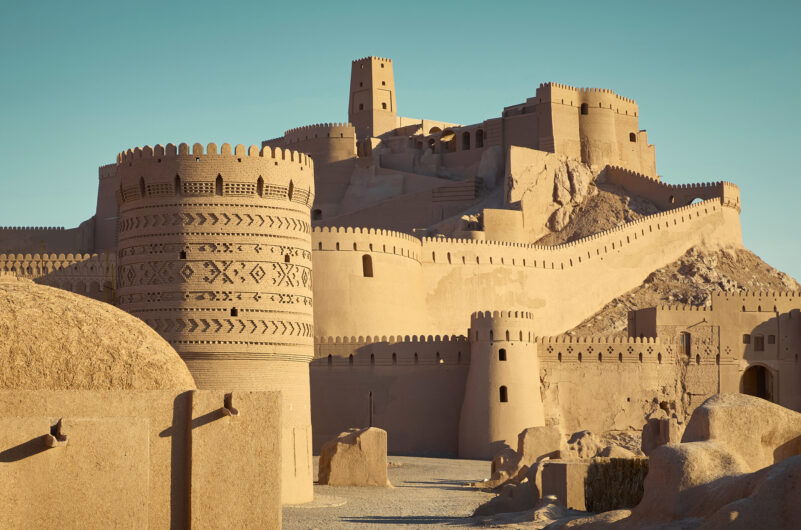
Persian is one of the oldest continuously spoken languages in the world, official in Afghanistan as Dari, in Iran as Farsi, and in Tajikistan as Tajik. Together, these varieties are spoken by about 100 million people, with many millions more in diaspora communities across North America, Western Europe, and the Gulf states. But its reach extends far beyond its speakers.
For nearly a thousand years, from the courts of the Mughal emperors in Delhi to the Ottoman palaces of Istanbul, Persian dominated administration, literature, poetry, and scholarship across an enormous arc of the world. It became one of the great languages of refinement and intellectual status across the Persianate world.
In this edition of the Santium Language Series, we look at Persian through its historical, scientific, cultural, and linguistic lenses.
Where Persian Comes From
Persian has one of the world’s longest continuous literary and administrative histories. Its oldest attested form, Old Persian, was the language of the Achaemenid Empire, founded by Cyrus the Great in the 6th century BCE. At its height, the empire stretched from Egypt to the Indus Valley and was the largest empire the world has yet seen.
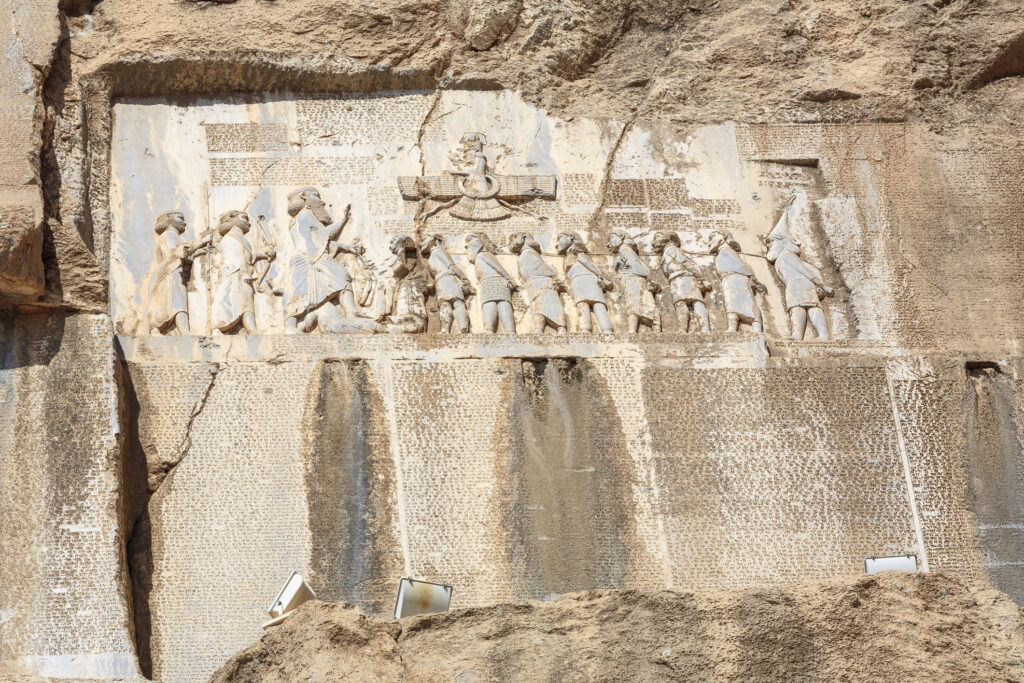
Old Persian was written in cuneiform, a wedge-shaped writing system also used in other ancient Near Eastern cultures. Its most famous inscription, carved into a cliff face at Behistun in western Iran, is often compared to the Rosetta Stone because it helped modern scholars decipher Old Persian cuneiform.
After Alexander the Great conquered the Achaemenid Empire in 330 BCE, Old Persian gradually disappeared from official use. Later, it re-emerged as Middle Persian, or Pahlavi, the administrative and literary language of the Sasanian Empire, which ruled from 224 CE until the Arab conquest in 651 CE.
The Sasanian Empire was one of the great powers of late antiquity, and for centuries it was locked in rivalry with Byzantium.
The Arab conquest was a pivotal moment in Persian linguistic history. Arabic became the language of scripture, imperial administration, and scholarship. Persian could have disappeared. Instead, it adapted by absorbing an enormous volume of Arabic vocabulary, but retained its own grammar, literary identity and cultural memory.
Within two centuries of the Arab conquest, Persian re-emerged as the prestige literary and administrative language of the Islamic world. From the 9th century onward, New Persian, written in the Arabic script but unmistakably Persian in structure and sensibility.
From eastern Iranian courts and Central Asia to the Mughal courts of India and many Ottoman literary circles, Persian became a language of refinement, administration, diplomacy, and, alongside Arabic, intellectual achievement.
The Persian Scientific Mind
The foundations of modern science are commonly associated with the Greeks, then a long pause, and then the European Renaissance. The pause happened, but only in Europe. While Western Europe politically fragmented after the fall of Rome and its intellectual life retreated inside the walls of monasteries, scholarship continued in India and across the Arab world. Khorasan, the historical region covering what is now northeastern Iran, Afghanistan, Turkmenistan, and Uzbekistan, was the intellectual heartland of Persian civilization during this period.
In the Khorasan region and across the broader Abbasid Caliphate, Persian and Arab scholars were building observatories, founding libraries, and advancing knowledge in mathematics, medicine, chemistry, astronomy, optics, navigation, and cartography at a pace Europe would not match for centuries to come.
The Islamic Golden Age occurred roughly between the 8th and 13th centuries, and was conducted under Arab Islamic political authority but with enormous Persian intellectual contribution. Many of its pivotal figures were Persian by origin, writing in Arabic because it was the scholarly language of the era, in the same way that European scholars of a later period wrote in Latin regardless of their nationality.
At the centre of it all was the House of Wisdom in Baghdad. It is believed to have been a vast library, a translation centre, and a research institution where scholars gathered from across the known world, Muslim and Christian, Arab and Persian, to learn, debate, translate, and extend the accumulated knowledge of antiquity.
Al-Khwarizmi, a Persian mathematician working in Baghdad in the 9th century, wrote the text from which the word algebra was derived: from the Arabic al-jabr in its title. He also gave us the algorithm, a word that is simply a Latinized version of his own name.
Persian and Arab cartographers produced world maps of such accuracy that they remained in use with only minor amendments for many centuries. Their achievements in geography and cartography, including the systematic use of longitude and latitude, facilitated the mapping of the world.
They also developed trigonometry as a practical mathematical discipline, furthering the work of Indian and Greek scholars to implement the sine, cosine, and tangent functions which are foundational to modern engineering, physics, and navigation.
Al-Biruni, a Persian polymath born in 973 CE in what is now Uzbekistan, wrote on astronomy, mathematics, geography, chronology, and comparative religion. His trigonometric method to estimate the Earth’s radius and the angle of dip to the horizon. Some reconstructions place his estimate within 1% of the modern value, although exact accuracy depends on unit conversion and measurement assumptions. It remains one of the most elegant scientific achievements of the period that remained unknown to the West until the 16th century.
Ibn Sina, known to the West as Avicenna, was a Persian polymath whose Canon of Medicine became one of the most influential medical texts in both the Islamic world and Europe. It remained in use in European universities for six centuries.
And they laid the early groundwork for chemistry through systematic experimentation, a methodology that would eventually become the scientific method.
From the 11th century onward, European scholars in Arab-controlled territories such as Spain and Sicily, and other contact points between the Islamic and Christian worlds, translated Arabic and Persian texts into Latin. The scholars of Florence who are credited with reawakening Western civilization were, in many cases, reading ideas written by Persian and Arabic scientists.
The Persian Scripts
If you have read the Arabic edition of the Santium Language Series, Persian script will look familiar.
The Persian alphabet is known in Persian as:
الفبای فارسی
Romanized as Alefba-ye Farsi, it is also called the Perso-Arabic script in English. The name Alefba is simply the Persian equivalent of ABCs, named after its first two letters, Alef and Ba, in the same way that alphabet comes from the Greek alpha and beta.
Persian uses a modified version of the Arabic script adapted to fit the Persian sound system. Otherwise, it has the same right-to-left cursive system, the absence of capital letters, and the same visual elegance of connected letters. But it is not Arabic.
Four letters were added to the Arabic alphabet to represent sounds unique to Persian: the sounds we would romanize as p, ch, zh, and g. Arabic has no p sound, which is why Arabic speakers learning English sometimes substitute b for p, and why the word Pakistan, which begins with a Persian-origin letter, has no equivalent entry point in the Arabic alphabet. These four additions bring the Persian alphabet to 32 letters.
Three Variations of the Persian Script
Iranian Persian, or Farsi, is written in the Perso-Arabic script. Modern printed and digital Persian usually uses Naskh-style typefaces, while the more calligraphic Nastaliq style is strongly associated with poetry and literary aesthetics. Nastaliq was developed in Persia in the 15th century and is also the standard script for written Urdu. Naskh was borrowed from the Arabic typographic tradition because Nastaliq is notoriously difficult to render in digital form.
Dari, the official form of Persian in Afghanistan, uses the same Perso-Arabic script, with minor variations in letter forms. They are subtle enough that a Farsi and Dari readers can generally read each other’s formal written languages, though there are notable differences in vocabulary, pronunciation, register, and sociopolitical context.
Tajik is an outlier. During the Soviet period, Tajik was first romanized in the 1920s and then switched to Cyrillic in 1939. This was a deliberate policy of cultural separation designed to distance Tajik speakers from Persian literary tradition and from the influence of neighbouring Iran and Afghanistan. Since Tajik independence in 1991, there have been efforts to reintroduce the Persian script, but Cyrillic remains the dominant national script.
The absence of capital letters means that the typographic conventions English relies on for proper nouns, headings, and acronyms need to be handled differently in Persian layouts. Text in Persian also runs shorter than its English source, which provides a practical consideration for anyone designing formatted documents or managing constrained digital fields.
Grammar: Simply Elegant
Surprisingly, Persian is an Indo-European language. This makes Persian relatively easy to learn for many Europeans. Compared to Arabic, which has a complex root-based morphology, three grammatical genders, and a dual number system, Persian is superbly regular and relatively forgiving.
Persian has no grammatical gender. Nouns are not masculine or feminine, and adjectives do not change according to gender. For translation, this is a significant practical advantage.
Persian uses the Subject-Object-Verb pattern: “the garden the visitor explored” rather than “the visitor explored the garden.” This means that translated text will not mirror English word order.
Example
English
I read the book.
Persian
من کتاب را خواندم
Transliteration: man ketab ra khandam
Literal translation: I book [object marker] read.
Persian also has no case system for nouns, which means that the relationship between words in a sentence is conveyed through word order and particles rather than through changes to words. Verb conjugation follows consistent and predictable patterns, and the language has relatively few irregular verbs, which makes it more consistent to translate and easier for MT engines to handle in its standard written form.
One of Persian’s most characteristic features is the ezafe construction, a small linking sound, pronounced “-e” or “-ye,” that connects a noun to an adjective, possessive, or another noun that modifies them. In English, modifiers typically precede the noun: “the red carpet.” In Persian, the noun comes first, and the ezafe connects it to what follows: “carpet-e red,” roughly. This gives Persian phrases a characteristic rhythm and means that noun phrases in translation will be structured in the reverse order from their English equivalents.
Example
English
A good book.
Persian
کتاب خوب
Transliteration: ketab-e khub
Literal translation: book-e good
English
Hello. How are you?
Persian
سلام. حال شما چطور است؟
Transliteration: Salam. Hal-e shoma chetor ast?
Literal translation: Hello. Your condition how is?
Persian also distinguishes between formal and informal address. شما (shoma) is the respectful or plural “you,” while تو (to) is informal and intimate. In professional, medical, regulatory, and public-facing content, shoma is generally the safer default.
Persian's Cultural Footprint in the West
Aside from scientific contributions, Persian civilization has left its mark on the Western world in other ways that are also rarely credited and even known. Some of the most familiar words, concepts, and cultural objects in Western life have Persian roots.
The English word paradise traces back to Old Iranian term pairidaeza, meaning an enclosed garden or walled park. It entered Greek as paradeisos, then Latin, then English, bringing with it one of the most influential models of landscape design in the Islamic world. The formal Persian garden is geometrically designed, walled, bisected by irrigated water channels, and lined with trees and flowering plants. The magnificent garden designs of Eram, Taj Mahal, Shalimar, Alhambra’s Generalife, Versailles and Butchart were all influenced by the Persian paradise style.
The Persian garden was a philosophical statement about order, beauty, and the relationship between humanity and nature. It became the template for Islamic garden design across the medieval world and continues to influence the formal garden tradition around the globe.
One caveat: The Hanging Gardens of Babylon, one of the Seven Wonders of the Ancient World, are widely associated in the Western imagination with the ancient Persian world. They were not Persian. They are attributed to the Babylonian king Nebuchadnezzar II, who ruled the region long before it became Persia. Modern scholars now question whether they existed at all, at least the way Greek writers had described them. Based on the Greeks’ architectural descriptions, the garden tradition that may have inspired the written legend, however, was very much Persian.
Chess travelled from India to Persia in the 6th century CE, where it was transformed, named, and brought westward through the Arab world into medieval Europe. It is named after the Persian word for king, shah, which gives us “chess”, and shah mat gives us “checkmate,” meaning “the king is defeated (or helpless).” The sound of these loanwords is more obvious in other languages that have the “sh” and “ch” sounds built into their alphabets:
Czech: šach and šachmat
German: Schach and schachmatt
Russian: shach and shach-i-matt
The Persian carpet is one of the most recognizable cultural objects in the world, and one of the oldest continuous art forms still practiced today.
Omar Khayyam’s Rubaiyat reached Victorian England in Edward FitzGerald’s translation and became one of the most widely read poems in the English language.
And the poet Rumi is by a considerable margin one of the bestselling poets in the Western world today. His poetry, which explores love, loss, spiritual longing, and the relationship between the human and the divine, has been translated into dozens of languages and resonates with audiences through ideas written in the 13th-century. His works are a testament to the depth of the literary tradition in which he wrote.
Machine Translation and AI: Proceed with Caution
AI Limitations
AI translation tools model patterns from available digital data that is openly available on the internet. For Persian, that data tends to overrepresent educated, urban, Standard Iranian Farsi. Rural speech, older speakers, Afghan Dari, Tajik, colloquial registers, and lower-literacy public-facing language are significantly underrepresented. This limitation is important if your target population is not, at minimum, the educated urban Iranian middle class.
RTL Format
Right-to-left directionality creates rendering problems in formatted documents that are easy to overlook and hard to catch without a native-script reviewer. Text boxes, tables, and headers all need to be checked specifically for directionality errors.
Tajik: Low-Resource Language
Training data for Tajik is thin. The Cyrillic script barrier also separates Tajik content from Farsi and Dari online, the resource for AI, further reducing resource availability. This makes it much less reliable for MT and AI workflows.
Dari and Farsi: Mid-Resource Languages
Farsi and Dari are not equally represented in digital training data. Standard Iranian Farsi is usually better supported than Afghan Dari. That means that AI output may be grammatically understandable but lexically, culturally, or politically misaligned for Afghan audiences.
This is especially important in medical, legal, educational, and public-facing materials, where the register you use is directly linked to the level of engagement people have with the content.
Finally, Iran’s geopolitical isolation has reduced the volume and diversity of Persian content in Western AI training datasets, meaning AI tools are likely to perform less consistently on Persian than its mid-resource classification suggests, especially in medical, scientific, and legal registers.
Working with Persian
At this politically turbulent moment, Persian projects may involve operational constraints. Depending on the client’s jurisdiction, sanctions, payment restrictions, institutional policies, or legal requirements, it may be difficult or impossible to work directly with translators or reviewers located in Iran or Afghanistan. Hence, many language service providers rely on Persian-speaking professionals in diaspora communities.
Diaspora expertise can be excellent, but it should be matched carefully to the target audience. A translator who left Iran decades ago may use a more formal or conservative register than contemporary speakers expect. A Dari speaker in Europe may not reflect the language of a specific Afghan patient population. For patient-facing, public-facing, or low-literacy materials, location, lived linguistic exposure, and audience familiarity matter.
For formal regulatory, legal, and administrative materials, a higher register may be appropriate. For instructions, patient diaries, consent-related explanations, surveys, and public health content, plain accessible Persian should be specified explicitly.
Finally, if your project involves Tajik, treat it as a separate language commission rather than a variant of Persian. The script difference alone makes it operationally distinct, and the Soviet-era linguistic divergence is significant.
If you’ve missed previous editions of the Santium Language Series, you’ll find them here – catch up!
How Santium Contributes to This Space
Curious About the World’s Languages?
If you found this article interesting, follow me on LinkedIn and subscribe to this newsletter to receive future editions. In the Santium Language Series, I explore interesting traits of the world’s languages, from the most widely spoken to obscure, introducing their structure and word formation to cultural nuance and their role in social norms.
Stay connected and don’t miss the next edition!

|
Thank you for signing up. |



Monika Vance
Managing Director | SANTIUM
My work sits at the intersection of linguistics, scientific and medical translation, psychometric measurement, and multilingual operations, where terminology, usability, and regulatory context must align. I write about scientific and medical translations, psychometrics, languages, and the operational challenges that inevitably come with them. I also teach translators how to properly translate and validate complex psychometric instruments to hone their expertise in linguistic validation.