
Imagine standing on a mountain slope and hearing a melodic whistle echo across the valley. Sounds like a bird, but seems too loud and varied for a bird. A few seconds later, another whistle answers from far away, followed by a short sequence of rising and falling tones.
Whistled languages are systems where a spoken language is converted into whistles so that messages can travel acoustically across long distances. Instead of using the full range of vocal sounds, whistlers reduce speech to pitch with highly controlled rhythm and modulation that is produced with the lips, fingers, or a leaf.
Interestingly, studies have shown that experienced whistlers process whistled speech using the same brain regions used for normal language comprehension. And linguists have noticed that tonal languages, like Chinese or Thai, adapt especially well to whistling. Tonal languages already encode meaning through pitch changes, and these remain intact in whistles.
Why Whistle a Language?
Long before radios and mobile phones existed, communities in mountainous regions around the world solved the same problem in the same ingenious way: to quickly communicate across deep valleys. In mountainous terrains, a whistle can instantly carry a message up to five kilometres away; far beyond the range of normal speech.
Whistled languages tend to emerge in similar environments, like remote mountains and forests, deep valleys separating small communities, isolated areas being protected from invaders, and agricultural work in high terrains, where farmers chat with peers somewhere far away.
The availability of technology has reduced the overall number of whistlers around the world. However, some ethnic groups preserve their whistled language as a part of their cultural heritage and teach it in schools.
How Spoken Languages Convert to Whistles
Every language has an intonation pattern. Take English as an example.
With clear annunciation, say this sentence aloud:
Where are you going?
Now say it again, but pay attention only to the rise and fall of your voice. The words carry the meaning, of course, but the sentence also has an acoustic contour. Of course, if English is not your first language, this contour will be different in your voice than that of a native speaker. Nonetheless, the principle is still the same.
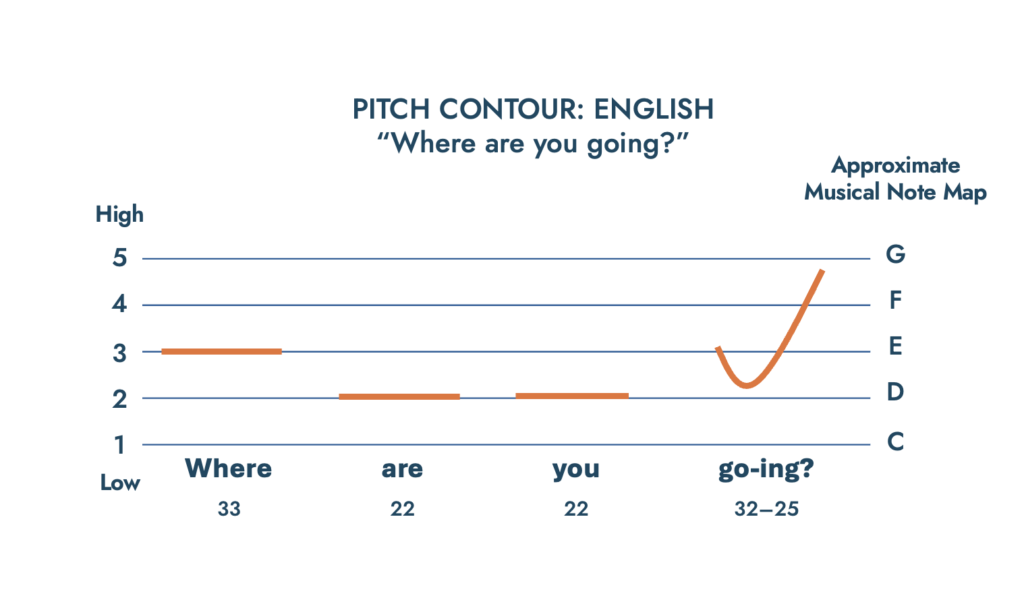
A native English speaker’s contour begins at a middle pitch, settles briefly, then rises toward the end because it is a question.
If we stripped away the consonants and vowels, only the contour would remain in the form of a rhythm, syllable timing, and pitch movement.
Depending on dialect, that might look something like this:
Now whistle it in the same rhythm as when you said it.
Just for fun, let’s try two different sentences using the same words and see how the melodic contour changes:
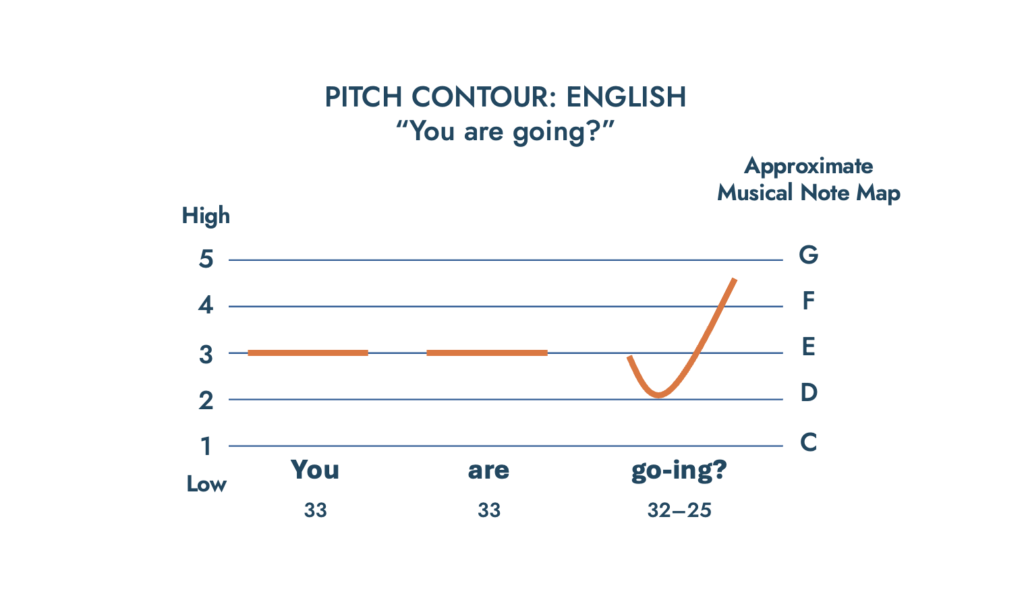
Speech is already structured like a melody, and some languages are more melodic than others. Theoretically, by removing everything except the parts that carry a language’s phonology, any language could have its own whistled version.
Of course, rules would have to be applied to its grammatical structure and whistled expression. For example, vowels could be assigned high or low pitch bands, and consonants could be represented through breaks and transitions, syllables with rhythm and timing, sentence types with overall pitch contour, and emphasis with louder, longer, or sharper whistle movements.
Let’s briefly look at some of the more famous whistled languages…
Silbo Gomero
On La Gomera in the Canary Islands, the terrain is steep and broken by deep ravines. The most famous whistled language, Silbo Gomero, developed so shepherds and farmers could send messages to each other.
Silbo is a compressed acoustic version of Spanish. Vowels are reduced into pitch bands, while consonants are suggested through breaks, transitions, and changes in modulation. Today it is taught in schools on La Gomera and recognized by UNESCO as intangible cultural heritage.
If you have time, here is a short video that demonstrates its sound system:
Kuşköy Bird Language
In northern Turkey’s Black Sea region, the village of Kuşköy. It is a whistled form of Turkish that developed in its steep valleys where villagers, especially farmers and shepherds in geographically separated communities, needed to communicate.
Kuş dili, literally “bird language”, became famous for its bird song sound. It carries Turkish phonology through pitch, rhythm, and melodic transitions in high, piercing whistles.
Its everyday use has declined with mobile phones, but it remains a powerful marker of local identity. As of 2017, it is on UNESCO’s List of Intangible Cultural Heritage in Need of Urgent Safeguarding, recognizing both its cultural value and vulnerability.
Mazatec
In Oaxaca, Mexico, Mazatec whistled speech developed in mountainous coffee plantation communities. Spoken Mazatec is a tonal language, so pitch already carries meaning in ordinary speech. When Mazatec is whistled, speakers preserve the tone and rhythm of the spoken language, making it easier to learn.
Thanks to its tonal phonology, Mazatec whistling has been used for real back-and-forth conversations instead of just short signals.
Sfyria
In the Greek village of Antia, on the island of Evia, whistling carries Greek phonology and is named after the Greek word sfyrizo, which means “to whistle.” It remained largely unknown outside the village until the late 1960s, when villagers reportedly used it during a search-and-rescue effort after a plane crash near Mount Ochi.
What makes Sfyria unique is that it is used only by residents of this one village, and it is in danger of disappearing.
Akha
Among the Akha communities of upland Southeast Asia, whistled speech is a practical and entertaining extension of verbal life. Akha is a tonal Tibeto-Burman language spoken across parts of China, Myanmar, Laos, Thailand, and Vietnam.
One distinctive feature is that Akha whistling is not limited to communication across distances. Researchers have also documented whistled Akha songs, including performances using a leaf, and combining its melody, ornamentation, and linguistic tone into an art form.
Hmong
Among Hmong communities in Southeast Asia, whistling is more a social art. Hmong is a group of indigenous tonal languages.
Its most interesting feature is how it is used in courtship. Young people could use whistling, leaf-blowing, flute-like sounds, or other speech-surrogate instruments to send messages that resembled melody but still followed the tones and rhythms of Hmong speech with its embedded tonal meaning.
A young man could communicate attraction, identity, or poetic messages without speaking plainly in front of family or the wider household. One scholarly description of related Hmong “thought-song” traditions explains that conveying a message through decorated whistling could help mask, easy-to-understand verbal speech, into erotically charged courtship messages that others nearby might not interpret in the same way.
Pirahã
In parts of the Amazon, whistled and speech-surrogate communication takes place in a very different setting. Depending on the situation, speakers of the Pirahã language shift from ordinary speech into humming, shouting, or whistling.
In dense rainforest, sound travels differently than in open air, and during hunting, quiet and controlled acoustic signalling is more important than volume. A whistle or hum allows communication that is less likely to disturb animals or reveal a speaker’s position.
Chepang
Among the Chepang of south-central Nepal, whistled speech is used for hunting. A specialized practice of communicating in the forest, one source describes Chepang as “whistle talk”. Research describes Chepang as Tibeto-Burman that preserves the prosodic and phonetic features of the spoken language, including pitch movement linked to glottal features.
Every living thing needs a way to communicate because survival depends on coordination. At the simplest level, communication lets living things signal needs, danger, territory, attraction, food, fear, trust, and intent. It can be with colour, scent, movement, vibration, or sound. Humans use language, and in creative ways.
Whistled languages are a testament to how adaptable human communication can be when spoken language alone cannot support the coordination needed to survive.
If you’ve missed previous editions of the Santium Language Series, you’ll find them here – catch up!
How Santium contributes to this space
Santium provides specialized language services focused on scientific, medical and technical content. We focus on delivering translated materials that work as intended across languages and cultures through translation, linguistic validation and subject-matter specialist review, preserving meaning, function, usability, and measurement integrity in real-world applications.
Curious About the World’s Languages?
If you found this article interesting, follow me on LinkedIn and join our newsletter to receive future editions. In the Santium Language Series, I explore interesting traits of the world’s languages, from the most widely spoken to obscure, introducing their structure and word formation to cultural nuance and their role in social norms.
Stay connected and don’t miss the next edition!

|
Thank you for signing up. |



Monika Vance
Managing Director | SANTIUM
My work sits at the intersection of linguistics, scientific and medical translation, psychometric measurement, and multilingual operations, where terminology, usability, and regulatory context must align. I write about scientific and medical translations, psychometrics, languages, and the operational challenges that inevitably come with them. I also teach translators how to properly translate and validate complex psychometric instruments to hone their expertise in linguistic validation.