Creole languages are fully formed, rule-governed languages that emerged when people who shared no common tongue were forced into sustained contact through trade, migration, colonization, or slavery. They are often mixed with languages that co-existed, or still co-exist, within the multi-lingual community, but their grammar, structure and expressive range are their own.
Today, there are over one hundred Creole languages spoken across the Caribbean, West Africa, the Indian Ocean, the Pacific and beyond, by tens of millions of people for whom these are their mother tongue.
Yet in clinical and institutional settings, the depth of expressive differences within spoken and written Creole languages is still routinely underestimated, maladapted or ignored altogether.
In this edition of the Santium Language series, we examine the social life of Creoles and, at the end, what happens when clinical outcome assessments — the questionnaires and rating scales used in clinical evaluations for capturing how patients feel and function — meet the sociolinguistic complexity of Creole-speaking societies, and why getting this wrong doesn’t just produce a poorly adapted translation. It produces a clinically meaningful measurement error.
What is Creole?
Creole is the linguistic product of a pidgin. A pidgin is an improvised variety of an emerging language that comes from contact among speakers of different languages who must communicate. They create their own language. It is often a blend of the languages spoken by its creators and captors.
A Creole becomes its own language when it is passed down to new generations of its native speakers and acquires a consistent grammatical structure and expressive range of any natural language.
How Creole is Born: Contact and Lay Improvisation
An unexpected but useful starting point comes from wartime communication during the First World War. In the book Somme, Lyn Macdonald describes how British soldiers on the Western Front improvised ways of speaking with French civilians.
In one account, a soldier tried to tell a woman that her cow had wandered off, with the phrase “doolay promenade, madame” (some milk for a walk, madam), a blend of du lait (some milk) and promener (to take a walk). British soldiers referred to cows as “doolay” from du lait. This kind of communication was known as “Tommy French” (Tommy being the slang word for British soldiers, like Fritz was for their German counterparts).
They also reshaped place names. Foncquevilliers became “Funky Villas”, Auchonvillers “Ocean Villas”, Ypres was “Wipers”, Étaples “eat apples” and, my favourite, Ploegsteert was “Plug Street”. These were sound-based reinterpretations; ways of turning unfamiliar words into forms that were easier to say, remember and pass on to other people.
In some cases, this kind of reshaping points toward what linguists call folk etymology. Clear examples include “Jerusalem artichoke”, from the Italian “girasole”. I love the more disputed folk etymologies and wish them to be true, such as the Route du Roi becoming “Rotten Row” and “Elephant and Castle” from Infanta de Castilla, both in London. Whether or not those last examples hold up, what matters here is the process: unfamiliar forms from one language are not translated but made socially usable in another.
Pidgin Foundations in Multilingual Homes and Workplaces
A miniature version of a forming pidgin can be seen within our own company, which operates bilingually in English and Spanish.
Over time, a stable set of hybrid ways of communicating has emerged, such as “pocket tin” (from poquitín) or “grassy ass” (from gracias). Others have become part of our everyday working language: cabal, taken from our Guatemalan team, is routinely used to mean “exactly” and pues (well, then) is deliberately overused as a kind of soft full stop at the end of an utterance, similar to the “stop” used in telegrams.
A typical interaction could be:
“¿Me podés mandar el quote, pues?” (“Can you send me the quote?”)
“Sí, sent on SharePoint hace poco, pues.” (“Yes, sent on SharePoint just now.”)
We codeswitch without thinking about it, within a single sentence and without treating it as unusual:
“Voy. I’ll send it ahorita.” (“Right on it. I’ll send it right now.”)
“Esto es lo que we agreed. Cabal, pues.” (“This is what we agreed. Exactly.”)
Correctness doesn’t matter to us, only the shared meaning. These expressions are recognised, repeated and expected within the group. In that sense, they do more than help communication: they mark social belonging. They bind us. It is in-group.
This is language contact in a microcosm. Contact produces innovation, which stabilises through use, and these stabilised forms carry social meaning alongside their literal sense.
The same underlying process can be seen in the baseball anecdote where Spanish-speaking players would call out “Yo la tengo!” (“I’ve got it!”, i.e. the ball) and this was heard by their Anglophone teammates as “yellow tango”.
The same happens in multi-lingual homes, especially in expatriate households. The language spoken at home begins to blend with the language spoken in the workplace and daily life outside the home.
What Makes a Creole
What we see in these examples is the same process operating from the historical and micro to the macro. From Tommy French to the hybrid language of a small bilingual team, contact produces forms that are initially improvised but functionally effective. In some settings, they remain local, informal and bounded to specific contexts. In others, where contact is sustained across generations and embedded in wider social structures, they stabilise into shared linguistic systems with their own norms, variation and social meanings.
It is at this point that we move from improvisation to what we recognise as pidgin and creole languages. What is striking is that when these processes stabilise over time, creole languages tend to share common features regardless of where they emerge. They typically draw much of their vocabulary from a dominant language, known as a lexifier, often English, French, Portuguese or Spanish. Meanwhile, their grammar reflects influences from the communities involved in the contact: African, Indigenous and other languages that form what we might call the creole substrate.
This is why we refer to English-based creoles, French-based creoles, and so on. English-based creoles such as Jamaican Patwa or Krio, French-based creoles such as the Krèyol of Haiti and elsewhere in the Caribbean and Indian Ocean, Portuguese-based creoles such as Crioulo and Papiamentu. These all differ in vocabulary, but often show striking similarities in how they organise meaning, grammar and word order.
Consider these examples of the same three sentences based on the three most common lexifiers:
English Creoles
Lexifier: English
- Present: I eat dinner with my family today
- Past: I ate dinner with my family today.
- Future: I will eat dinner with my family today.
Jamaican Patwa
- Present: Mi nyam dina wid mi famli tideh.
- Past: Mi nyam dina wid mi famli tideh.
- Future: Mi a go nyam dina wid mi famli tideh.
Origins:
nyam = eat → West African
dina = dinner → English
tideh = today → English
a go = I go → English (future/prospective marker)
Past tense is often unmarked and context-driven.
Tok Pisin (Papua New Guinea)
- Present: Mi kaikai kaikai wantaim famili bilong mi tude.
- Past: Mi bin kaikai kaikai wantaim famili bilong mi tude.
- Future: Mi bai kaikai kaikai wantaim famili bilong mi tude.
Origins:
mi = I → English me
kaikai = eat and food → English; thought to come from British cake or cakes (e.g., sweet bread, fish cakes, potato cakes, etc.)
wantaim = with → English one time, which shifted to together with
bilong = belonging to → English
tude = today → English
bin = past marker → English been
bai = future marker → English by
French Creoles
Lexifier: Standard French
- Present: Je mange le dîner avec ma famille aujourd’hui.
- Past: J’ai mangé le dîner avec ma famille aujourd’hui.
- Future: Je mangerai le dîner avec ma famille aujourd’hui.
Haitian Creole
- Present: Mwen manje dine ak fanmi mwen jodi a.
- Past: Mwen te manje dine ak fanmi mwen jodi a.
- Future: Mwen pral manje dine ak fanmi mwen jodi a.
Origins:
mwen = I → French moi
manje = eat → French manger
jodi = today → Fench aujourd’hui
te = past marker
pral = going to → future marker; French apre al
Réunionnais Creole (Réunion, near Madagascar)
- Present: Mi manz dine ek mon fami ozordi.
- Past: Mi la manz dine ek mon fami ozordi.
- Future: Mi va manz dine ek mon fami ozordi.
Origins:
mwen = I → French moi
manje = eat → French manger
jodi = today → Fench aujourd’hui
te = past marker
pral = going to → future marker; French apre al
Portuguese Creoles
Portuguese Creoles are derived from early modern Portuguese, and it’s not really possible to show what these three sentences looked like in this form. For the sake of providing a reference point, I’ll use modern Portuguese.
Standard Portuguese (Europe)
- Present: Eu como o jantar com a minha família hoje.
- Past: Eu comi o jantar com a minha família hoje.
- Future: Eu vou comer o jantar com a minha família hoje.
Cabo Verde Crioulo (Cape Verde)
- Present: N ta kumê djantar ku nha família ôji.
- Past: N kumê djantar ku nha família ôji.
- Future: N ta bai kumê djantar ku nha família ôji.
Origins:
n = I
ta = present/habitual marker
kumê = eat → Portuguese comer
ôji = today → Portuguese hoje; past often unmarked or inferred
ta bai = future marker
bai = goes → Portuguese vai
Papamientu (Aruba, Bonaire and Curaçao, The Caribbean)
- Present: Mi ta kome sena ku mi famia awe.
- Past: Mi a kome sena ku mi famia awe.
- Future: Mi lo kome sena ku mi famia awe.
Origins:
mi = I
ta = present marker
kome = eat → Portuguese and Spanish
awe = today → Portuguese hoje
a = past marker
lo = future marker → Spanish luego or modal origin
Across these examples, a key feature of Creole languages is how they organise tense and aspect. Rather than changing the form of the verb through conjugation, they typically use particles placed before it.
Across different Creoles, these markers have exactly the same function: bin, te, la and a are used to indicate past tense; bai, pral, lo and va signal the future; ta commonly marks present or habitual meaning.
At the same time, vocabulary reflects the influence of the lexifier: French-derived forms such as manje or ozordi (from manger and aujourd’hui), Portuguese-derived words such as kumê or ôji (from comer and hoje), and English-derived forms such as tude or bai (from today and by-and-by). Despite the vocabulary differences, the underlying grammatical organisation converges.
Other languages have similar characteristics without being Creoles. Swahili, for example, has absorbed a large number of Arabic words over time (around 20% of its current vocabulary), whilst maintaining a Bantu substratum. Dutch in South Africa underwent a significant transformation in a language contact situation, and the result is Afrikaans. Even Middle English (the language of Shakespeare) carries a heavy French vocabulary, accounting for about one third of the English lexicon, while its grammatical structure is Germanic. None of these is typically classed as a Creole, but the point stands: language contact can transform a language a great deal without everyone agreeing on what to call the result.
Diglossia in Creole-Speaking Societies
In sociolinguistics, the term for what we are describing here is diglossia. First coined by Charles Ferguson in 1959 and later extended by Joshua Fishman, it refers to situations where two languages, or two varieties of the same language, divide social life between them. One variety handles the formal, official and written domains: government, education, law, medicine. The other handles the informal, personal and spoken ones: home, community, everyday life. Neither is more capable than the other. But they are not treated as equals, and everyone in the community knows which is which.
If you are bilingual, think about the languages you associate with authority, education and official life, and then think about the ones you associate with home, family and informality. Chances are they are not the same. In Creole-speaking societies, this difference maps almost exactly onto the relationship between the dominant European language and the Creole. French carries more weight than Krèyol in Haiti. English more than Patwa in Jamaica. Portuguese more than Crioulo in Cape Verde.
This is not because one language is grammatically superior to another. It is because colonial administrations spent centuries making sure that is how it was perceived, and independence did not change that. In many cases, the post-colonial elite inherited the hierarchy, because mastery of the European language was precisely what provided access to power in the first place. So, the language spoken fluently by the vast majority of the population remained unofficial, informal or somehow insufficient by the country’s own institutions.
The boundaries between Creoles and their standard language parent are not always clear-cut, and what counts as a language versus a Creole is itself shaped by questions of legitimacy. Who uses it? Where is it used? Is it recognised as appropriate? Creoles do not occupy the same sociolinguistic position around the world. Some function as national lingua francas. Some have official status. Some have established roles in media and education. Others remain widely spoken but politically marginalised.
- Tok Pisin is one of Papua New Guinea’s official languages and is widely used in public communication, yet English remains dominant in government, commerce and education.
- Haitian Creole has been an official language since 1987 and is the first language of most Haitians, but French still carries strong authority in elite and formal domains.
- Crioulo is the most widely spoken language in Cabo Verde, though Portuguese remains the official language in formal settings.
- Krio is Sierra Leone’s lingua franca, but English has more official prestige.
- Papiamentu has strong public and educational visibility, especially in Aruba and Curaçao, yet Dutch retains institutional weight.
- In the French Caribbean, local Creoles are widely spoken, but French remains the official language.
- In Jamaica, Patwa is socially and culturally central without equivalent official standing, though many people believe it to be nothing more than “broken English”.
Language and Setting
This variation in status has a direct bearing on how Creoles function across different areas of social life, what sociolinguists call domains of use. The idea is straightforward: different languages are associated with different social contexts and expectations. Home, community and everyday interaction tend to belong to the Creole. Education, government, law and medicine tend to belong to the dominant European language. These are not rigid rules, but they are deeply embedded in the society. Using a language outside its expected domain is immediately noticeable, and sometimes unacceptable.
Health sits in a particularly contested position. It straddles everyday life and formal authority. Patients describe symptoms, pain and emotion most naturally in Creole. But institutions may still associate documentation, academic communication, and linguistic legitimacy with the European language. Creoles tend to be strong in oral, community-facing health communication, such as a public health campaign, or a conversation with a community health worker. Their role in formal written materials, consent forms and questionnaires is more variable and more sensitive.
The table below shows how different Creoles occupy different positions across domains, with direct implications for what is appropriate in healthcare communication:
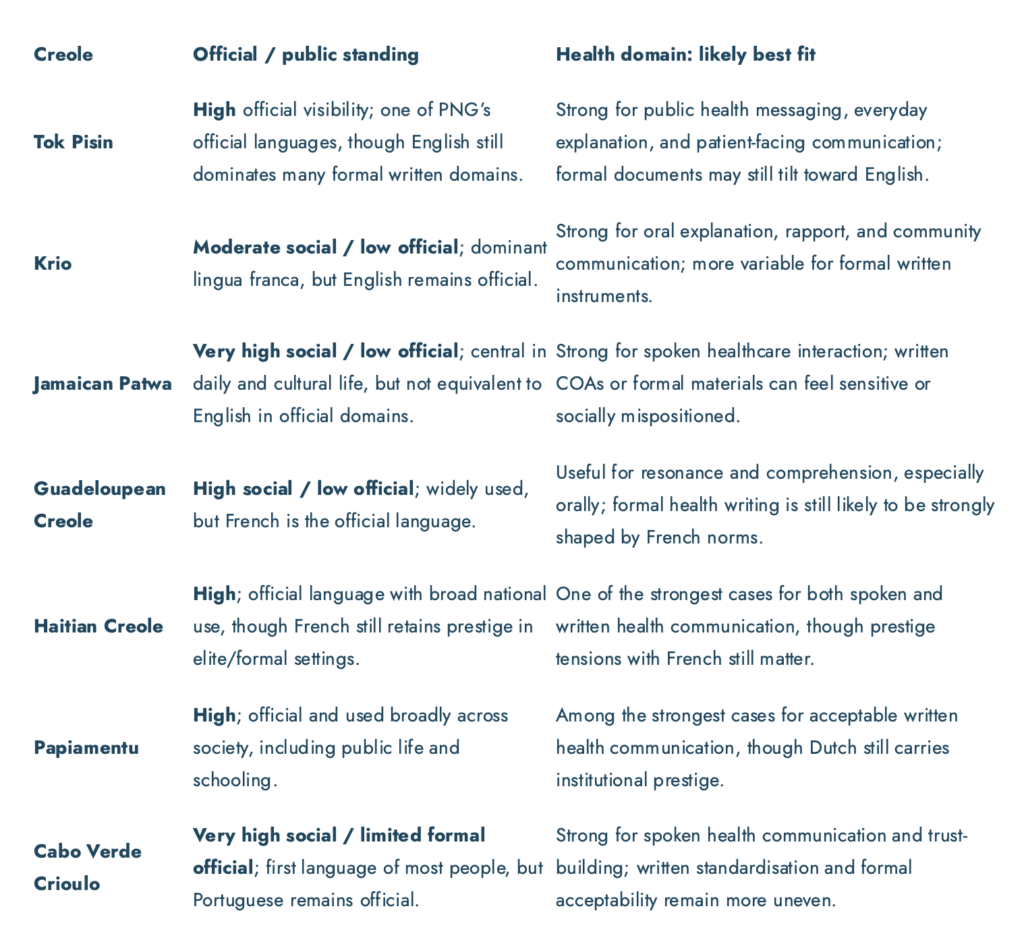
What the table also shows is that the question is never simply which language to use. It is which variety of that language, and at what register. This is where the post-Creole continuum becomes important.
In many Creole-speaking societies, there is no clear boundary between the Creole and the European standard. There is a range, a continuum of ways of speaking that runs from the most distinctively Creole forms at one end to forms that are almost indistinguishable from the standard at the other. Linguists call the deepest creole end the basilect, the standard-adjacent end the acrolect, and the broad middle ground the mesolect. People move along this range constantly, shifting register depending on who they are speaking to, where they are and what they are trying to do.
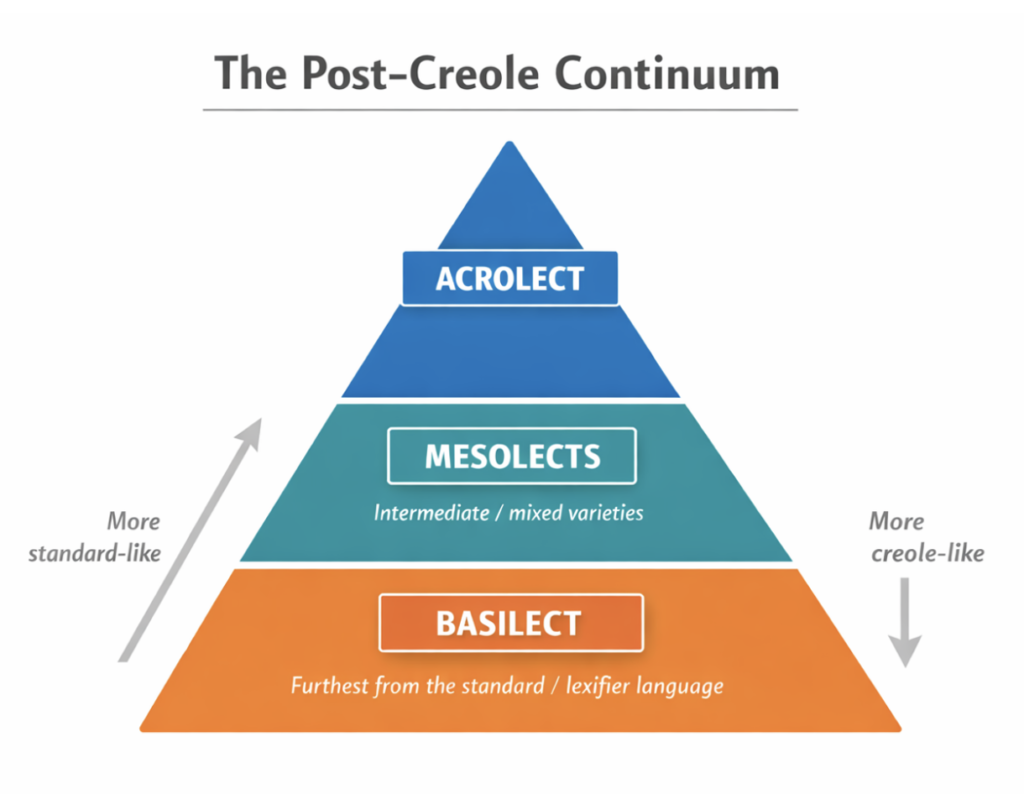
Jamaica illustrates this particularly well. Standard English sits at one end, Patwa at the other, with a wide and well-populated middle ground in between. Most Jamaicans do not live at either extreme. They navigate the continuum fluidly, using the standard in formal or institutional settings and switching to Patwa in personal or community ones.
Consider these examples how Jamaicans navigate the continuum of English-Patwa registers:
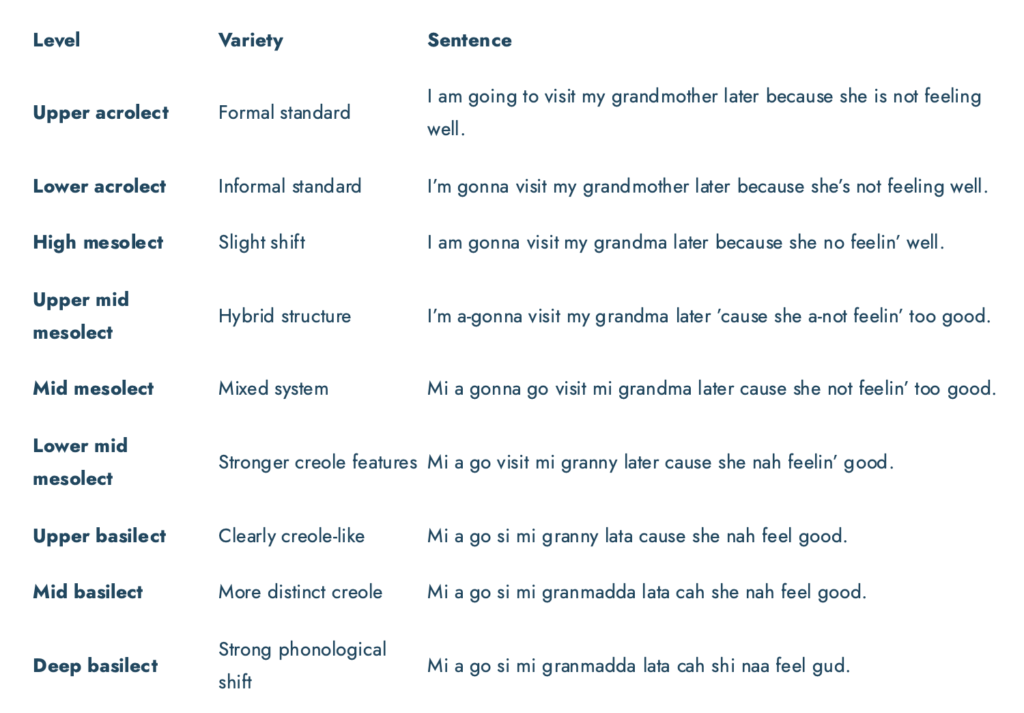
This has a direct consequence for COA adaptation. Standard forms carry overt prestige that is associated with education and official authority. Creole forms carry covert prestige, signalling identity, belonging and cultural authenticity. Neither is automatically right for a COA. The challenge is finding the register that people recognise as natural without feeling either talked down to or misrepresented.
In practice, materials produced from outside, such as a health leaflet or a medical questionnaire, tend to be written in the mid- or deep Creole forms, as if reaching for the most visibly authentic version of the language. The effect is often the opposite of what was intended. It can be perceived as a caricature of what outsiders think Jamaicans speak like. Most people are operating somewhere in the mesolect, and that is where a COA needs to land.
Standardisation adds one further layer of difficulty. In many Creole languages, spelling systems are not fully fixed, or there are multiple accepted versions in circulation. This applies to Papiamentu, Crioulo and Patwa. Haitian Creole and Tok Pisin have established spelling standards, but literacy in those standards is not universal. There may not be a single stable written form to translate into, even within one language. And even where standardisation is well established, it does not dissolve the hierarchy: the European language still carries a higher institutional status. For anyone producing materials that need to reach real people in real situations, this remains the problem.
Implications for COA Design
Adaptation of clinical outcome assessments (COAs) is not a straightforward linguistic task. Translate the words, adjust sentences, and once there is proof of understanding with real users, the job is considered complete. The problem with this approach is that it starts to break down in language contact settings where lay register is deeply embedded in everyday speech and doesn’t map well to the standardized written form of its official language.
Though not limited to Creole, Creole languages happen to be an excellent example of this. So, the challenge is not just translating between languages, but choosing the right way of speaking within a range of socially meaningful varieties.
In the case of Haiti, it is neither standard French nor Creole. In everyday life, people usually mix the two languages. COA adaptation often assumes that spoken language can simply be written down, but in these contexts, that assumption does not hold. People may use French words for clinical terms while speaking in Krèyol mid-stream or vice versa.
These issues directly affect measurement. COAs rely on people matching their experiences to the rating options provided. If the language of the questionnaire sits at the wrong point on the continuum, people may understand the question but feel that this is not how they would naturally express themselves. It may cause individuals to disengage from the task. This is especially the case with specific concepts such as emotions or symptoms. Words like “depressed”, “anxious” or “fatigued” may exist in the dominant register, but may not map neatly onto everyday expressions of the more Creole-like varieties. There may be different ways of speaking, like different words and metaphors to describe the same experience in the Creole forms. If this is not handled with cultural insight, the questionnaire may end up measuring something different from what it was designed to measure, or nothing at all.
AI-assisted translation adds another layer of risk. Machine-pretranslated text in Creole languages may be grammatically correct but socially off-target. Again, it is more often than not rendered in the deepest dialectal forms, which can feel unnatural or exaggerated. The fact is that Creoles are lesser-resourced languages, and many AI translation solutions for Creole languages are not good enough to be deployed in high-stakes translations. And yes, they are often pretranslated with AI, because they carry the AI signature prose. I’m using AI to help me edit and organise this article, and I’m sure you’ve noticed where its edits are. It is clear as day in other languages too.
In COA design, the goal is to produce something that people can comfortably recognise as a legitimate way of speaking; their way. With Creole translations of COA, this requires a shift in mentality from assuming that the standardized language is the default for that country to figuring out which way of speaking fits the target audience, in this context and for this purpose.
Understanding domains of use is vitally important. This is particularly so because many COA contexts are involving more and more creole languages: Tok Pisin, Nigerian Pidgin English, Krio, Crioulo, Papiamentu, Haitian Creole, Patwa, Mauritian and Seychellois Creoles, to name but a few.
Creole adaptation of COAs requires understanding how native speakers actually use the language, how they shift between different registers and how they respond to different styles of communication. It also requires working closely with local subject-matter experts to avoid placing people in the wrong social or linguistic bucket. Finally, choose your Creole language specialists very carefully.
Thank you for reading.
How Santium and GRC Health Contribute to This Space
Santium provides specialized language services focused on scientific, medical and technical content. Our British partner, Gibson Research Consultancy supports our linguistic validation efforts with cognitive debriefing of non-clinical subjects. With deep experience in psychometrics, linguistic validation and transadaptation, we focus on delivering translated materials that work as intended across languages and cultures, preserving meaning, function, usability, and measurement integrity in real-world applications.
Curious About the World’s Languages?
If you found this article interesting, follow me on LinkedIn or subscribe to our newsletter. In our language series, I explore interesting traits of the world’s languages, from the most widely spoken to obscure, introducing their structure and word formation to cultural nuance and their role in social norms.
Stay connected and don’t miss the next edition!
If you’ve missed previous editions of the Santium Language Series, you can find them here and catch up!

|
Thank you for signing up. |



Mark Gibson
Owner & CEO | Gibson Research Consultancy
I am the founder of Gibson Research Consultancy (GRC Health), a Leeds-based consultancy established in 2008 to support multilingual, patient-centred research in international settings. My background is in qualitative research and health communication spanning different healthcare and cultural contexts. I write about linguistic validation, health communication, patient-centred research, and the wider methodological issues that affect how qualitative research is carried out and understood. I am also a contributing author to Santium Language Series.
References
Allen, C. (1997). Middle English case loss and the creolization hypothesis. English Language and Linguistics, 1(1), 63–89.
Arends, J., Muysken, P., & Smith, N. (Eds.). (1995). Pidgins and creoles: An introduction. John Benjamins.
DeCamp, D. (1971). Toward a generative analysis of a post-creole speech continuum. In D. Hymes (Ed.), Pidginization and creolization of languages (pp. 349–370). Cambridge University Press.
Holm, J. (1988). Pidgins and creoles: Volume 1, Theory and structure. Cambridge University Press.
Holm, J. (1989). Pidgins and creoles: Volume 2, Reference survey. Cambridge University Press.
Irvine-Sobers, G. A. (2018). The acrolect in Jamaica: The architecture of phonological variation. Language Science Press.
Kong, M., et al. (2025). Evaluation of the accuracy and safety of machine translation of discharge instructions.
Macdonald, L. (1983). Somme. Michael Joseph.
Mühlhäusler, P. (1986). Pidgins and creoles: An introduction. Basil Blackwell.
Rickford, J. R. (1987). Dimensions of a creole continuum: History, texts, and linguistic analysis of Guyanese creole. Stanford University Press.
Roberge, P. T. (2002). Convergence and the formation of Afrikaans. Journal of Germanic Linguistics.
Siegel, J. (2008). The emergence of pidgin and creole languages. Oxford University Press.
Thomason, S. G. (2001). Language contact: An introduction. Georgetown University Press.
Winford, D. (1997). Creole studies and sociolinguistics. Journal of Pidgin and Creole Languages, 12(2), 233–274.