One language, two writing systems, and a fascinating and complex history shaped by some of the world’s greatest empires. Punjabi has survived centuries of political divisions, religious transformations, and forced cultural change, yet remains a shared identity for millions of people cruelly divided by an international border.
Punjab stretches across northwestern India and eastern Pakistan, across an area roughly equivalent to the size of the entire United Kingdom.
Its name comes from the Persian words panj (five) and āb (water), referring to the five rivers that historically watered the region: the Jhelum, Chenab, Ravi, Beas, and Sutlej. These rivers and their extensions have sustained local agriculture and settlements for thousands of years, making Punjab one of South Asia’s most productive farming regions.
The landscape is predominantly flat, with fertile agricultural plains extending to the horizon in every direction. Fields of wheat, rice, sugarcane, and mustard dominate the countryside, interspersed with villages, market towns, rivers, and majestic irrigation canals.
In spring, mustard fields turn bright yellow, followed by the golden colours of ripening wheat. To the north, the landscape gradually changes to rolling hills and the foothills of the Himalayas. The larger cities, especially Lahore and Amritsar, are densely populated urban centres with historic buildings, bustling markets, and streets crowded with cars, motorcycles, and rickshaws.
Roadside food stalls, open-air markets, colourful clothing, and the sounds of Punjabi music are part of the local atmosphere. Food and hospitality are an essential part of Punjab culture, and sharing a meal is as much a social occasion as a necessity. The region is known for its rich cuisine, lively celebrations, and strong sense of community. For visitors coming from completely different cultures, it is the vibrancy of the people, their genuine, friendly hospitality, unusual yet perfectly balanced flavours in meals that quickly grow on you, the seemingly chaotic craziness of Punjab city life until it suddenly somehow makes sense, and the constant activity of daily life that tend to leave the strongest and most unforgettable impression.
Punjabi is spoken by well over 100 million people worldwide, including large communities in Canada, the United Kingdom, Australia, and the United States, along with other countries, although in smaller proportions outside of the British Commonwealth. It is a language with a rich literary and musical heritage, closely associated with Sikhism and Sufi traditions.
The language and traditions of one of the world’s oldest civilizations have a long, complex history. An interesting one. I’ll do my best to pack 3,000 years into a coffee-break read…
A Brief History
The history of Punjab stretches back thousands of years before the emergence of the Punjabi language. By around 2600 BCE, when the ancient Egyptians were building the Great Pyramid of Giza and Stonehenge was entering its major phases of construction, the Indus Valley Civilization had established prosperous cities, including Harappa in present-day Pakistan. Its inhabitants developed sophisticated systems of agriculture, trade, sanitation, and urban planning. Unfortunately, their writing system remains undeciphered; hence, the language they spoke is unknown.
Migration from the Great Steppe
During the 2nd millennium BCE, Indo-Aryan-speaking populations migrated into the northwestern Indian subcontinent from the Eurasian Steppe, travelling through Central Asia. They encountered and mixed with existing populations, including descendants of the Indus Valley Civilization. Their languages belonged to the Indo-European family and contributed to the development of Vedic Sanskrit and later Indo-Aryan vernaculars.
Punjabi eventually emerged from Middle Indo-Aryan linguistic traditions, including Prakrit and Apabhramsha, becoming a distinct language between roughly the 10th and 13th centuries CE.
Agricultural Wealth and Political Conquests
Punjab’s fertile plains and strategic location made it an important agricultural and commercial region. Connected to the wider Silk Road network, its merchants traded agricultural products, textiles, dyes, and salt, while regional routes gave way to goods, blending of languages, religious beliefs, and exchange of ideas between South Asia, Central Asia, Persia, and beyond.
Its wealth and position also attracted successive foreign powers.
The Achaemenid Persian Empire (c. 550–330 BCE)
By the late 6th century BCE, parts of the northwestern subcontinent had come under the control of the Achaemenid Persians, whose empire originated in present-day Iran. Founded by Cyrus the Great and expanded under Darius I, it connected the region to Persian administrative systems, commercial networks, and cultural traditions, although the extent of Persian control in Punjab remains uncertain.
Alexander the Great and the Macedonians (326 BCE)
In 326 BCE, Alexander the Great entered Punjab after conquering the Persian Empire and defeated King Porus at the Battle of the Hydaspes, near the Jhelum River. Alexander’s soldiers then refused to advance farther east, ending the campaign. Although Macedonian control was brief, later Greek influence became visible in the architecture, sculpture, and bilingual coinage.
The Mauryan Empire (c. 322–185 BCE)
After Alexander’s departure, Chandragupta Maurya, an Indian ruler of a neighbouring kingdom of Magadha in present-day Bihar in eastern India, overthrew the ruling Nanda dynasty. He then established one of the first empires to unite much of the Indian subcontinent, including Punjab. Under his grandson Ashoka, Buddhism received extensive royal patronage, while Taxila flourished as a centre of commerce and learning. Inscriptions in Prakrit, written in scripts including Kharosthi and Brahmi, provide evidence of the region’s early linguistic traditions.
The Indo-Greeks and Kushans (c. 2nd century BCE–3rd century CE)
After the Mauryan Empire declined, Punjab came under successive Indo-Greek, Indo-Scythian, Indo-Parthian, and Kushan rulers. These kingdoms maintained connections with Central Asia and the wider trading world. Buddhism flourished in Gandhara, where Greek, Iranian, and Indian artistic traditions blended, and Prakrit, Greek, and Bactrian were used in inscriptions and official records.
Regional Kingdoms, the Ghaznavids, and the Delhi Sultanate (c. 4th–15th centuries)
Following the Kushans, Punjab experienced periods of rule or influence under the Gupta Empire, the Huns, and regional dynasties. In the early 11th century, Mahmud of Ghazni, a Turkic Muslim ruler based in present-day Afghanistan, conquered much of Punjab.
The Ghaznavids established Persian as the language of government and literary culture, with Lahore becoming an important political and intellectual centre.
The Delhi Sultanate, founded in 1206, continued this tradition. Punjabi remained widely spoken and gradually incorporated Persian vocabulary and words of Arabic origin, while developing its own literary expression.
The Mughal Empire (1526–18th century)
Founded by Babur in 1526, the Mughal Empire made Punjab an important administrative and commercial region, with Lahore becoming a major cultural centre. Persian remained the language of government and elite literature, while Punjabi flourished in oral storytelling, poetry, and devotional traditions.
This period also coincided with the emergence and growth of Sikhism, founded in the late 15th century.
Afghan Rule and the Sikh Empire (18th century–1849)
As Mughal authority weakened, Punjab became contested territory among Afghan rulers, regional powers, and Sikh confederacies. Maharaja Ranjit Singh captured Lahore in 1799 and established the Sikh Empire in 1801, bringing much of Punjab under a unified administration.
Punjabi was widely spoken, although Persian remained the principal language of government. Following the Anglo-Sikh wars, the British East India Company annexed Punjab in 1849.
British Colonial Rule (1849–1947)
British rule transformed Punjab through railways, irrigation projects, education, and new administrative institutions. English gained importance in government and higher education, while Urdu was favoured for much official business and schooling.
Meanwhile, printing, religious reform movements, and literary organizations contributed to Punjabi publishing and language standardization, tying particular languages and scripts to different religious communities.
The Partition of British India and Modern Punjab (1947–present)
In 1947, the Partition of British India divided Punjab between India and Pakistan, triggering widespread violence and the displacement of millions of people. The division transformed the region’s demographic and religious composition and placed Punjabis within two different national education and language-policy systems.
Subsequent migration established large Punjabi-speaking communities in British Commonwealth countries and elsewhere.
Today, Punjabi remains one of South Asia’s major languages, still reflecting the influence of its history.
Linguistic Characteristics of Punjabi
Punjabi belongs to the Indo-Aryan branch of the Indo-European language family, alongside Hindi, Urdu, Bengali, and Marathi. It shares many grammatical features with these languages, including grammatical gender, verb conjugation, and a preference for placing verbs at the end of sentences. However, Punjabi has several distinctive characteristics, especially in its pronunciation and use of tone.
A Tonal Language
Although tone is relatively uncommon among Indo-Aryan languages, Punjabi is tonal, a characteristic commonly associated with languages such as Mandarin Chinese. Punjabi was not influenced by Chinese and has its own developmental trajectory. In comparison, English speakers generally change the pitch of their voice to express emotion, emphasis, or a question. In Punjabi, pitch can change a word.
Punjabi’s tonal system emerged through changes in the pronunciation of certain consonants, especially historically breathy sounds such as bh, dh, and gh. As these sounds changed or disappeared, differences in pitch took over part of their role in distinguishing words. This linguistic process is known as tonogenesis.
Punjabi has 3 common tonal categories: high, low, and level. These contrasts developed as certain consonants changed their pronunciation, particularly those that had originally been pronounced with breathy or aspirated voicing.
Tone is an important consideration for learners but also for translators working with spoken Punjabi, especially in interpreting, dubbing, audio recordings, and speech-recognition technology. Regionality plays a critically important role in audible comprehension. The translator, voice talent or interpreter must be fluent in the regional spoken variety of the language for accurate comprehension by the audience.
Pronunciation and Sounds
Punjabi contains several consonant distinctions unfamiliar to many English speakers. Among these are retroflex consonants, produced by curling the tongue slightly backward toward the roof of the mouth, and dental consonants, articulated with the tongue against the upper teeth.
Some of Punjabi’s pronunciation patterns come through when native Punjabi speakers speak English and other languages. For example, the Punjabi words koṛā (ਕੋੜਾ, whip) and ghoṛā (ਘੋੜਾ, horse) have similar pronunciations, but differ in their consonant history and tonal pattern. Depending on the variety of Punjabi being spoken, the difference can be heard partly through the pitch of the voice along with the audibility of the gh sound.
Another example is when a Punjabi speaker pronounces t and d sounds, which tend to be pronounced with the tongue farther forward or slightly curled, contributing to the characteristic sound of Punjabi-accented English.
It also distinguishes between aspirated and unaspirated consonants. Aspiration refers to the short burst of air released with a consonant. In Punjabi, this difference can distinguish words. For example, the English p in pin is usually aspirated, while the p in spin is not. Punjabi speakers tend to use different aspiration patterns when speaking English, depending on their dialect and experience with English.
Vowel length and nasalization are also important. Nasalized vowels are pronounced with air passing through both the mouth and nose, and can also distinguish one word from another. Together with tone, these features give Punjabi a sound system that differs considerably from other languages.
Grammar and Sentence Structure
Punjabi generally follows a subject–object–verb (SOV) sentence structure, unlike English’s SVO word order.
Example
I am reading a book.
ਮੈਂ ਕਿਤਾਬ ਪੜ੍ਹਦਾ ਹਾਂ।
Pronounced as: Maiṁ kitāb paṛhdā hāṁ.
Literal translation: I book read am.
Punjabi has two grammatical genders, masculine and feminine, which apply not only to people and animals but also to inanimate objects. Nouns, adjectives, and verbs may change form according to gender and number.
Punjabi verbs change according to grammatical features such as gender, number, person, and aspect. The form paṛhdā is masculine; a female speaker would use paṛhdī in this sentence construction.
Another interesting contrast from English is the use of postpositions rather than prepositions. Where English demands the preposition before the noun in a phrase such as in the house, Punjabi places the corresponding grammatical element after the noun or noun phrase, like this: (the) house in.
Punjabi also does not have a direct equivalent of the English definite article the, so depending on context this phrase can mean either in a house or in the house.
Regional Dialects
Punjab has a large geographic spread. Regardless of partition, its combined linguistic area is roughly the size of the United Kingdom. Across Punjab, Punjabi’s regional varieties differ in pronunciation, vocabulary, tone, and some grammatical structures, reflecting centuries of geographic separation and contact with neighbouring languages.
*Majhi*, traditionally associated with the central Punjab region around Lahore and Amritsar, forms the principal basis of standardized Punjabi. Other important varieties include *Doabi*, spoken between the Beas and Sutlej rivers, *Malwai*, associated with southern Indian Punjab, and *Puadhi*, spoken toward the southeastern part of the region.
In Pakistani Punjab, varieties such as Pothohari, Shahpuri, and Jhangvi are part of a broader western Punjabi linguistic continuum. Their classification is not always straightforward. Some are described as Punjabi dialects, while others are recognized by their speakers or by linguists as distinct languages.
These varieties are not separated by precise linguistic boundaries. Pronunciation, vocabulary, and grammar change gradually between neighbouring areas, and speakers may adjust their speech depending on whom they are addressing.
For translation, the distinction is particularly relevant when selecting terminology and working with spoken materials. Standard written Punjabi may be appropriate for many audiences, but it does not necessarily reflect the everyday speech of every Punjabi-speaking community.
A Language With Two Scripts
One of Punjabi’s most unusual characteristics is that it is written in two distinct scripts. In Indian Punjab, the predominant writing system is Gurmukhi (ਗੁਰਮੁਖੀ), while in Pakistani Punjab, Shahmukhi (شاہ مکھی) is used. Both represent the same language, but their use reflects the region’s religious, cultural, and political history.
Gurmukhi, written from left to right, developed from earlier Indian writing systems and was standardized in the 16th century under Guru Angad, the second Sikh Guru. It became closely associated with Sikh religious literature and is now the official script of Punjabi in India.
Shahmukhi, written from right to left, is based on the Perso-Arabic writing system and developed through Punjab’s long association with Persian and Islamic literary traditions.
Although speakers from both sides of the border can often understand each other, someone literate in only one script may be unable to read the other. Converting between Gurmukhi and Shahmukhi is not always straightforward because the scripts represent certain sounds and vowels differently. For translators, identifying the intended audience and its preferred writing system is therefore an essential consideration.
Punjabi literature: Poetry, Devotion, and Storytelling
Punjabi has a rich literary tradition rooted in poetry, religious teachings, and oral storytelling. For centuries, while Persian and Sanskrit dominated scholarship, Punjabi was widely used in folk songs, spiritual verse, and popular narratives.
Some of the earliest surviving poetry associated with Punjabi is attributed to the 13th-century Sufi saint Baba Farid, whose verses explored devotion, humility, and human suffering. Later Sufi poets, particularly Shah Hussain and Bulleh Shah, used everyday language to question religious divisions and social hierarchies. Sikh religious literature also played an important role, with the Guru Granth Sahib preserving hymns and devotional compositions from other linguistic and religious traditions.
Among Punjabi’s best-known literary works is Heer Ranjha, a tragic love story by the poet Waris Shah written in 1766. The story of two lovers separated by family and social expectations offers a portrait of 18th-century Punjabi society, its customs, social classes, and attitudes toward marriage. Other traditional romances, including Sohni Mahiwal and Mirza Sahiban, have also survived through generations of oral storytelling, poetry, and song.
The Partition of Punjab in 1947 profoundly influenced modern Punjabi literature. In her celebrated poem Ajj Aakhaan Waris Shah Nu (Today I Call Upon Waris Shah), Amrita Pritam invoked the 18th-century poet to mourn the suffering of women during Partition. Her poem became a powerful expression of grief shared across the newly established border.
Today, Punjabi literature continues to develop in both Gurmukhi and Shahmukhi, while its longstanding connection to music and oral performance keeps many older works still familiar to new generations.
Sikhism, Seva and Community Life
Punjab is the birthplace of Sikhism, a noble faith founded by Guru Nanak in the late 15th century in a society where Hindu and Muslim religious traditions were both practiced. Although Sikhism shares certain ethical principles with Islam, such as belief in one God, charity, and social responsibility, it developed its own religious philosophy. Sikhism rejects religious discrimination and hereditary caste hierarchy as spiritual principles. It emphasizes equality between men and women and the responsibility to defend people facing oppression.
Today, Sikh traditions remain an important part of Punjab’s cultural identity and have been brought by Punjabi communities to other parts of the world. Central to Sikh teachings are equality, honest work, sharing with others, and seva, the principle of selfless service without expectation of reward.
The 5 Ks of Sikhism
The Five Ks of Sikhism refer to five articles of faith established by Guru Gobind Singh in 1699 as part of the founding of the Khalsa, the community of initiated Sikhs.
Each begins with the letter K in Punjabi: kesh (uncut hair), representing respect for God’s creation; kangha (a wooden comb), symbolizing cleanliness and discipline; kara (a steel or iron bracelet), serving as a reminder of one’s faith and moral responsibilities; kirpan (a ceremonial sword), representing the duty to defend justice and protect others; and kachera (a traditional cotton undergarment), symbolizing modesty and self-control. Together, these articles represent Sikh commitment to spiritual discipline, equality, and ethical conduct.
The turban, known as a dastār in Punjabi, is a symbol of dignity, social equality, honour, and a commitment to the Sikh faith. As observant Sikhs traditionally leave their hair uncut, the turban serves both to protect and respectfully cover it. It is worn by many Sikh men and some Sikh women, although not all Sikhs wear turbans. Styles and colours vary according to personal preference, regional tradition, and occasion, and there is no universal religious meaning assigned to particular colours.
The Generosity of Seva
Perhaps the most common expression of Seva is langar, the free communal kitchen found in Sikh gurdwaras. Meals are prepared and served by volunteers and offered to everyone, regardless of religion, ethnicity, or financial circumstances. At the Golden Temple in Amritsar, one of Sikhism’s holiest sites, volunteers prepare and serve tens of thousands of free meals every day.
The tradition of selfless service extends well beyond religious institutions. Sikh communities organize food banks, disaster relief, emergency meals, fundraising, and assistance for people experiencing hardship. During the COVID-19 pandemic, Sikh volunteers in Canada, Britain, India, and elsewhere distributed food and essential supplies to people in need. In Toronto, their cars with trunks filled with meals pulled over at street curbs to offer meals to the homeless and to individuals reluctant to enter crowded soup kitchens. These activities reflect another Sikh principle, sarbat da bhala, meaning the well-being of all.
Gurdwaras also serve as important cultural and community centres, particularly among Punjabi communities living abroad. Many provide Punjabi language classes, religious education, music instruction, and support for newcomers, helping younger generations maintain a connection to their language and heritage.
Although Punjabi identity extends across several religions and communities, Sikh institutions have played a particularly visible role in preserving and promoting the language internationally.
A Greeting Gesture
Greetings in Punjabi often reflect the region’s religious and cultural diversity.
Among Sikhs, the traditional greeting is Sat Sri Akal (ਸਤਿ ਸ੍ਰੀ ਅਕਾਲ), meaning roughly Truth is eternal, and is commonly accompanied by folded hands as a gesture of respect.
Punjabi Muslims generally greet one another with Assalamu Alaikum (السلام علیکم), meaning Peace be upon you, to which the customary response is Wa Alaikum Assalam (And peace be upon you).
Punjabi Hindus may use Namaste (ਨਮਸਤੇ) or Namaskar (ਨਮਸਕਾਰ), greetings expressing respect for the person being addressed.
More informal greetings, such as Ki haal ae? (ਕੀ ਹਾਲ ਐ?), meaning How are you?, are widely used in everyday encounters.
Punjabi Culture: Music, Dance and Celebration
Music and dance are central to Punjabi cultural life, with traditions closely connected to agriculture, seasonal festivals, weddings, and community gatherings.
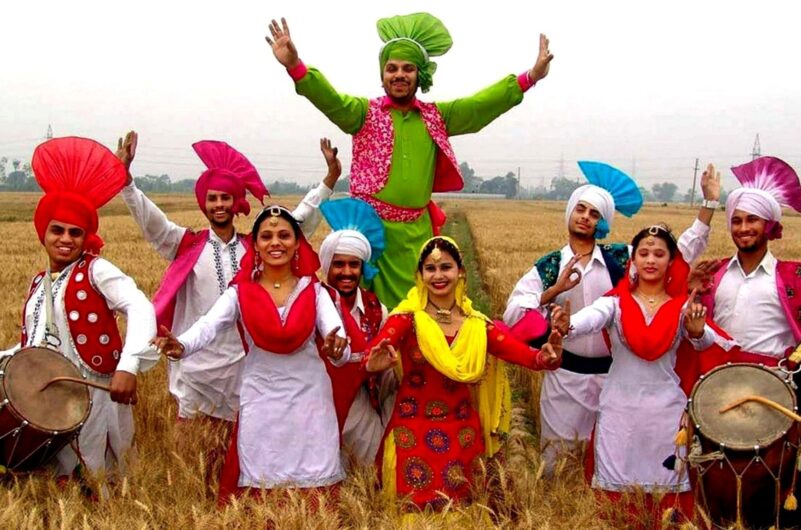
The best-known dance is probably bhangra, a lively folk dance associated with the spring harvest festival of Vaisakhi. Traditionally performed by men to the rhythmic beat of the dhol, a double-headed drum, bhangra has evolved into a popular form of music and dance performed by people of all backgrounds. Giddha, traditionally performed by women, combines energetic movements with boliyan, short folk verses that often contain humour, social commentary, and observations about everyday life.
Like its people, Punjabi music has travelled far beyond South Asia, particularly through communities established in Britain and Canada. Beginning in the late 20th century, musicians blended traditional Punjabi rhythms and instruments with reggae, hip-hop, electronic dance music, and Western pop. Contemporary performers such as Diljit Dosanjh, AP Dhillon, and Karan Aujla have brought Punjabi-language music to international audiences.
Beyond its colourful celebrations, music, and cuisine, what leaves a lasting impression is the generosity and warmth associated with Punjabi hospitality. There is a genuine pleasure in welcoming others, sharing a meal, and making visitors feel like friends.
How Santium Contributes to This Space
Santium contributions to the Life Sciences industry are designed to support the global implementation of patient-centered endpoints and patient-facing research materials. We do this through multilingual patient and stakeholder interviewing, cross-cultural evidence gathering, local subject-matter expert engagement, and measurement-aware linguistic and cultural adaptation.
Drawing on expertise in psychometrics, thousands of linguistic validation projects, multilingual interviewing, and multinational study operations, Santium helps sponsors and researchers evaluate whether patient-facing concepts remain relevant, clinically meaningful, culturally appropriate, and operationally usable across languages, countries, and modes of administration.
Curious About the World’s Languages?
If you found this article interesting, follow me on LinkedIn and join our newsletter to receive future editions. In the Santium Language Series, I explore interesting traits of the world’s languages, from the most widely spoken to obscure, introducing their structure and word formation to cultural nuance and their role in social norms.
Stay connected and don’t miss the next edition!

|
Thank you for signing up. |


References
Encyclopaedia Britannica. (n.d.). Punjabi language. [https://www.britannica.com/topic/Punjabi-language]
Mir, F. (2010). The social space of language: Vernacular culture in British colonial Punjab. University of California Press.
Shackle, C. (2003). Punjabi. In G. Cardona & D. Jain (Eds.), The Indo-Aryan languages. Routledge.
Shackle, C. (n.d.). Punjabi. Encyclopaedia Iranica. [https://www.iranicaonline.org/articles/punjabi-indo-aryan-language/]
Sikh Research Institute. (n.d.). Sikh Research Institute. [https://sikhri.org/]
The Unicode Consortium. (2025). The Unicode standard, version 17.0. [https://www.unicode.org/versions/Unicode17.0.0/]
UNESCO World Heritage Centre. (n.d.). Taxila. [https://whc.unesco.org/en/list/139/]
UNESCO World Heritage Centre. (n.d.). Silk Roads: The routes network of Chang’an–Tianshan Corridor. [https://whc.unesco.org/en/list/1442/]
The International Phonetic Association. (2019). Punjabi (Lyallpuri variety). Journal of the International Phonetic Association.

Monika Vance
Managing Director | SANTIUM
My work sits at the intersection of linguistics, scientific and medical translation, psychometric measurement, and multilingual operations, where terminology, usability, and regulatory context must align. I write about scientific and medical translations, psychometrics, languages, patient-centred research and the operational challenges that inevitably come with them. I also teach translators how to properly translate and validate complex psychometric instruments to hone their expertise in linguistic validation.