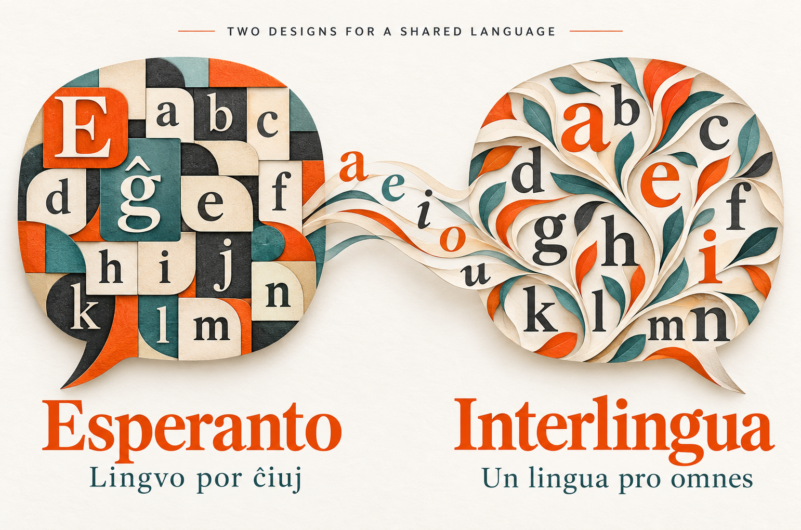
Lingvo por ĉiuj.
Un lingua pro omnes.
Both mean “a language for everyone.” Suppose you could learn one of these languages more easily than English. Which would you choose if you needed it for work?
Both Esperanto and Interlingua have active speakers worldwide and were deliberately developed as easier-to-learn languages for cross-border communication. Esperanto relies on consistent rules and systematic word-building. Interlingua draws on vocabulary shared across several European languages, giving many readers the intriguing experience of understanding words in a language they have never encountered before.
Both approaches have an appeal. Familiar-looking words were designed to help learners understand at least some of it right away, and predictable rules to help synthesize what is being said. But familiar to whom? And, given that almost all second languages were acquired either by force, by necessity or by wistful desire to learn a new language, how much can a language’s design achieve to persuade the world’s population to willingly use it? To switch from English, French, Chinese or Arabic…to Esperanto or Interlingua? En masse, is it worth the “switching cost”?
In this edition of the Santium Language Series, let’s explore Esperanto and Interlingua side by side: their origins, their distinctive features, and what their stories reveal about the relationship between language, culture, and our desire to understand one another.
A Brief History
The Story of Esperanto
Esperanto’s birth began in the streets and courtyards of 19th-century Białystok, then part of the Russian Empire and now in Poland. It was a city where Yiddish, Polish, Russian, and German coexisted within the same neighbourhood. These communities lived alongside one another, but proximity was not the same as a sense of belonging.
Ludwik Lejzer Zamenhof, born into a Jewish family in 1859, grew up observing social and linguistic boundaries in his community. Language overlapped with religious and national identity, forming uncrossable differences. In a letter, he described the hostility between the city’s groups and how painful it was to see people primarily as Russians, Poles, Germans, or Jews rather than as fellow human beings. This experience shaped his lifelong linguistic project.
For Zamenhof, it was both a spiritual and an emotional problem that went beyond a common language. Having to use one’s language over another’s also meant accepting another community’s terms and their prejudices. He imagined a shared language that speakers of all other languages would learn and use when they were together, allowing all to communicate without any party having to permanently adopt the native language of another.
In 1887, he published his proposal under the name Doktoro Hopeful, and that vision became Esperanto. Its consistent rules and systematic word-building were intended to make this shared language easy to learn and practical to use.
Esperanto speakers are known as Esperantists.
The Story of Interlingua
Interlingua came from a different perspective.
The world’s scientific and technical vocabulary is built largely from Greek and Latin roots. For example, compare English international, Italian internazionale and Spanish internacional, and the resemblance is obvious.
So, could this similarity, coupled with shared Greek and Latin words and roots, provide the foundation for an entire international language?
This was the central question in the work of the International Auxiliary Language Association, founded in 1924. Over the following decades, its researchers compared languages and investigated how an international auxiliary language could work.
If you already understand at least two European languages, you will likely know what this sentence says:
Un lingua international.
Interlingua’s designers sought to build on that word recognition by combining vocabulary that was already being used across linguistic borders, and to simplify the grammar.
In 1951, the association published the Interlingua–English Dictionary, directed by Alexander Gode, and a grammar prepared by Gode and Hugh Blair.
While both projects borrowed from existing languages, especially European ones, Esperanto provides a systematic way to learn unfamiliar sentences; Interlingua provides familiar words as the learning entry point. Yet again, familiarity in this context exists only if you already understand a Romance language or related vocabulary.
What Can You Understand Without a Lesson?
English Esperanto Interlingua
Bad malbona mal
Warm varma calide
Cold malvarma frigide
In Esperanto, mal- means “the opposite of” and varma (VAHR-mah) means “warm.” Then, you can work out that malvarma (mahl-VAHR-mah) means “cold.”
Try one on your own: if longa means “long,” what does mallonga mean?
In Interlingua, calide may remind you of Spanish cálido, and frigide may remind you of English frigid. However, in English, frigid usually suggests very cold. These differences also exist across languages in the same linguistic families and need to be learned. But, at first exposure, you will already get the idea behind the word.
The Alphabets, Words and Sentences
Both use the Latin alphabet, but Esperanto replaced q, w, x and y with six letters with diacritics. Interlingua uses the same letters as English, but with different pronunciation rules.
Esperanto (28 letters)
a b c ĉ d e f g ĝ h ĥ i j ĵ k l m n o p r s ŝ t u ŭ v z
Interlingua (26 letters)
a b c d e f g h i j k l m n o p q r s t u v w x y z
Let’s look at some examples:
Example 1
English: I am reading a book
Esperanto: Mi legas libron.
Interlingua: Io lege un libro.
Example 2
English: The dog sees the cat.
Esperanto: La hundo vidas la katon.
Interlingua: Le cane vide le catto.
Example 3
English: The ship is big.
Esperanto: La ŝipo estas granda.
Interlingua: Le nave es grande.
Example 4
English: We live in the city centre.
Esperanto: Ni loĝas en la centro de la urbo.
Interlingua: Nos habita in le centro del citate.
Esperanto has no grammatical gender. La means “the” for every noun, and adjectives don’t change to indicate gender.
In the dog-and-cat sentence, Esperanto adds -n to kato for aspect, to show that the cat is being seen. Even if we put the cat first, La katon vidas la hundo, the dog is still doing the seeing. In ordinary Interlingua sentences, as in English, putting the cat first and the dog last changes who sees whom.
The endings also show up in the plural. For example, Esperanto bona libro becomes bonaj libroj, while Interlingua un bon libro becomes bon libros.
Only the noun changes in Interlingua. Both languages keep the verb form the same when the subject changes. For example, Esperanto has mi estas and ni estas, and Interlingua has io es and nos es, for “I am” and “we are.”
So, now that you’ve had some exposure and know some of the rules, could you follow an Esperanto or an Interlingua speaker without having learned either of the languages? Which would be easier: on the page or spoken?
Think about how babies learn a language: first, it is visual (observing and learning facial expressions and movements), then auditory (deciphering individual words and learning meaning) and then verbal (babbling and gradually learning to say the words), and then building vocabulary into and throughout adulthood.
Hence, if someone lifts a coffee pot and says in Esperanto, Ĉu vi volas trinki kafon? (literally, “Do you want to drink coffee?”), kafon and seeing the coffee pot might be enough. Over the phone, you would have less to work with.
Interlingua gives more clues on the page, especially if you know a Romance language. But reading a sentence you can reread at leisure has a different cognitive load than following a conversation at normal speed.
Adoption and Limitations
In 1922, the League of Nations Assembly adopted a report on Esperanto as an international auxiliary language. The report discussed experience teaching it in schools.
Interlingua found a different entry point. In the 1950s, medical journals, including the American Heart Journal, published their paper abstracts in Interlingua. Physicians already familiar with the Greek and Latin roots of medical terminology could use that vocabulary to make sense of an Interlingua summary without having learned the language. The practice then spread across journals but never became a publishing standard. Interlingua abstracts appeared in 27 medical journals, including titles in Brazil, Denmark, Peru, Poland and the United States.
Why are not Esperanto and Interlingua used more widely?
Esperanto ran into political opposition. The League of Nations adopted the report on Esperanto, but France blocked proposals to adopt it as a working language and recommend it for schools. French was already one of the League’s two working languages, alongside English. There was no room for a third.
Interlingua’s publishing foothold depended heavily on one person. Alexander Gode, who helped develop the language, supplied many of the translations himself. JAMA was an exception, because its own staff prepared its Interlingua summaries. This demonstrated some real interest across countries, but no serious intention to fully adopt it.
English did not become the default in science because linguists compared its vocabulary and grammar with the alternatives and found it somehow more universal. Adoption of English as the world’s lingua franca has a much more turbulent history than that. As historian Michael Gordin shows, science in particular had long travelled across several languages, and its shift towards English was tied to changes in the political and institutional world in which scientists worked.
Esperanto’s opening at the League and Interlingua’s opening in medical publishing came in different eras and settings. What they shared was a problem of coordination. The benefits of learning either language grew only when other people and institutions agreed to use it too.
There’s also a question of who gets a head start, and how painful it will be. A person who grew up speaking English has an advantage when English is the working language. A Spanish or French speaker may recognize more Interlingua vocabulary. A Czech, Polish or Croatian speaker may find Esperanto easier to learn. An Arabic or a Chinese speaker with no prior exposure to European languages other than English may not find any practical benefit in learning either of the languages.
How Esperanto and Interlingua Are Used Today
Both languages are still used around the world.
It is estimated that there are roughly 100,000 Esperanto speakers worldwide. In 2006, linguist Jouko Lindstedt estimated that about 100,000 people could speak it, with a plausible range of 30,000 to 300,000. He separately estimated that about 1,000 people had acquired Esperanto from birth. But these are only estimates, not census figures.
In 2026, about 1,000 people from 56 countries attended the 2026 World Esperanto Congress in Graz, according to the Austrian Esperanto Association.
Interlingua has no reliable worldwide speaker count. Linguist Federico Gobbo has suggested roughly 100 active users, but that’s an informal estimate of people who regularly use the language. It doesn’t consider everyone who can speak it occasionally or read it without having studied it.
In today’s daily life, Esperanto gives people who have learned it a way to meet, travel and keep in touch with speakers whose languages they don’t know. Much like English is used in the broader linguistic spectrum.
For example, Pasporta Servo, is a hospitality network for Esperantists. Travellers can arrange to stay for free with volunteer hosts, and both host and guest are expected to speak Esperanto.
Interlingua speakers use it at gatherings and in conversation too. You can also read Panorama in Interlingua, a magazine written in Interlingua and published by the Union Mundial pro Interlingua. Books and audiobooks are also available, or you can listen to interviews and stories on Radio Interlingua.
Overall, relatively small interest groups work together to preserve and to promote the existence and potential applications of these two synthetic languages.
Learning Either Language and Translations
If you’re interested in Esperanto, start with a lesson. lernu! has a free Esperanto course with recordings, exercises and a grammar guide. Multi-language learning guides, dictionaries and books are available in online bookstores.
For Interlingua, try a sample issue of Panorama in Interlingua. The Union Mundial pro Interlingua has beginner materials and dictionaries, and you can listen to people using the language in interviews on Radio Interlingua.
Google Translate, DeepL and multiple professional translation assistants support Esperanto text. For Interlingua, AI assistants such as ChatGPT can produce a rough English translation of a passage. However, Interlingua does not have the same breadth of material available for training AI as Esperanto; hence, the quality of translations should be verified by someone fluent in both the source language and Interlingua. Although Esperanto resources are somewhat greater, it is still advisable to have a translation carefully reviewed.
Throughout history, people have often had to learn another language under circumstances they never chose. Enslavement, conquest, and forced displacement could make a new language necessary for survival. In other cases, people learned it because it was the language of work, school, or public life.
Esperanto and Interlingua carry a different proposition: learn this language because you want to use it. However, for most of the world, learning either one to drive broader adoption of a new shared language will require a much stronger value proposition.
How Santium Contributes to This Space
Santium contributions to the Life Sciences industry are designed to support the global implementation of patient-centered endpoints and patient-facing research materials. We do this through multilingual patient and stakeholder interviewing, cross-cultural evidence gathering, local subject-matter expert engagement, and measurement-aware linguistic and cultural adaptation.
Drawing on expertise in psychometrics, thousands of linguistic validation projects, multilingual interviewing, and multinational study operations, Santium helps sponsors and researchers evaluate whether patient-facing concepts remain relevant, clinically meaningful, culturally appropriate, and operationally usable across languages, countries, and modes of administration.
Curious About the World’s Languages?
If you found this article interesting, follow me on LinkedIn and join our newsletter to receive future editions. In the Santium Language Series, I explore interesting traits of the world’s languages, from the most widely spoken to obscure, introducing their structure and word formation to cultural nuance and their role in social norms.
Stay connected and don’t miss the next edition!
About the Author
Monika Vance | Managing Director | SANTIUM
My work sits at the intersection of linguistics, scientific and medical translation, psychometric measurement, and multilingual operations, where terminology, usability, end-user experience, and regulatory context must align. I write about scientific and medical translations, psychometrics, languages, patient-centred research and the operational challenges that inevitably come with them. I also teach translators how to properly translate and validate complex psychometric instruments to hone their expertise in linguistic validation.

|
Thank you for signing up. |


References
Białystok Esperanto Society. (n.d.). List do Borowki [Letter to Borovko].
Gode, A., & Blair, H. E. (1951). Interlingua: A grammar of the international language. Storm Publishers. Online edition.
Gordin, M. D. (2015). Scientific Babel: How science was done before and after global English. University of Chicago Press.
League of Nations Secretariat. (1922). Esperanto as an international auxiliary language: Report of the General Secretariat of the League of Nations adopted by the Third Assembly.
lernu! (n.d.). Grammar and Lesson 2.
Lindstedt, J. (2006). Native Esperanto as a test case for natural language. SKY Journal of Linguistics, 19, 47–55.
Österreichischer Esperanto-Verband. (2026). Eine Woche lang sprach Graz Esperanto.
Pasporta Servo. (n.d.). Kondiĉoj por la uzado de Pasporta Servo.
Polish Institute in Brussels. (2017). 100th anniversary of the death of L. L. Zamenhof, the creator of Esperanto.
Union Mundial pro Interlingua. (n.d.-a). Historia de Interlingua.
Union Mundial pro Interlingua. (n.d.-b). Le début scientific de interlingua pro summarios.
Union Mundial pro Interlingua. (n.d.-c). Practica interlingua.

Monika Vance
Managing Director | SANTIUM
My work sits at the intersection of linguistics, scientific and medical translation, psychometric measurement, and multilingual operations, where terminology, usability, and regulatory context must align. I write about scientific and medical translations, psychometrics, languages, patient-centred research and the operational challenges that inevitably come with them. I also teach translators how to properly translate and validate complex psychometric instruments to hone their expertise in linguistic validation.