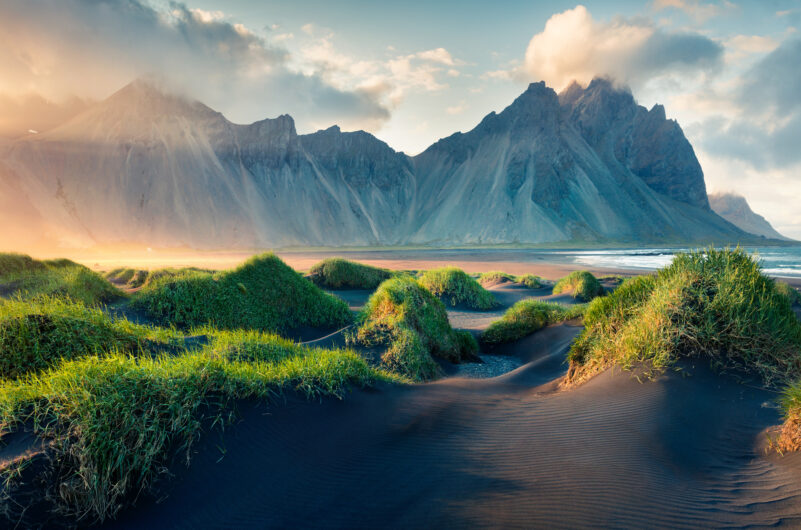
Iceland is a stunning island of striking contrasts. It is quite literally the land of ice and fire. Formed from volcanic activity, with active volcanoes still erupting relatively frequently, its landscape is a photographer’s dream. Glaciers stretch across volcanic plateaus, countless waterfalls tumble over black basalt cliffs, and broad lava fields join with vivid green valleys. Along the coast, surfing-worthy waves litter black-sand beaches with chunks of glacial ice, where they sparkle like diamonds in the sun. Mountains, fjords, geothermal springs, and treeless plains give the island a post-apocalyptic appearance, with microclimates that change within short distances. Unpredictable weather moves quickly too. Sunshine gives way to fog, rain, or strong winds in short time intervals.
Although Iceland lies close to the Arctic Circle, the surrounding North Atlantic Ocean moderates its climate. Coastal areas generally experience cool summers and comparatively mild winters, while the central highlands are colder, drier, and more exposed. Mountains, glaciers, prevailing winds, and ocean currents create numerous microclimates. One valley being sheltered and fertile while the next one is wet and windswept. Northern communities enjoy clearer, colder conditions while the south has heavier rainfall. These local variations have influenced settlement, agriculture, travel, tourism and daily life.
The Icelandic language developed within this distinctive environment. Brought to the island by Norse settlers more than a thousand years ago, it became a record of how Icelanders interacted with their surroundings. Its vocabulary preserves a close attention to weather, water, terrain, and changing natural conditions.
Today, Iceland has a population of just under 400,000, making Icelandic one of Europe’s smallest national languages. Although the island was historically a relatively homogeneous society, immigration has made it increasingly diverse. Now, roughly one resident in five is an immigrant.
Icelandic connects this modern society with its medieval storytelling and literary tradition and with the formidable island landscape in which the language developed.
A Brief History
The story of Icelandic begins long before Iceland was even settled.
Its earliest ancestor was spoken in Scandinavia and gradually developed into Old Norse, the language of the Vikings. When Viking settlers began colonizing Iceland in the late 9th century, most came from western Norway, bringing their language across the North Atlantic.
Not everyone came from Norway. Some settlers had travelled through Ireland, Scotland and the Hebrides, and the Northern Isles. People of Celtic origin were also part of Iceland’s early population. A handful of names and place names provide traces of that Celtic presence. But the language of the new island society was firmly Norse.
For a long time, the people of Iceland and Norway considered themselves speakers of the same language, the “Norse tongue.” But while languages on the European mainland changed through people merged by wars and conquest, trade, migration, and regular contact with their neighbours, Icelandic was developing at a much slower pace on its remote island inhabited by a small and scattered population. It changed too, of course, especially in gramamtical ways that makes it distinct from its mainland Scandinavian neighbours.
Then, around the year 1000, Iceland adopted Christianity, and the language was forced into a new phase. The Church brought Latin literacy and the Roman alphabet, which Icelanders adapted to suit their own sound system. Letters such as þ and ð were added to represent spoken sounds that did not exist in Latin. Then, Icelanders began recording laws, religious works, histories, poetry, and stories that were passed down from one generation to another.
By the 12th century, they were also studying Icelandic. The anonymous author of the First Grammatical Treatise examined the sounds of the language and proposed a standardized spelling system for them.
Then, the great age of Icelandic writing followed. During the 12th, 13th, and 14th centuries, writers recorded ancient sagas, Eddic poetry, histories of kings, accounts of exploration, and stories of the old Norse gods. The Sagas of Icelanders are stories about the Viking world and events from the Viking Age; of family feuds, difficult voyages, lawsuits, revenge, loyalty, and survival.
In the centuries that followed, Iceland came under foreign rule. First Norwegian and later Danish, while hardship, disease, volcanic eruptions, and isolation placed enormous pressure on its small population. Yet the language endured.
The publication of a complete Icelandic Bible in 1584 helped establish a common written standard. This in turn anchored Icelandic as the language of religion, literature, and public life.
In the 19th century, language became closely tied to the growing movement for Icelandic independence. Writers and scholars looked to the sagas and older vocabulary for inspiration. They resisted excessive Danish influence, and created Icelandic words for a changing world. Preserving their language became a way of preserving Iceland’s national identity. When Iceland became a republic in 1944, defense of Icelandic was at the centre of that identity.
The language is sometimes portrayed as a living museum of Old Norse. But that is only partly true. Its pronunciation has changed, modern vocabulary is continuously added, and its spelling is different. But Modern Icelanders can still read it with some education or guidance. This closeness between the founding ancestor and its modern counterpart is rare among modern languages.
Today, Icelandic carries more than a thousand years of history through continued adaptation efforts to include terminology for science, social media, and technology.
Distinctive Features of Icelandic
Icelandic is recognizable by its alphabet, which contains 32 letters.
Alongside familiar Latin characters, it uses þ (thorn) and ð (eth). The letter þ represents the unvoiced “th” sound in English “thing”, while ð usually represents the voiced sound in “this”. Icelandic also uses accented vowels, including á, é, í, ó, ú, ý, æ, and ö, which have distinct pronunciations.
Example 1
Good day or Hello
Góðan daginn
Pronounced approximately: GOH-than DIE-in
This is a polite greeting used during the day.
Example 2
It will all work out.
Þetta reddast
Pronounced approximately: THET-ta RET-ast
This characteristically Icelandic expression conveys practical optimism. It is sometimes referred to as an informal national motto.
The language has a close relationship between spelling and pronunciation, but several features can be challenging for new learners. Stress almost always falls on the first syllable of a word. Some consonants change their sound according to their position, while combinations of letters may produce sounds that are not obvious to English speakers. Icelandic also preserves grammatical distinctions that many related languages have lost.
Nouns belong to one of three grammatical genders: masculine, feminine, or neuter. And they change form according to four cases: nominative, accusative, dative, and genitive. Adjectives and pronouns must agree with the nouns they describe in gender, number, and case. Verbs also change according to person, number, tense, and mood. This way, a single word may have many different forms.
These endings help show how words work within a sentence, giving Icelandic some flexibility in word order. Nevertheless, the usual pattern is subject–verb–object (SVO), much as it is in English. Icelandic also forms new vocabulary by combining existing words, producing compounds that can be precise and deeply expressive.
Although Icelandic is closely related to Norwegian, Danish, Swedish, and Faroese, it is not generally understandable to speakers of the mainland Scandinavian languages. Faroese is its closest living relative, but the two languages differ substantially in pronunciation.
Icelandic’s conservative written form and elaborate grammar make it distinctive within the modern Nordic world.
Literature and the Medieval Sagas
Iceland’s literary tradition is one of the richest associated with any language spoken by such a small population. Its best-known works are the medieval Icelandic sagas, composed mainly during the 13th and 14th centuries. These prose narratives describe families, feuds, voyages, legal disputes, and struggles for power during Iceland’s early settlement period.
The Sagas of Icelanders focus on the lives of settlers and their descendants. Works such as Njáls saga, Egils saga, and Laxdæla saga combine historical memory with throughtfully constructed storytelling. Told in a restrained style with dramatic events and vivid descriptions of landscapes, family relationships, and legal customs. Characters are portrayed through actions and dialogue designed for readers to interpret their motives.
Other medieval works also preserved Iceland’s mythological and poetic tradition. The Poetic Edda contains poems about Norse gods and legendary heroes, while the Prose Edda, attributed to Snorri Sturluson, explains Old Norse mythology and the techniques of skaldic poetry. Together, these texts are among the most important surviving sources for the pre-Christian traditions of Scandinavia.
The sagas also demonstrate the close relationship between Icelandic language and cultural memory. Many began as stories passed down orally before being recorded on vellum. Later generations wrote them down, studied them, and eventually also printed them, helping maintain continuity in Icelandic literary culture. Because the written language has changed relatively slowly, modern Icelanders can read these works with less linguistic distance than English readers experience when trying to decipher medieval English.
Storytelling and literature are still central to Icelandic cultural life. Poetry, novels, crime fiction, memoirs, and children’s books all contribute to a vibrant contemporary tradition.
Creating New Icelandic Words
Icelandic has a strong tradition of forming new terms from native linguistic materials. Rather than adopting foreign words, Icelanders just create a compound from existing Icelandic words, revive an older term, or give a familiar word an additional meaning. This approach allows the language to evolve on its own, stay relevant to modern life and retain its distinctive character.
A famous example is:
tölva
Translation: computer
Pronounced approximately: TUL-va
The word combines tala, meaning “number,” with völva, a woman associated with prophecy in Old Norse tradition. It loosely translates to “number prophetess.”
Other modern coinages are:
sjónvarp
Translation: television
Pronounced approximately: SYOHN-varp
Formed from words associated with “sight” and “projection”
veðurfræði
Translation: meteorology,” literally “weather studies”
Pronounced approximately: VEH-thur-frye-thee
geimfari
Translation: astronaut,” literally “space traveller”
Pronounced approximately: GAYM-far-i
Language organizations, specialists, writers, and the public all contribute to this word-creation process. A newly proposed word succeeds only if speakers find it useful and begin using it. Some foreign loanwords also enter Icelandic, particularly through technology, business, entertainment, and youth culture, so native coinage is a preference rather than an absolute rule.
The creation of new vocabulary reflects a larger cultural aim: keeping Icelandic functional in every area of contemporary life. By building modern words from familiar roots, speakers can make unfamiliar ideas feel recognizably Icelandic while preserving connections to the language’s history.
Learning the Language
Most of the island is littered with small rural communities separated by relatively long distances. And not everyone speaks English in smaller villages. With an increasing number of immigrants settling in the country, Icelanders expect them to learn Icelandic and to integrate into their society.
Icelandic can be a steep learning curve for new learners. But of course, how formidable the learning curve is depends on the languages the learner already speaks.
Pronunciation presents a new set of challenges too. Although Icelandic spelling is relatively systematic, some sounds are unfamiliar to English speakers. The letters þ and ð have two kinds of “th,” and the Icelandic r is tapped or rolled. Double consonants, vowel combinations, and pre-aspiration, which is a brief puff of air before certain consonants, also require practice.
Just like with any language, the best and fastest way to learn it is to study its grammatical rules and a complete immersion in the spoken language. Studying common phrases and complete sentences also helps learners understand how word endings change in context. Listening to Icelandic radio, music, audiobooks, and television develops familiarity with its rhythm, while reading short news reports or children’s books gradually builds vocabulary.
Speaking, even of imperfectly, can feel stressful but it is valuable and helps build confidence.
A few more phrases, if you plan to visit Iceland:
Takk
Translation: Thank you
Pronounced approximately: tahk
Já / nei
Translation: Yes / no
Pronounced approximately: yow / nay
Hvað segirðu gott?
Translation: How are you? or, more literally, What’s good with you?
Pronounced approximately: kvadh SAY-ir-dhu goht
Ég skil ekki
Translation: I don’t understand
Pronounced approximately: yeh skil EH-kih
Learning Icelandic not only enables a conversation, it also provides a deeper understanding of how words are formed, how places are named, and how the modern language remains connected to old traditions.
Icelandic in Everyday Life
Icelandic is the principal language of government, education, literature, news, and public life. Its use across public institutions gives it a secure position, but maintaining that position requires continuing investment in education, publishing, media, and language technology.
Most Icelanders also learn English, and many learn Danish or another Scandinavian language at school. English is especially prevalent in tourism, entertainment, business, and online culture. Iceland has also become more linguistically diverse, since immigrants now constitute roughly one-fifth of the population. Polish is the most widely spoken immigrant language, while many other languages are spoken in schools, workplaces, and neighbourhoods.
Personal names provide another distinctive feature of Icelandic life. Many Icelanders use a patronymic or matronymic instead of an inherited family name. A child’s second name is traditionally formed from a parent’s first name plus -son (“son”) or -dóttir (“daughter”).
For example, Jóns’ daughter is likely to be named Anna Jónsdóttir, while his son might be Einar Jónsson. Some people use gender-neutral forms, and inherited family names do exist, but they are less common.
Because these names usually change from one generation to the next, Icelanders are generally addressed by their first names, even in formal settings. Directories and alphabetical lists are also commonly organized by first name. This practice reflects the relatively informal character of Icelandic social interaction and it is not considered as a lack of respect.
Icelandic Sign Language, or íslenskt táknmál, is also an essential part of the country’s linguistic life. It is a fully developed language with its own grammar.
Icelanders in Their Culture
Icelandic culture is deeply social. Some of its best-known traditions revolve around gathering together.
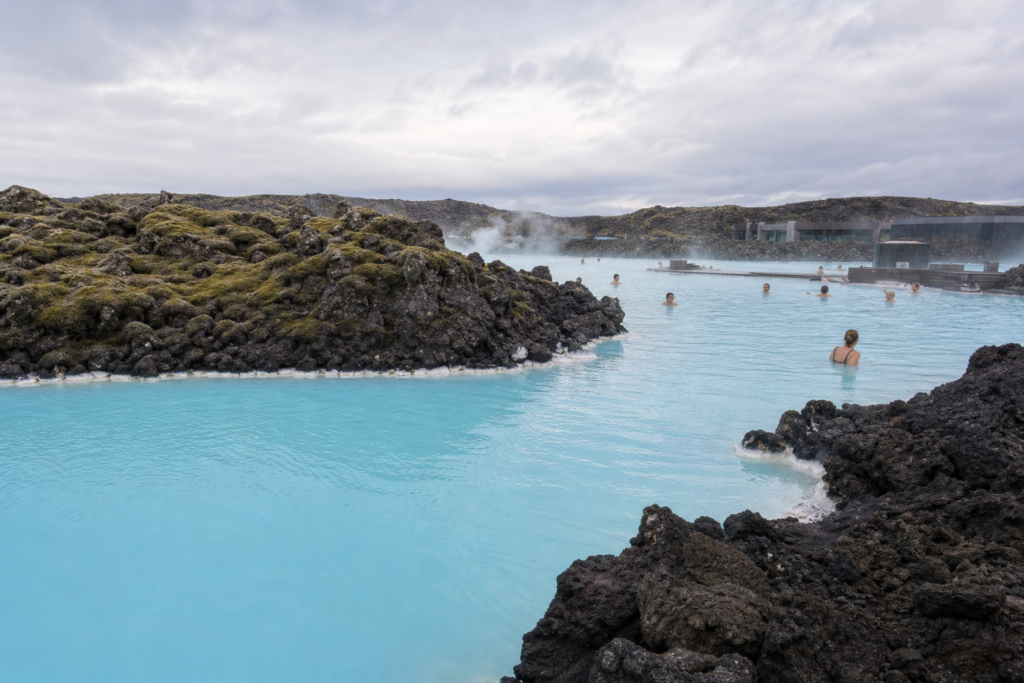
Geothermal pools and hot springs are part of everyday life. Icelanders visit local pools throughout the year to swim, relax, recuperate from a night at the bar, talk, and catch up on neighbourhood news. Iceland’s abundance of volcanic hot springs offers a tradition of sitting outdoors in warm or hot water, in the rain or snow. They also bathe in natural volcanic hot springs found in rivers, secluded pools, and even glacier-shielded caves. Some require a hike through lava fields or remote valleys, making the journey just as memorable. Of course, some skip the hot springs and opt for ice baths instead.
Reykjavík has a lively nightlife, especially for such a small capital. Its relatively small city centre is filled with cafés, bars, music venues, and clubs. People usually begin the evening at home before heading out later, and during the summer months, the almost endless daylight can make the nights feel even longer. The city also has a vibrant music and arts scene, where creative communities gather.
Icelandic food reflects the realities of island life. Fish, lamb, rye bread, and dairy products have long been staples. Skyr, a thick cultured yogurt, is eaten throughout the day, while rúgbrauð is a dark, slightly sweet rye bread that can be baked using geothermal heat. More traditional foods, such as fermented shark can be now found only at festivals.
Icelanders know how to cook. Today’s food scene across the island is fresh and inventive, combining local seafood, lamb, geothermal greenhouse-grown vegetables, and wild herbs with culinary influences from around the world. Even a family diner in a fishing village along the ring road is likely to serve delicious healthy meals, often with flavours and a presentation worthy of the Michelin guide.
Coffee culture is also strong, and the Icelandic hot dog, served with raw and fried onions, mustard, ketchup, and remoulade, is a simple national favourite.
However, Iceland is also one of the more expensive European countries to visit, particularly when it comes to accommodation and eating out. As a remote island with a small population, with remote communities across the island, it does not have the buying power larger European countries enjoy, and must import and locally distribute many foods and consumer goods, adding shipping costs to already high prices.
Since 1924, Iceland has been harnessing its geothermal heat and built naturally-heated greenhouses to grow fresh produce, including vegetables, mushrooms, herbs, berries and flowers. In recent years, expansion of existing facilities has taken place with technological advancement. Larger operations, improved lighting for seasons with dark days, hydroponics, automation and more intensive cultivation has helped build a sustainable food system. This food system is designed to help aleviate the cost of importing herbs, vegetables, and also plants and flowers, from mainland Europe and other parts of the world.
Iceland also has high wages and operating costs, which are reflected in restaurant and hotel bills, while the small market limits competition. As such, even a casual meal can feel expensive to visitors. Grocery shopping, bakery lunches, and the much-loved Icelandic hot dog offer more budget-friendly ways to eat.
So, keep that in mind when you’re planning to visit this absolutely incredible island. And visit it you should! It should be on anyone’s bucket list, because you will probaby not see or experience anything like it anywhere else.
Here is an excellent guide for planning a visit to Iceland, including learning some Icelandic!
How Santium Contributes to This Space
Santium contributions to the Life Sciences industry are designed to support the global implementation of patient-centered endpoints and patient-facing research materials. We do this through multilingual patient and stakeholder interviewing, cross-cultural evidence gathering, local subject-matter expert engagement, and measurement-aware linguistic and cultural adaptation.
Drawing on expertise in psychometrics, thousands of linguistic validation projects, multilingual interviewing, and multinational study operations, Santium helps sponsors and researchers evaluate whether patient-facing concepts remain relevant, clinically meaningful, culturally appropriate, and operationally usable across languages, countries, and modes of administration.
Modern COA development, selection and eCOA implementations increasingly depend on understanding how physicians, patients and caregivers address and describe symptoms, treatment experience, functioning, burden of illness, burden of care, and quality of life within their own linguistic and cultural frameworks.
Curious About the World’s Languages?
If you found this article interesting, follow me on LinkedIn and join our newsletter to receive future editions. In the Santium Language Series, I explore interesting traits of the world’s languages, from the most widely spoken to obscure, introducing their structure and word formation to cultural nuance and their role in social norms.
Stay connected and don’t miss the next edition!

|
Thank you for signing up. |


References
Árni Magnússon Institute for Icelandic Studies. Icelandic: At Once Ancient and Modern.
Árni Magnússon Institute for Icelandic Studies. Iceland and Icelanders.
Government of Iceland. Act Respecting the Status of the Icelandic Language and Icelandic Sign Language.
Icelandic Meteorological Office. Icelandic Climate.
Icelandic Meteorological Office. Climate of Iceland.
Statistics Iceland. Population by Origin, 2026.
Statistics Iceland. Population and Inhabitants.
UNESCO. Arnamagnæan Manuscript Collection.
University of Iceland, Web of Science. The Origins and Age of the Icelandic Language.
OECD. OECD Economic Surveys: Iceland 2025.

Monika Vance
Managing Director | SANTIUM
My work sits at the intersection of linguistics, scientific and medical translation, psychometric measurement, and multilingual operations, where terminology, usability, and regulatory context must align. I write about scientific and medical translations, psychometrics, languages, patient-centred research and the operational challenges that inevitably come with them. I also teach translators how to properly translate and validate complex psychometric instruments to hone their expertise in linguistic validation.