Here, I will pick up where we left off in the first post about Chinese languages and the common writing system. In this post, I’ll introduce the four main tones of Mandarin and show you how Mandarin speakers use them to form words.
Mandarin Chinese is the most widely spoken language in the world, with over a billion native speakers. It is the official language of mainland China and Taiwan and one of the four official languages of Singapore.
Chinese is not a single spoken language. Rather, it is a family of related languages. Mandarin is just one of them. People in China speak Mandarin, Cantonese, Hokkien (Southern Min), Shanghainese (Wu), Hakka, and more. Many of these varieties are not mutually intelligible. For example, a native Mandarin speaker and a native Cantonese speaker cannot automatically understand each other in conversation. Their writing system unifies intelligibility across the entire Chinese language family.
Linguistically, Chinese belongs to the Sinitic branch of the Sino-Tibetan language family. Modern Standard Mandarin is based largely on the Beijing dialect and serves as the common spoken standard across China’s diverse regions. It uses Hanzi Chinese characters for writing in simplified and traditional styles, and Pinyin which is a standardized Romanization system that maps Mandarin pronunciation onto the Latin alphabet, which is helpful for most foreign learners.
Tone Carries Lexical Meaning
Chinese is a tonal language system. Each Chinese language uses the tones in their own unique ways. In Mandarin, pitch patterns (tones) are built into the vocabulary itself. The same syllable can represent entirely different words depending on whether the voice stays high and level, rises, dips, or falls sharply. Each syllable must be pronounced with the correct pitch to convey the intended meaning.
This is one of the reasons why different Chinese languages are not mutually intelligible. A Mandarin speaker and a Cantonese speaker cannot verbally understand each other because their sound systems are different. They sing a different song.
In English and most European languages, pitch serves a different purpose. Speakers use it for intonation – raise the voice to show surprise, lower it to sound serious, or stretch it to emphasize a point. Pitch expresses emotion, attitude, and sentence type, but it does not change the core meaning of a word. No matter how dramatically you say “rea-lly,” it is still the same word.
In Mandarin, however, exaggerating pitch can alter meaning. Because tone distinguishes words, speakers must keep their pitch movements controlled and accurate. Overly dramatic intonation can blur distinctions or make speech sound unnatural. As a result, Mandarin is typically spoken within a more regulated pitch range. The voice still changes in pitch, but it follows specific tonal patterns instead of shifting for emotional effect.
The Four Main Tones of Mandarin
Mandarin has four primary tones. Each one is a specific pitch contour; a defined movement your voice follows when pronouncing a syllable. Think musical. Chinese speakers sing their words.
Below is a clear breakdown of how each tone behaves and how it sounds in practice. The lines in the diagram below indicate where the pitch starts, relative to the pitch of what you may have already said. The pitch scale (1–5) is a mathematical system that helps with tone clarity. The letters represent the pinyin pronunciation system. For those of you who are musically inclined, I added an approximate note mapping.
Just for fun, I encourage you to try the tones and get a feel for them!
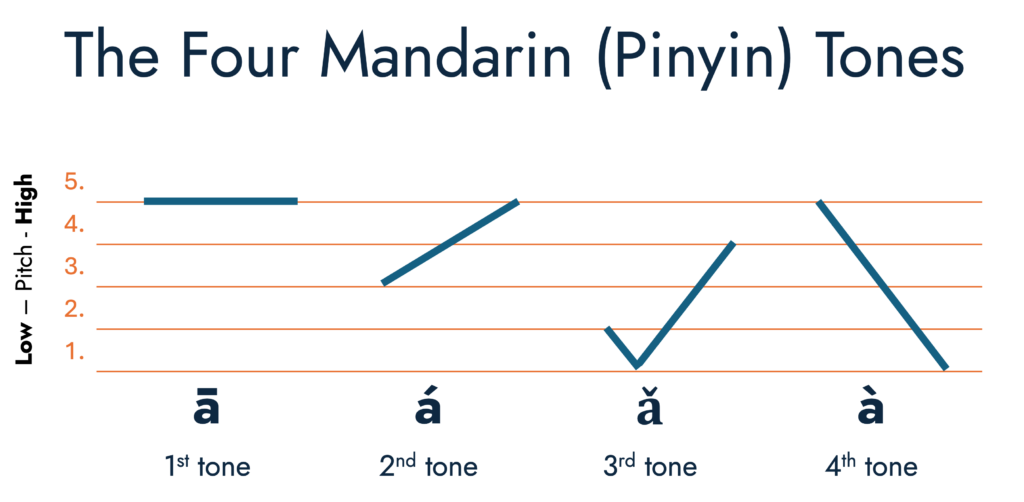
Use your hand to replicate the lines in the air when you say the tone, like an orchestra conductor. It will likely help you stay on pitch. Ready?
1. First Tone — High Pitch and Level (ā)
The first tone is steady and high. Your voice stays at a consistent pitch from beginning to end. This tone should sound calm and even. One note.
Example:
mā (妈) — mother
Musical note mapping: G-to-G (or A-to-A)
Pitch Scale: 55
When you say it, imagine sustaining a musical note without letting it drift. Analogy for English speakers: imagine someone is taking a picture of you and you’re supposed smile, so you say a long higher-pitched steady “cheese”. That’s the sound. Don’t exaggerate it, just raise your voice slightly higher on the octave to distinguish “cheese” from “take the picture already!”
2. Second Tone — Rising (á)
The second tone starts at a mid pitch, the level at which you normally speak, and rises upward. Two notes.
Example:
má (麻) — hemp
Musical note mapping: E-to-G (or D-to-F)
Pitch Scale: 35
It resembles the natural rise in English when asking a short question, like saying “Rea-lly?” The pitch begins lower and short, and once you get to -lly it moves upward smoothly. Another English example would be “O-kay?” Low short “O”, higher “-kay” and fluid.
This tone sounds inquisitive or upward-moving.
3. Third Tone — Dipping mǎ
The third tone falls and then rises again. With three notes, it is long and melodic.
Example:
mǎ (马) — horse
Musical note mapping: E-to-C-to-E
Pitch Scale: 214
It starts at mid-range, drops lower, and then curves back up. In careful pronunciation, you will hear both parts of the dip.
This tone requires the most control because of its contour change.
4. Fourth Tone — Falling (à)
The fourth tone begins high and drops sharply downward. It’s very short.
Example:
mà (骂) — to scold
Musical note mapping: G-to-D (or A-to-E)
Pitch Scale: 51
This tone sounds decisive and firm. For English speakers, think of the way your voice drops when giving a strong command like “Stop!” The fall is quick and direct.
This tone is the most abrupt of the four.
The video below provides a helpful demonstration. Watch it long enough to get a sense of the pattern.
Combining Tones in Real Speech
Tones in Mandarin are assigned to individual syllables, but in natural speech they are combined. When words are made up of two or more syllables, each one keeps its tone but the second syllable influences how the first one is pronounced. The result is a sequence of pitch contours that flow into one another.
Examples:
中国 (Zhōngguó) “China”
1st tone (Zhōng) + 2nd tone (guó)
Musical approximation: G–G + E–G
Pitch scale: 55 + 35
Move from a sustained high pitch into a smooth upward glide.
电脑 (diànnǎo) “Computer”
4th tone (diàn) + 3rd tone (nǎo)
Musical approximation: G–D + E–C–E
Pitch scale: 51 + 214
Drop decisively, then curve downward and back up.
老师 (lǎoshī) “Teacher”
3rd tone (lǎo) + 1st tone (shī)
Musical approximation: E–C–E + G–G
Pitch scale: 214 + 55
Curve down and up, then stabilize.
When Two Third Tones Meet
The most well-known example of this is the third tone sandhi: when two third tones appear together and the first one changes to a rising tone.
你好 (nǐ hǎo) “Hello”
With two third tones together, this is pronounced more like ní hǎo:
3rd tone (nǐ) doesn’t dip and becomes 2nd tone + 3rd tone (hǎo) remains full
Musical approximation: E–G + E–C–E
Pitch scale: 35 + 214
This adjustment keeps the rhythm natural. Try to reproduce both to feel the difference. In natural speech, the full double sequence is difficult to pronounce smoothly, so speakers shorten the first 3rd tone and convert it to a second tone. This allows a smooth transition from nǐ into hǎo.
The Neutral Tone
Commonly referred to as the fifth tone, or a light tone, it is not a full contour tone like the other four tones. It doesn’t have a fixed pitch pattern of its own because it depends on the tone that comes before it.
The neutral tone is short and unstressed and typically settles lower, around pitch 2. It sounds softer and quicker than the full tones and its job is to signal that the syllable is grammatically important but phonologically light. It provides rhythm and structure in Mandarin speech without adding contrast.
Example:
吗 → ma (no diacritic; it’s a question particle)
你好吗?Nǐ hǎo ma?
“Are you well?”
Musical approximation: E–G + E–C–E | D
Pitch scale: 35 + 214 | 2
好吗? Hǎo ma?
“Okay?”
Musical approximation: E–C–E | D
Pitch scale: 214 | 2
The final ma is neutral. It is not pronounced with a rising question intonation. It is short, light and without a tone.
For learners, just like with any language, or singing, the key is practice. Mandarin is not spoken one tone at a time, so practice tones in pairs and short phrases. Learners typically listen and train their ear to catch the rhythm to begin hearing and differentiating tones spoken in sequences. Once they hear the tonal transitions, it starts to become logical and pronunciation becomes more fluid and far more natural.
Clear Articulation Matters More Than Projection
Speech traditions shape how languages sound. In much of the Western world, public speaking has long been influenced by Greek rhetoric, theater, and later formal oratory. Strong projection, vocal expansion, and expressive delivery are often seen as persuasive and confident. The voice is expected to carry, to swell, and to command attention.
Classical Chinese communication developed under different cultural priorities. Effective speech traditionally emphasized clarity, economy, and control. Instead of dominating the room, the goal was to maintain balance and mutual understanding with precision and refinement of the message.
This cultural orientation aligns naturally with a tonal language in which pitch carries lexical meaning and tonal stability is essential. The need for careful articulation and controlled pitch movement is both a linguistic and a stylistic norm that produces a calmer and more measured vocal style to Western ears, even while it is fully expressive.
Learning Mandarin
Learners often overshoot by speaking too high. When foreigners first learn Mandarin tones, many instinctively exaggerate them. They raise their pitch too high, stretch the contours too wide, or overact the rises and falls in an effort to “make the tones clear.”
Native listeners then hear unstable pitch, overly dramatic contour shifts and a delivery that sounds theatrical.
Ironically, the path to natural pronunciation is the opposite. Lower your overall pitch. Relax your voice. Keep the movement controlled and precise by tracing the defined tone contour that carries the meaning.
How Santium contributes to this space
We support organizations operating across complex linguistic environments by ensuring that translations preserve conceptual intent, structural integrity, and real-world usability. Our role is to safeguard clarity when language carries scientific, medical, or technical weight. Whether the content is written, spoken, or digitally administered, Santium ensures that translated content performs as intended across languages, including tonal systems like Chinese.
Follow Santium to stay connected
If you found this article interesting, follow me on LinkedIn or subscribe to our newsletter. In our language series, I explore interesting traits of the world’s languages, from the most widely spoken to obscure, introducing their structure and word formation to cultural nuance and their role in social norms.
Stay connected and don’t miss the next edition!

|
Thank you for signing up. |



Monika Vance
Managing Director | SANTIUM
My work sits at the intersection of linguistics, scientific and medical translation, psychometric measurement, and multilingual operations, where terminology, usability, and regulatory context must align. I write about scientific and medical translations, psychometrics, languages, and the operational challenges that inevitably come with them. I also teach translators how to properly translate and validate complex psychometric instruments to hone their expertise in linguistic validation.