Rapa Nui sits alone in the southeastern Pacific Ocean, more than 3,500 kilometres from the coast of Chile and over 2,000 kilometres from the nearest inhabited Polynesian island. It is globally known as Easter Island. It is also known for its moai, the enormous stone figures carved by the island’s Polynesian inhabitants, intimidatingly positioned across its landscape.
Centuries ago, Rapa Nui may have also produced something even rarer: its very own system of writing. Its isolated geography is thought to contribute to the development of a script without the usual reference to another script or influence from another culture.
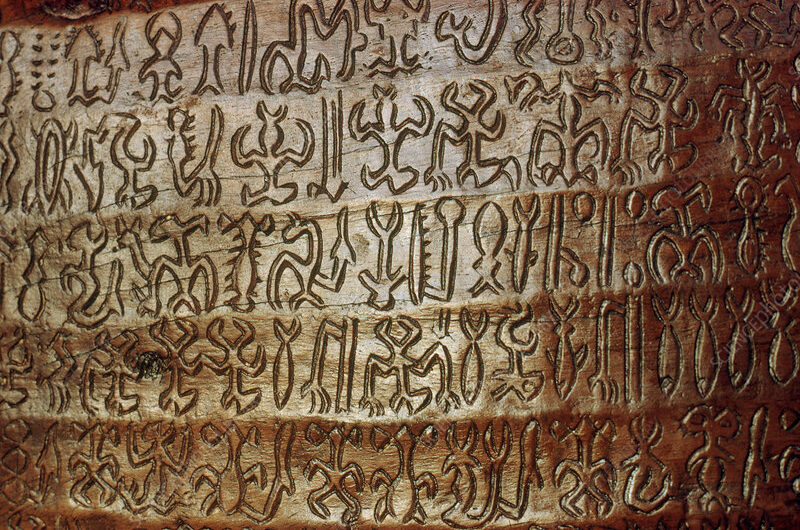
The writing system is known as rongorongo. Rows of small figures, carved into wooden tablets and other objects. Some resemble people, birds, fish and plants. Others are geometric or difficult to identify. The signs are arranged in regular sequences, repeat in recognizable patterns and appear to follow an established structure. A structure linguists generally associate with written language.
But no one can read them. Yet.
A Brief History
The history of rongorongo is difficult to reconstruct because it was discovered at about the same time that its last readers began to disappear.
The first recorded European arrival on Rapa Nui was in 1722, when the Dutch navigator Jacob Roggeveen reached the island on Easter Sunday. His expedition described the islanders and their monumental statues, but their entries do not mention their writing. Spanish explorers arrived in 1770 and asked local leaders to mark a document claiming the island for Spain. The marks they drew have sometimes been compared with rongorongo, but the connection is unclear.
The first documented description came almost a century later. In 1864, French missionary Eugène Eyraud reported seeing wooden tablets covered with unfamiliar signs in many Rapa Nui homes. His observation suggested that the tablets were relatively common, although he did not explain how they were used or how the islanders read them.
By then, the Rapa Nui society had already suffered a devastating rupture.
Beginning in 1862, Peruvian slave raiders abducted a substantial part of the island’s population. Among those taken were likely chiefs, priests and other literate locals responsible for preserving genealogies, ritual practices and inherited knowledge. Most of the captives died. A small number eventually returned, bringing diseases that caused more deaths. Then, missionary conversion, new spoken and written languages, outside settlement and the systemic breakdown of traditional institutions followed.
Within a few decades, the population fell from several thousand people to little more than one hundred. Though Rapa Nui culture did not disappear, the collective body of knowledge and cultural memory was interrupted, and most of it destroyed. Rongorongo writings appear to have been a part of that.
Today, only about twenty tablets, fragments and other inscribed objects are known to have been preserved. Most were removed from Rapa Nui during the 19th century and are now displayed in museums and held in private collections around the world.
They leave linguists and anthropologists with a mystery and many unanswered questions. Did rongorongo encode spoken Rapa Nui in the way that writing normally represents language? Was it a mnemonic system used to guide chants, genealogies or ceremonies? Or did it combine written signs with knowledge that the reader was expected to memorize?
The Theory: How Did Rongorongo Work?
In the world of linguistics, Rongorongo is generally associated with reciting, chanting or declaiming, which offers one theory, or at least a clue, to how the tablets were used. The longer expression kōhau rongorongo has been interpreted roughly as “lines for chanting” or “recitation boards.” That suggests that reading may have been closely connected with oral performance. Though theories about undeciphered languages have been proven wrong from time to time, it’s a start.
The tablets also had to be read in an unusual way. Their inscriptions follow a system known as reverse boustrophedon. A reader would follow one line, then turn the tablet 180 degrees before continuing with the next. So, every alternate row of glyphs appears upside down when the tablet is viewed from any single position.
The signs are highly pictorial. Some resemble human figures with prominent heads or limbs, while others look like birds, fish, plants, tools or geometric shapes. Many occur in slightly altered forms or are joined with other signs, which makes determining exactly how many distinct glyphs there are more difficult. To figure out the meaning of a sign, scholars have to decide if two similar-looking forms are separate symbols or variants of the same one.
The natural wood shape mattered as well. On some tablets, the inscriptions were carved into shallow grooves, and the lines follow the contours and irregularities of the wooden piece. The shape of the tablet influenced how the inscription was organized and read.
The physical relationship between the tablet’s individual shape and the rules behind reading the glyphs was one of the key reasons that made rongorongo so difficult to decipher.
By the 19th century, scholars had begun trying to recover whatever knowledge of rongorongo remained.
The Knowledge That Was Almost Recovered
One of the most prominent efforts was made by Bishop Florentin-Étienne Jaussen, who collected several tablets and sought explanations from Rapa Nui informants.
The best-known of those informants was Metoro Tauʻa Ure. While looking at the tablets, Metoro recited words and phrases that Jaussen and others attempted to record. In theory, this would provide a match between the sound of the language and the glyphs. In practice, however, it did not work as planned.
The same glyph did not always produce the same word, and repeated sequences were not consistently matched with repeated spoken language. Metoro’s recitations were not direct readings. He may have been naming what individual glyphs resembled or described, or reconstructing associations and meanings of the glyphs from memory as he went.
The context also matters. Communication passed through several linguistic and cultural layers. The people attempting to record the recitations were outsiders trying to understand a system they had never seen used in its original context. Questions may have been leading, translations may have been approximate, and expectations about what “reading” should look like may have influenced interpretation.
This is one of the more frustrating parts of the rongorongo story because at the time, the tradition had not yet completely disappeared. There were still people who recognized the glyphs on the tablets and had some memory of how the objects had been used. But the connection between the glyphs and the spoken interpretation was already too weak to reconstruct it reliably.
Was Rongorongo Invented Independently?
Rongorongo’s origin is another unresolved mystery. Was it developed before or after European contact? Or another contact that was never recorded?
A 2024 radiocarbon study added an important piece of evidence. One of the tablets was made from wood dating to around the 15th century, well before the first documented European arrival on Rapa Nui in 1722.
However, that does not mean that the inscription is equally old. Radiocarbon dating establishes the age of the wood, not when the glyphs were carved, and the timber may have been reused or preserved for a long period.
Still, the finding makes a pre-contact origin more plausible. If rongorongo was created independently, it would belong to the very small group of writing systems thought to have developed without direct influence from an existing written tradition.
That possibility makes the mystery considerably more important than the decipherment of the script. For the linguistic community, it raises a much broader question about how writing emerges within a society without outside influence.
Why the Mystery Remains Unsolved
Rongorongo lacks almost every advantage that has helped scholars decipher other ancient scripts.
There is no bilingual inscription for cross-referencing, like for ancient Egyptian on the Rosetta Stone. No agreed value for a single glyph like for ancient Mayan. No securely identified personal names or place names, and only a very small surviving corpus. Even the sign inventory is unclear because some forms may be variants of the same glyph instead of separate symbols.
Modern technology can improve the evidence. High-resolution imaging, 3D scanning and digital comparison can recover damaged marks, distinguish carving details and identify repeated sequences. Computational analysis can also test the patterns and determine if certain signs tend to occur together or only in specific positions.
What it cannot do, yet, is supply the missing link between a glyph and its meaning. It cannot tell us reliably what a sequence sounded like, what language form it represented, or if it was ever meant to be read word for word.
And so we wait for another iconic linguistic breakthrough…
How Santium Contributes to This Space
Santium provides specialized translation and cross-cultural research services focused on adapting and validating scientific, medical and technical content. We deliver translated materials that work as intended across languages and cultures through translation, linguistic validation, and subject-matter specialist engagement, preserving meaning, functionality, usability, and, where applicable, measurement integrity in real-world applications and settings.
Curious About the World’s Languages?
If you found this article interesting, follow me on LinkedIn and join our newsletter to receive future editions. In the Santium Language Series, I explore interesting traits of the world’s languages, from the most widely spoken to obscure, introducing their structure and word formation to cultural nuance and their role in social norms.
Stay connected and don’t miss the next edition!

|
Thank you for signing up. |


References
Ferrara, S., Tassoni, L., & Talamo, S. (2024). The invention of writing on Rapa Nui (Easter Island): New radiocarbon dates on the Rongorongo script. Scientific Reports, 14, 2794.
Fischer, S. R. (1997). Rongorongo: The Easter Island script: History, traditions, texts. Oxford University Press.
Lastilla, L., et al. (2022). Modelling the Rongorongo tablets: A new transcription of the Échancrée tablet and the foundation for decipherment attempts. Digital Scholarship in the Humanities, 37(2), 497–516.
Pozdniakov, K. (2024). The Rongorongo “lunar calendar” of Rapa Nui (Easter Island). In S. Ferrara & M. Valério (Eds.), The Oxford handbook of undeciphered scripts. Oxford University Press.
The British Museum. (n.d.). Kohau rongorongo tablet, Oc1903,-.150.

Monika Vance
Managing Director | SANTIUM
My work sits at the intersection of linguistics, scientific and medical translation, psychometric measurement, and multilingual operations, where terminology, usability, and regulatory context must align. I write about scientific and medical translations, psychometrics, languages, patient-centred research and the operational challenges that inevitably come with them. I also teach translators how to properly translate and validate complex psychometric instruments to hone their expertise in linguistic validation.