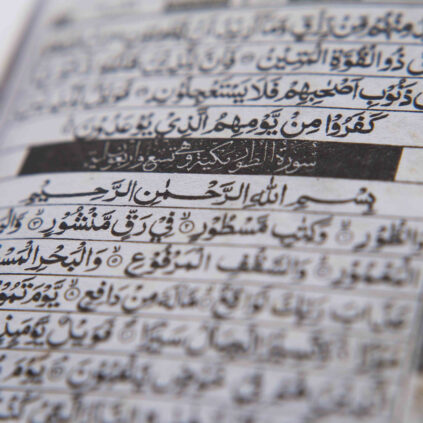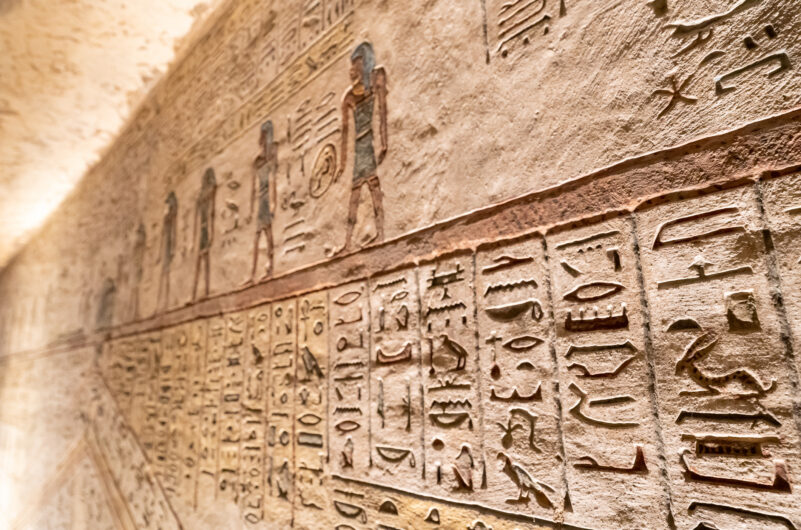
Ancient Egyptian society was highly ordered, deeply religious, and built around continuity. It endured for more than three thousand years, and though it changed over time, it maintained its core social logic. Egyptian society was built around the idea that the world should exist in proper balance, and that the state was responsible for preserving it. This was a civilization concerned with permanence, legitimacy, classification, ritual, and cultural memory.
The society was strongly hierarchical. At the top stood the royal family, high officials, priests, military leaders, and large landholders. Beneath them were scribes, administrators, craftsmen, merchants, and skilled workers. The king, or pharaoh, stood at the center of this order. His or her role extended beyond politics. The pharaoh was understood as the guarantor of justice, fertility, stability, and right order. This idea was closely tied to ma’at, the principle of truth, rightness, and proper order that shaped Egyptian ideas of power and society.
Most of the population consisted of agricultural labourers, and life was organized around the Nile. The state’s wealth depended on fertile land, seasonal flooding, grain production, storage, taxation and coordination of labour. Survival in an arid environment required administration on a large scale, and this gave writing a central role in managing land, harvests, and state activity.
Temples were places of worship, and also major economic and political institutions that controlled land, wealth, labour, and ritual activity. Death and the afterlife carried enormous weight, and family life, inheritance, and kinship formed the social foundation of continuity across generations.
This social fabric is essential for understanding the language and its writing system.
The Three Egyptian Scripts
Egyptian remained in use for several thousand years, and over that span, it changed substantially in grammar, vocabulary, and written form. What we call Ancient Egyptian is really a long linguistic continuum.
The earliest major phase is Old Egyptian, followed by Middle Egyptian, the form that became the classical prestige language of literature, religion, and monumental inscription. Middle Egyptian retained its written authority long after everyday speech had evolved, much the way Latin continued to dominate formal and academic writing in Europe long after it had ceased to be anyone’s native language.
Later stages brought clearer shifts in structure and usage. Late Egyptian became closer to the language people actually spoke. As the spoken language continued to evolve, the written tradition also adapted, eventually giving rise to Hieratic and then to Demotic, which were faster and more compact scripts used for the practical business of daily life.
The final major stage was Coptic, written in an adapted Greek alphabet with additional signs that supported Egyptian speech. Coptic preserves the last historical form of Egyptian and provides scholars with more information and evidence about sound and grammar than earlier scripts.
After the Arab conquest, Arabic gradually became the language of administration, religion, and public life, while Egyptian retreated from daily use.
Egyptian Hieroglyphs
Egyptian hieroglyphs worked by combining different kinds of signs. Some represented sounds, some stood for whole words, while others helped clarify the meaning of a word by placing it into a semantic category. A sign could therefore contribute phonetic value, lexical meaning, or conceptual guidance depending on its context and purpose.
In contrast, an alphabet points primarily to sound. A purely logographic system points more directly to words or morphemes. Egyptian hieroglyphs worked across both levels while adding semantic cues that helped organize meaning. The script is compact, highly precise, visually structured and memorable.
Egyptian phonograms are written only in consonants. English and most other world languages are written in a mix of consonants and vowels that provide explicit sound and meaning; Egyptian would usually provide only the consonants and expect the reader to supply the rest from knowledge and context.
The easiest way to introduce the script is through the uniliteral, biliteral, and triliteral consonantal signs, which are the closest thing Egyptian has to alphabetic characters.
Uniliteral Signs
A uniliteral sign represents one consonant. In that sense, it works somewhat like a single letter in English.
Example
The owl sign is a uniliteral phonogram that represents the consonant m. Why m? No one knows for sure. Scholars share two common views. One view is that the phonetic value may go back to an old Egyptian word for the owl. Another view is that since hieroglyphic writing belongs to Middle Egyptian, the phonetic value may refer to an even older sound pattern that became standardized.
𓅓 = m
The reed leaf:
𓇋 = i or j
The water ripple:
𓈖 = n
The mouth:
𓂋 = r
The folded cloth:
𓋴 = s
The bread loaf:
𓏏 = t
These appear regularly in names, grammatical endings, and phonetic complements.
Biliteral and Triliteral Signs
Egyptian also uses biliteral and triliteral signs. A biliteral sign represents two consonants at once, and a triliteral sign represents three. In English, we write sound clusters such as sh or th with two letters when they function as a unit. Egyptian did the same with two and three letters.
Example
pr = “per”
𓉐
Often translated as: house, courtyard, house plan or enclosure.
nfr = “nefer”
The sign is usually depicted as a heart with a windpipe attached.
𓄤
Often translated as: good, beautiful, or perfect, depending on the context. This is the element behind names like Nefertiti and Nefertari.
Scribes often added extra single-consonant signs after biliteral or triliteral signs to reinforce the reading. These are called phonetic complements. To an English speaker, this is like writing a word with a built-in pronunciation hint attached to it. In Egyptian, it helped confirm the intended meaning, and it kept the grammatical structure clear.
Determinatives
A determinative is usually not pronounced. It is placed at the end of a word to show what kind of thing the word refers to, such as a person, a place, an action, or a god. English has nothing quite like this built into its script. We clarify meaning with context and additional words.
For example, the English word bank could refer to a financial institution or the side of a river, and only the sentence clarifies which one is meant. Egyptian often helped the reader explicitly. If two words had similar consonantal shapes, the determinative would indicate the intended semantic category.
Example
The seated man:
𓀀
This symbol tells the reader that the word belongs to the semantic category of a man, a male person, or a male role.
A feminine equivalent often uses the seated woman determinative:
𓁐
Combining Hieroglyphs
On Egyptian monuments and pieces displayed in museums, you will find long lines of symbols ordered in vertical columns, right to left, or left to right. Human and animal signs face the beginning of the line, so you read toward them. If the birds and people face left, you read from the left. If they face right, you read from the right. In vertical writing, like a cartouche, you read from top to bottom, and within the grouping, you read from the direction that the birds and people face.
Examples
Pharaoh (likely pronounced as per-aa)
𓉐 𓉻 = pr-aa
Approximate translation: the great house
Nefertari
𓄤𓏏 = nfr.t
Approximate translation: the beautiful one
Nefertiti
𓄤𓏏𓇍𓏭𓁐 = nfr.t-jy.tj
Approximate translation: the beautiful one has come
Breakdown:
𓄤 = nfr = “beautiful / good / perfect”
𓏏 = .t or .wt = feminine ending
𓇍𓏭 = jy / jj = “has come”
𓁐 = seated woman determinative, marking the name as feminine
Consonantal sequences are not always meaningful on their own. A pair of signs, such as 𓅓𓈖, gives us the consonantal sequence m-n, but depending on context, that combination can have various functions. It may be part of a longer word, it may be a grammatical element, it may be a consonantal core of a word whose vowels are not included, or it may be reinforced by other signs, including determinatives.
In English, a written word maps more directly onto pronunciation because vowels are included, even if spelling is inconsistent. Egyptian script often gives the consonantal framework and leaves the reader to supply the fuller pronunciation from knowledge of the language and the surrounding context.
Example
Life, prosperity, and health.
𓋹 𓍑 𓋴𓈖𓃀
Transliteration: ankh wdja snb (pronounced: ankh wedja seneb)
Breakdown:
𓋹 = ankh = life (triliteral: a-n-kh)
𓍑 = wdjaa = prosperous / whole / flourishing (triliteral: w-dj-aa)
𓋴𓈖𓃀 = snb = health (uniliteral: s, n and b)
The eye of Ra
𓁹 𓇳
Transliteration: jrt raa (pronounced: yeret Ra)
Breakdown:
𓁹 = jrt = “eye”
𓇳 = raa = “Ra,” the sun god / the sun
Foremost of Noble Women, united with Amun.
This is the phrase represented in the cartouche describing Pharaoh Queen Hatshepsut.
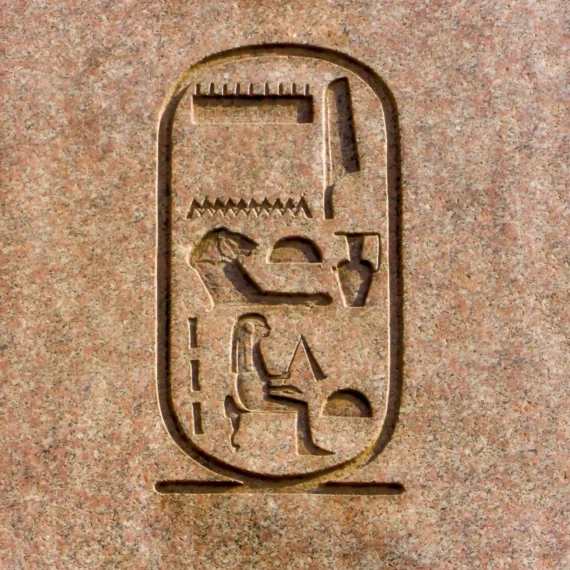
Her full, formal birth name is generally written as:
𓇋𓏠𓈖𓍘𓏏𓄂𓏏𓀼𓏪
Literal translation: Amun is united with the foremost of Noble Women.
Let’s read this together. The cartouche is read from top to bottom. The faces and animals face the direction you read from, so you read into their face, not in the direction they’re looking. Looking at the image, the seated figure at the bottom is facing right. That tells us we must read the cartouche from right to left.
So, working from top to bottom, right to left:
𓇋 𓏠 𓈖 (Imn) = Amun, subject written first (honorific to the chief deity, Amun). The second symbol, a comb with spines (hmnt) provides the “united” or “united with” meaning.
Now, the next part is tricky. The ‘shps.wt’ comes before ‘haat’. Egyptians sometimes rearranged signs within a word or name for visual balance, especially in tight spaces like cartouches. The assumption was that whoever would read the text would already be fluent in the language and able to extract the meaning without having it explicitly spelled out.
𓍘𓏏 (shps-t) = “noble” and t marks is as feminine, hence she is a “noble lady”. In the cartouche, the ‘alabaster jar’ carries the “shps” sound. It looks differently here in text because of differences in font.
𓄂 (haat) = the forepart of a lion (ideogram) translates to “front,” “foremost,” or “leading”.
𓏏 = (t or wt) feminine ending
𓀼 = a determinative for her role as a royal
𓏪 = plural strokes; a modifier
Writing Beyond Monuments: Hieratic and Demotic Scripts
Hieroglyphs were only one part of the Egyptian writing world. They were highly formal. However, an evolving civilization that kept prolific records, administered land, copied literature, and handled legal and economic life needed faster forms of writing.
Over time, ancient Egyptian developed a broader scribal culture with different scripts for different purposes.
Hieratic Script
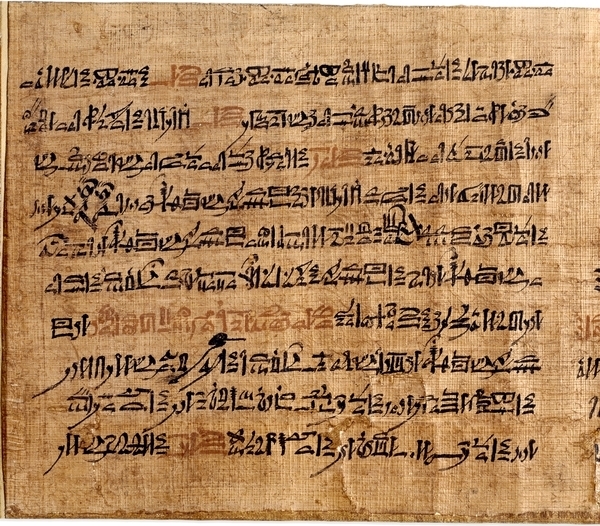
Hieratic was the cursive counterpart to hieroglyphic writing. It was used for everyday written work on papyrus, wood, and ostraca, especially in administration, literature, education, and religious copying. The underlying language was still Egyptian, but the visual form of the script changed, becoming much quicker and more fluid. Hieratic was built for speed, routine use, and the practical demands of scribal life.
A good example of hieratic script is the Tale of the Two Brothers on Papyrus d’Orbiney, a literary text written in flowing black-ink hieratic on papyrus.
Demotic Script
As the spoken language continued to evolve, the written tradition also adapted, eventually giving rise to Demotic, a faster and more compressed script used for the practical business of daily life: legal documents, tax records, letters, contracts, and routine writings.
By this stage, the writing looks much more removed from the formal hieroglyphs. The underlying continuity is still there, but the visual connection is much less obvious.
The Rosetta Stone provides a great example.
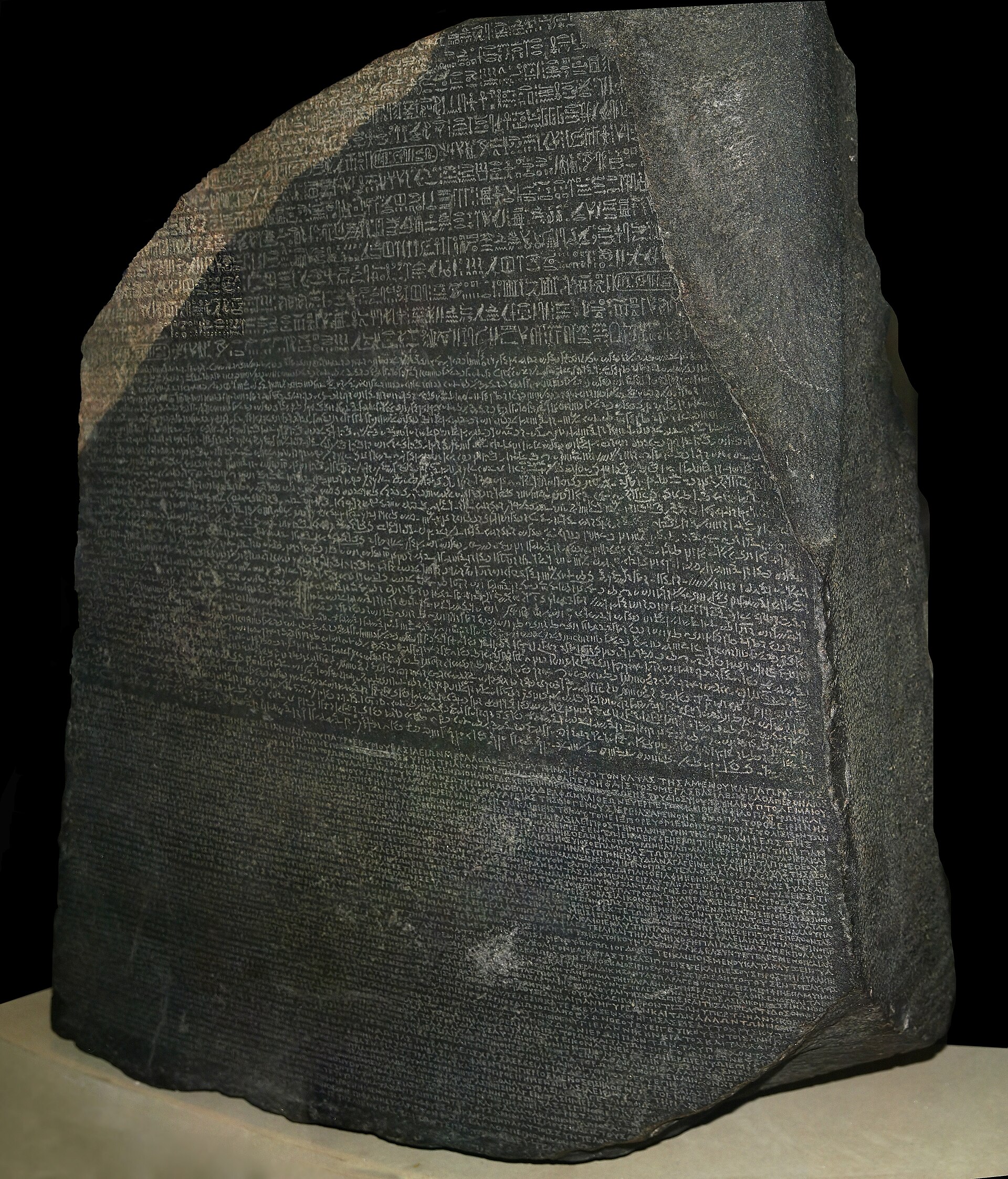
The Rosetta Stone: A Translation Breakthrough
For centuries, Egyptian hieroglyphs were unreadable. Scholars, travellers, and antiquarians could copy them, admire them, and speculate about them, but they could not read them as language. The breakthrough came through linguistic comparison.
In 1799, French soldiers discovered the Rosetta Stone during Napoleon’s colonization campaign in Fort Saint-Julien (or Fort Julien) while laying the foundation for expanding the Mamluk fort. It is located on the left bank of the Nile, about 5 kilometres northwest of the city of Rashid (Rosetta) on the north coast of Egypt. The officer of Engineers and his team observed that it likely bore the same text in three scripts and sent it to Cairo for further study.
The Rosetta Stone is a basalt slab dating back to 196 B.C.E. that carries the decree of Ptolemy V Epiphanes in three scripts: Egyptian hieroglyphs at the top, Demotic in the middle, and Greek on the bottom. The decree is a formal priestly loyalty proclamation that praises Ptolemy’s rule and grants him divine honours, and orders the decree to be publicly displayed.
Scholars could already read Greek at this time, and the Greek text itself states that the decree is written in all three scripts. That gave scholars a reliable point of reference. The Greek text gave researchers known names, titles, and repeated patterns to look for in the Egyptian versions. Royal names were especially useful. On the hieroglyphic side, they appeared inside oval frames, called cartouches.
Thomas Young, an English polymath, best known in science for his work on light and vision, partially deciphered the Egyptian script. He identified the name Ptolemy in a cartouche and demonstrated that these enclosed sign groups were connected to royalty. He also made major progress on deciphering Demotic.
But the big turning point came in 1822. A French linguist, Jean-François Champollion, cracked the basic logic of Egyptian hieroglyphs. His breakthrough came when he realized that hieroglyphs were a mixed writing system, and he used that insight to begin reading ancient Egyptian texts. This opened the door to a massive historical and literary record and broke its three-thousand-year-old silence.
The Rosetta Stone is now on display in the British Museum in London, England, and has become a symbol for unlocking language and the power of translation. It remains one of the most important objects in the history of writing.
Coptic: The Last Surviving Variant
When hieroglyphs fell out of use, ancient Egyptian continued to evolve into its final historical stage as Coptic.
Egypt eventually became Arabic-speaking after the Arab conquest, and the older Egyptian language narrowed over time into Coptic.
Coptic was written in an adapted Greek alphabet with a small number of additional signs taken from Demotic to represent Egyptian sounds Greek could not capture. It was important for scholars because it preserves the latest phase of the Egyptian language in a script that uses vowels.
Champollion used Coptic as a linguistic bridge to the older language. This gave scholars an essential historical link to pronunciation and grammatical structure, though limited because the language had evolved. With access to Coptic, Egyptian could be studied through reverse engineering.
Coptic gradually retreated from daily life as Arabic became the main language in government and daily life. However, it still lives on today in the liturgy of the Coptic Church.
The decipherment and translation of Egyptian hieroglyphs into modern language is one of the great linguistic achievements in modern scholarship. Ancient Egypt left behind a prolific writing culture, which gave us a rare opportunity to have a first-hand account of the language, institutions, and belief systems of its ancient society. Egypt’s history could be studied through its own voice in texts that recorded Egyptian life across millennia, instead of searching for its story mainly through ruins and external anthropological theories.
In 2013, French archaeologists Pierre Tallet and Gregory Marouard discovered the Diary of Merer from circa 2500 B.C.E., a detailed construction log written in Hieratic script, which finally helped resolve the long-standing mystery of the logistics involved in building the pyramids of Giza.
If you’ve missed previous editions of the Santium Language Series, you’ll find them here – catch up!
How Santium contributes to this space
Santium specializes in translating and adapting complex, high-stakes content where precision matters. We ensure that meaning is preserved across languages, dialects, and contexts. Our workflows combine subject-matter expertise, structured review, and in-country validation to align language with how it is actually used and understood. This is particularly important in environments where small shifts in wording can affect interpretation, usability, or outcomes. Santium’s role is to manage that complexity so that translated language remains reliable, consistent, and fit for purpose.
Curious about the world’s languages?
If you found this article interesting, follow me on LinkedIn and join our newsletter to receive future editions. In the Santium Language Series, I explore interesting traits of the world’s languages, from the most widely spoken to obscure, introducing their structure and word formation to cultural nuance and their role in social norms.
Stay connected and don’t miss the next edition!

|
Thank you for signing up. |


References
Britannica. (2026, March 24). Egyptian language. Encyclopaedia Britannica.
Britannica. (2026, March 24). Coptic language. Encyclopaedia Britannica.
Britannica. (2026, March 24). Hieratic script. Encyclopaedia Britannica.
Britannica. (2026, March 24). Hieroglyphic writing: Discovery of the Rosetta Stone. Encyclopaedia Britannica.
Britannica. (n.d.). Rosetta Stone. Encyclopaedia Britannica.
Britannica. (n.d.). Hieroglyphic writing: Relationship of writing and art. Encyclopaedia Britannica.
British Museum. (n.d.). Explore the Rosetta Stone.
British Museum. (2025, December 18). Everything you ever wanted to know about the Rosetta Stone.
British Museum. (n.d.). Hieroglyphs: Unlocking ancient Egypt.
British Museum. (n.d.). Stela [Rosetta Stone record].
Woods, C. (n.d.). Visible language. Institute for the Study of Ancient Cultures, University of Chicago.

Monika Vance
Managing Director | SANTIUM
My work sits at the intersection of linguistics, scientific and medical translation, psychometric measurement, and multilingual operations, where terminology, usability, and regulatory context must align. I write about scientific and medical translations, psychometrics, languages, and the operational challenges that inevitably come with them. I also teach translators how to properly translate and validate complex psychometric instruments to hone their expertise in linguistic validation.