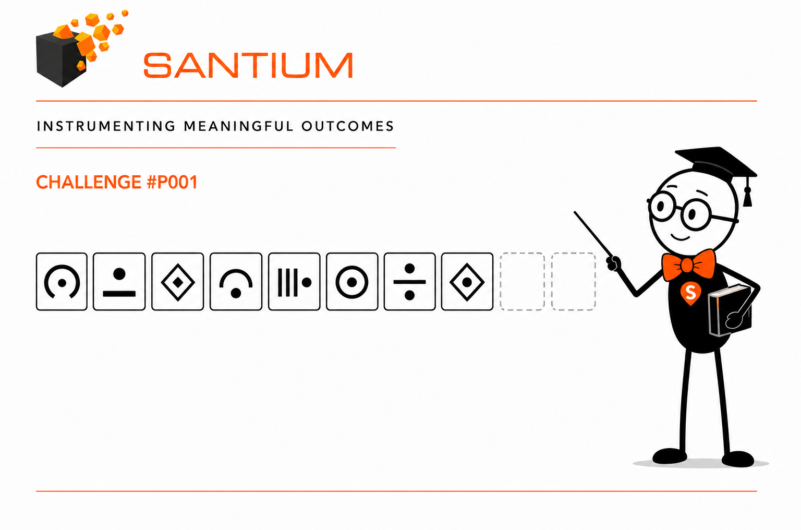
Commonly included in IQ tests, a symbol translation task is an adult version of a rebus puzzle, though it is also used for teenage children. The symbols in a symbol translation task do not provide the examininee with any clues about the assigned meaning of any symbol. Whereas symbols in traditional rebus tasks reveal or suggest their assigned meaning, hence they are commonly used with younger children.
In the context of today’s linguistic challenge, a child refers to a kid between the ages of 12–17 years.
In this task, the child must learn each visual-verbal association, remember it, retrieve it when the symbol reappears, and process the symbols in sequence.
But these tasks are frequently translated as text-based sentences in computer-assisted translation platforms without visual references or explicit adaptation instructions for the translator to see what the purpose of measurement actually is.
So, what happens when that sequence follows English grammar and the child’s language does not?
The target-language words may need to appear in a different order. The language may require information that English leaves unmarked. Or, it may not need something English represents on its own. A grammatically simple sentence in English may not be equally simple in another language.
So, if you speak a different language, and you’re up for an intellectual challenge, here is a linguistic puzzle for you. Click on the download link at the end of this task brief to download it.
What Rebus Tasks Measure
- Learning new visual-verbal associations
- Encoding and retrieving their meanings
- Remembering the order of a sequence
- Combining separate meanings into a coherent phrase
- Retaining the associations after a delay
When Are These Tasks Useful?
- Does the child learn efficiently with repeated exposure?
- Can the child remember the associations later?
- Is recognition easier than unaided recall?
- What happens as the symbol sequences become longer?
- Where do the errors begin: during learning, retrieval, sequencing or sentence production?
What Happens in Another Language?
A symbol sequence that produces a natural English sentence may not produce an equally natural sentence in another language.
The words may need to appear in a different order. A language may require information that English does not, or may not need something English expresses separately.
- So, which meanings need their own symbols?
- Which grammatical words can the child supply naturally?
- And how do we add symbols without allowing their designs to reveal what they mean?
That brings us to Weekend Challenge P001!
Today's Linguistic Challenge
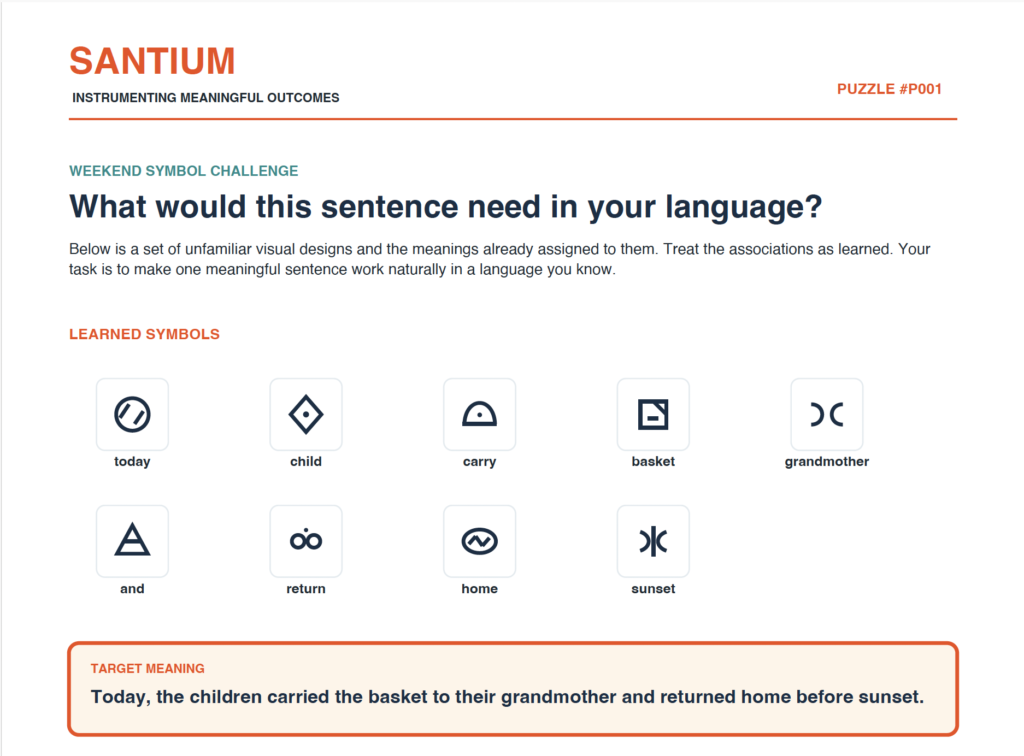
Nine abstract designs have already been assigned these meanings:
- Today
- Child
- Carry
- Basket
- Grandmother
- And
- Return
- Home
- Sunset
The intended sentence is:
Today, the children carried the basket to their grandmother and returned home before sunset.
Your task is to make the symbol sentence work naturally in a language you know.
Using the downloadable worksheet:
- Translate the sentence naturally.
- Rearrange the learned symbols into the order your language requires.
- Propose up to four additional symbols or modifiers where meaning would otherwise be lost or unclear.
- Draw each new symbol in the same abstract style.
- Explain what it conveys and why it is needed.
- Identify anything a child could naturally add without a separate symbol.
There is one important rule:
The new symbols must not give away their meanings.
For example, a plural marker should not show several people. A past marker should not look like a clock or a backward arrow. These are associations the child must learn—just like learning a new and unfamiliar language.
Try It on Someone
Once you have a solution, try it with a family member, friend or colleague.
First, show them your new symbols without explaining the meanings. Can they guess what the symbols represent? If they can, your designs may be revealing too much.
Then teach them the associations and show them the complete sequence.
Does the sentence feel natural? Is anything missing? Is anything unnecessary? Would they arrange it differently? Revise your proposal if their feedback changes your thinking.
If you would find additional feedback useful, share your language, proposed symbols and rationale in the comments. It will be interesting to see how differently languages solve the same problem.
These are real-world challenges in adapting neuropsychological assessments. They require deeper understanding of measurement concepts than psychiatric and other COAs, along with careful and analytical approach to preserving content validity.
Most importantly, have fun with it!
This is an original informal linguistic exercise for educational and practice purposes. It is not a standardized assessment item and should not be used to evaluate cognitive ability.
How Santium Contributes to This Space
Modern COA development, selection and eCOA implementations increasingly depend on understanding how physicians, patients and caregivers address and describe symptoms, treatment experience, functioning, burden of illness, burden of care, and quality of life within their own linguistic and cultural frameworks.
Santium contributions to the Life Sciences industry are designed to support the global implementation of patient-centered endpoints and patient-facing research materials. We do this through multilingual patient and stakeholder interviewing, cross-cultural evidence gathering, local subject-matter expert engagement, and measurement-aware linguistic and cultural adaptation.
Drawing on expertise in psychometrics, thousands of linguistic validation projects, multilingual interviewing, and multinational study operations, Santium helps sponsors and researchers evaluate whether patient-facing concepts remain relevant, clinically meaningful, culturally appropriate, and operationally usable across languages, countries, and modes of administration.
Curious About the World’s Languages?
If you found this article interesting, follow me on LinkedIn and join our newsletter to receive future editions. In the Santium Language Series, I explore interesting traits of the world’s languages, from the most widely spoken to obscure, introducing their structure and word formation to cultural nuance and their role in social norms.
Stay connected and don’t miss the next edition!
Are you interested or work in the COA-related area of clinical research?
If you found this article interesting, follow us on LinkedIn or subscribe to this Adapting COAs the Right Way series, where we explore the psychometrics hiding under the hood and the translation methods for clinical outcome assessments – from simple rating scales to complex neuropsychological batteries. We introduce their constructs, design rules you need to know about, the importance of phrasing, concepts being measured, and how cultural nuance and age-based norms impact the translation and cultural adaptation process.
Join me in elevating the quality of COA translation through a psychometrically-driven perspective.
Stay connected and don’t miss the next edition!
About the Author
Monika Vance | Managing Director | SANTIUM
My work sits at the intersection of linguistics, scientific and medical translation, psychometric measurement, and multilingual operations, where terminology, usability, end-user experience, and regulatory context must align. I write about scientific and medical translations, psychometrics, languages, patient-centred research and the operational challenges that inevitably come with them. I also teach translators how to properly translate and validate complex psychometric instruments to hone their expertise in linguistic validation.

|
Thank you for signing up. |


References
Deák, G. O., & Toney, A. J. (2013). Young children’s fast mapping and generalization of words, facts, and pictograms. Journal of Experimental Child Psychology, 115(2), 273–296. https://doi.org/10.1016/j.jecp.2013.02.004
Ehm, J.-H., Lonnemann, J., Brandenburg, J., Huschka, S. S., Hasselhorn, M., & Lervåg, A. (2019). Exploring factors underlying children’s acquisition and retrieval of sound-symbol association skills. Journal of Experimental Child Psychology, 177, 86–99. https://doi.org/10.1016/j.jecp.2018.07.006
Georgiou, G. K., Liu, C., & Xu, S. (2017). Examining the direct and indirect effects of visual-verbal paired associate learning on Chinese word reading. Journal of Experimental Child Psychology, 160, 81–91. https://doi.org/10.1016/j.jecp.2017.03.011
Monika Vance
Managing Director | SANTIUM
My work sits at the intersection of linguistics, scientific and medical translation, psychometric measurement, and multilingual operations, where terminology, usability, and regulatory context must align. I write about scientific and medical translations, psychometrics, languages, patient-centred research and the operational challenges that inevitably come with them. I also teach translators how to properly translate and validate complex psychometric instruments to hone their expertise in linguistic validation.