In 1912, a Polish rare-book dealer Wilfrid Voynich was looking through a collection of manuscripts at the Jesuit Villa Mondragone outside Rome when he came across a rather unusual book.
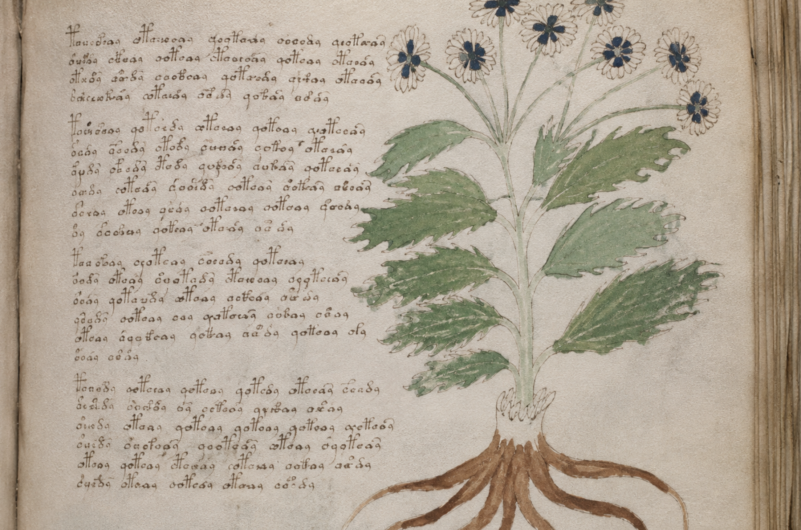
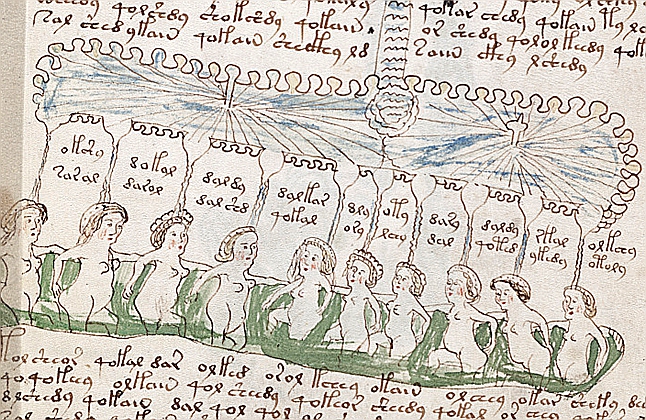
Its pages were covered in writing he could not identify. Alongside the text were drawings of plants, astronomical and zodiac-like diagrams, bizarre vessels and tubes, and small naked figures bathing in what appear to be pools of coloured liquid. Some of the plants look vaguely recognizable. Others do not seem to correspond to anything we know.
The manuscript came with another clue. Tucked inside was a letter written in 1665 or 1666 by Johannes Marcus Marci, a Prague physician and scholar, to Athanasius Kircher, a Jesuit polymath with an interest in ancient languages and scripts. Marci was sending Kircher the book in the hope that he could decipher it.
He also wrote that the manuscript had once belonged to Holy Roman Emperor Rudolf II, who had supposedly paid 600 ducats for it. Whether that part of the story is true, we may never know.
Kircher apparently did not manage to read it either.
After that, the manuscript largely disappeared from view for about two centuries, until Voynich acquired it in 1912. It eventually became known by his name.
What We Know
For a manuscript famous for how little we understand it, there are a few things we can say with reasonable confidence.
The vellum has been radiocarbon dated to between 1404 and 1438, and analysis of the inks and pigments has found materials consistent with those used in medieval manuscripts. Although this does not tell us exactly when the writing was added, there is no convincing physical evidence that the manuscript is a modern forgery.
Where it comes from is a mystery. Various parts of Europe have been proposed, but the manuscript does not identify its author, location or purpose. Even its earliest ownership is difficult to reconstruct.
By the 17th century, however, the trail seems clearer. The manuscript was in Prague and passed through the hands of several scholars interested in deciphering it. One was Georg Baresch, an alchemist who owned the book and was sufficiently puzzled by it to send samples of its writing to Athanasius Kircher in Rome. Kircher had become famous for his work on Egyptian hieroglyphs and seemed like a reasonable person to ask, although his supposed decipherment of hieroglyphs would later turn out to be spectacularly wrong.
After Baresch’s death, the manuscript passed to Johannes Marcus Marci, who eventually sent the entire book to Kircher. From there it entered Jesuit collections, where it remained until Voynich purchased it in 1912.
The manuscript we have today contains roughly 240 pages, including several large foldouts. Some pages are missing, and the original order may have changed over time.
The illustrations have allowed researchers to divide it loosely into sections. The largest is botanical, with drawings of plants accompanied by text. Other pages contain stars, suns, moons and zodiac symbols. One especially bizarre group shows small female figures, many of them immersed in pools or connected by elaborate systems of tubes. Another contains drawings resembling medicinal plants, jars and pharmaceutical containers. Near the end are pages of short text entries, each marked with a star or flower-like symbol, which have often been described as recipes.
But terms such as botanical, pharmaceutical and recipe are just the way we describe what the pages look like to us now.
The plants illustrate the problem best. Some seem to resemble real species, but many combine leaves, flowers and roots in ways that make identification difficult. They may be from foreign parts of the world, inaccurate drawings of real plants, composites, symbolic representations or something else. Perhaps a brilliant notion of grafting plants for some of their specific properties, a protoform of genetic engineering?
We don’t know what the script says.
And the words are where the mystery is even more intriguing.
Voynichese: Is It Really a Language?
For lack of a better name, the writing in the Voynich manuscript has become known as Voynichese.
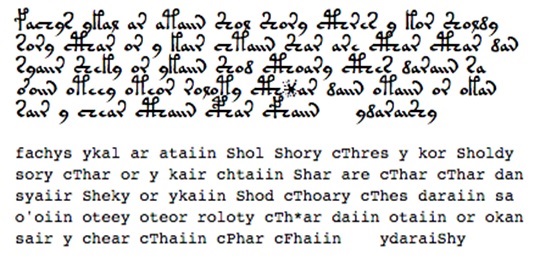
It looks like a language someone ought to be able to read. The text runs from left to right. There are spaces between apparent words. Lines form paragraphs, and some sections have what looks like headings. The script uses a relatively small inventory of recurring characters, although exactly how many depends on how it is analyzed. Certain variations of seemingly the same lettter could be separate letters.
Some characters resemble Latin letters or numerals. Others are more elaborate. A few tall characters, known as gallows glyphs because of their appearance, frequently occur near the beginnings of paragraphs or lines. The handwriting is beautifully fluent, with little evidence that the writer was laboriously drawing unfamiliar symbols one at a time.
If it is a cipher of some kind, its writer was already fluent in writing it, and probably also speaking it. If it even had a spoken form.

More importantly, the text has patterns.
Certain words appear again and again. Some differ from one another by only a single character. Some characters tend to appear in specific positions within words, while some combinations are common and others are rare or missing altogether. Word frequencies are uneven but not randomly distributed.
This is partly why the idea that somebody would write hundreds of pages using meaningless symbols is difficult to justify, or at least accept. The writing looks very much like structured information.
But it is not an ordinary written language either.
Its vocabulary is unusually repetitive. Words that are nearly identical frequently appear close together. Some common character combinations appear with a regularity that would be odd in many natural languages.
There is another complication.
In the 1970s, cryptographer Prescott Currier noticed that the language of the manuscript was not uniform. He identified two broad textual varieties, now known as Currier A and Currier B. They use essentially the same script, but differ in the frequency of particular words and character sequences. The differences are substantial enough that a page can be classified as A or B by the way it is written.
This suggested that the content was written by more than one person. Modern handwriting analysis has identified multiple people who likely contributed to the manuscript, making the idea of a single eccentric author inventing hundreds of pages of gibberish even less likely.
Still, none of this proves that Voynichese represents a natural language. Statistical structure can be produced in other ways, and something that looks linguistic is not necessarily language.
So What Could It Be?
There has been no shortage of theories.
Since Voynich brought the manuscript to wider scholarly attention, proposed solutions have included Latin, Hebrew, Italian, German, various Romance languages and several others.
Some researchers believe the text is encrypted. It’s a good place to start. Ciphers were certainly used in medieval and Renaissance Europe, particularly in diplomacy. If the manuscript contains medical, alchemical, herbology or other knowledge its author wanted to conceal, encryption would make sense. But conventional substitution ciphers generally preserve statistical traces of the language behind them. Generations of cryptographers have looked for those traces in Voynichese without finding a solution that works consistently across the manuscript.
A more complicated encoding system could explain some of its peculiarities, but no method tried so far has produced consistent “translations” throughout the entire volume of text. So, if it contains a cipher, we have not figured out its key.
Another possibility is that Voynichese represents a real language written in an unfamiliar or deliberately modified script. Perhaps a phonetic one. This has produced some interesting claims over the years, often accompanied by proposed translations but none has gained general acceptance. If a solution requires symbols to change meaning from one passage to another, allows several possible readings whenever convenient, or produces translations only after considerable interpretation, it is difficult to reproduce and test independently. If the manuscript in fact contains a language, we do not know which one.
And then there is the possibility that it says nothing at all. The hoax theory has an equally long history. Perhaps the manuscript was created to look mysterious and valuable, possibly to attract a wealthy collector. Rudolf II, if the story about his ownership is correct, would certainly have been a promising target. The emeperor’s court was famously interested in alchemy, astrology and unusual objects.
But producing more than 240 pages of consistent pseudo-writing, elaborate illustrations and carefully prepared vellum would have required a considerable investment of time and materials. It is certainly possible. If it is nonsense, whoever wrote it created a spectacular-looking nonsense with an extraordinary amount of structure.
There are also theories that fall somewhere between language and hoax. Some scholars have suggested an invented language, a system of abbreviations or a specialized notation or shorthand. Voynichese might have been generated using a set of rules that produces language-like text but never intended to represent ordinary sentences. Instead, it might represent mnemonic material, technical notation or information recorded in a form whose conventions have been lost.
This may explain why the manuscript has attracted so many supposed breakthroughs. With no agreed language, no bilingual inscription, no key and no passage whose meaning we know independently, there are very few anchors against which a proposed translation can be tested.
Surely AI Can Solve It...
AI should be able to decipher a cipher in no time, right?
It seems like exactly the kind of problem artificial intelligence should be good at. Feed it a couple of hundred pages of text, let it analyze every character and word, compare the patterns against known languages, and voilà!
Researchers have, in fact, been applying computational methods to the Voynich manuscript for years. Computers can identify recurring sequences, measure word frequencies, compare different sections of the manuscript and detect patterns that would be extremely difficult to find by hand. More recently, machine learning has made it possible to compare linguistic patterns across very large collections of languages and texts.
It still cannot tell us what the manuscript says. Computing power is certainly there. The problem is evidence.
When AI translates French into English, it has enormous amounts of French and English text from which to learn the relationships between the two languages. Even when researchers decipher an ancient script, they usually have something to work with: related languages, recognizable names, known writing systems, bilingual inscriptions or archaeological context that helps constrain possible meanings.
Voynichese gives us very little of that.
We do not know what language, if any, the text represents. We do not know what each symbol represents: a letter, a sound, a syllable, an abbreviation or something else. We do not even know if the spaces reliably mark words. We are just assuming that they do.
The illustrations seem as though they should help, but they introduce another level of uncertainty. If we could confidently identify a plant, for example, we might expect the surrounding text to contain its name. But many of the plants cannot be identified with certainty, and there is no guarantee that the text beside a drawing describes what the drawing depicts. We just assume they do, because it seems logical.
Computational analysis can therefore tell us a great deal about how Voynichese is structured without telling us what it means.
There is also a risk in using increasingly powerful models on a manuscript like this. Give a sufficiently flexible system enough possible languages, substitutions and transformations, and it can find patterns that appear meaningful. Humans are very good at doing the same thing.
Real decipherment has to hold up to a basic scientific principle: someone else should be able to take the same rules, apply them to text the original researcher did not select, and obtain a coherent result. So far, neither humans nor machines have managed to do that.
AI may eventually help solve the Voynich manuscript. But first, it has to find the right pattern with the very limited Voynichese resource it has to work with.
How Santium Contributes to This Space
Santium provides specialized translation and cross-cultural research services focused on adapting and validating scientific, medical and technical content. We deliver translated materials that work as intended across languages and cultures through translation, linguistic validation, and subject-matter specialist engagement, preserving meaning, functionality, usability, and, where applicable, measurement integrity in real-world applications and settings.
Curious About the World’s Languages?
If you found this article interesting, follow me on LinkedIn and join our newsletter to receive future editions. In the Santium Language Series, I explore interesting traits of the world’s languages, from the most widely spoken to obscure, introducing their structure and word formation to cultural nuance and their role in social norms.
Stay connected and don’t miss the next edition!

|
Thank you for signing up. |


References
Beinecke Rare Book & Manuscript Library. (n.d.). Voynich manuscript (MS 408). Yale University Library.
Currier, P. H. (1976). Some important new statistical findings. In M. E. D’Imperio (Ed.), New research on the Voynich manuscript: Proceedings of a seminar. National Security Agency.
D’Imperio, M. E. (1978). The Voynich manuscript: An elegant enigma. National Security Agency.
Davis, L. F. (2020). How many glyphs and how many scribes? Digital paleography and the Voynich manuscript. Manuscript Studies: A Journal of the Schoenberg Institute for Manuscript Studies, 5(1), 164–180.
Landini, G. (2001). Evidence of linguistic structure in the Voynich manuscript using spectral analysis. Cryptologia, 25(4), 275–295.
Montemurro, M. A., & Zanette, D. H. (2013). Keywords and co-occurrence patterns in the Voynich manuscript: An information-theoretic analysis. PLOS ONE, 8(6), e66344.
Reddy, S., & Knight, K. (2011). What we know about the Voynich manuscript. In Proceedings of the 5th ACL-HLT Workshop on Language Technology for Cultural Heritage, Social Sciences, and Humanities (pp. 78–86).
Stolte, M., Austin, J., & Fiddyment, S. (2024). The biological analysis of the Voynich manuscript. Heritage Science, 12.
Zandbergen, R. (n.d.). The Voynich manuscript. Voynich.nu.

Monika Vance
Managing Director | SANTIUM
My work sits at the intersection of linguistics, scientific and medical translation, psychometric measurement, and multilingual operations, where terminology, usability, and regulatory context must align. I write about scientific and medical translations, psychometrics, languages, patient-centred research and the operational challenges that inevitably come with them. I also teach translators how to properly translate and validate complex psychometric instruments to hone their expertise in linguistic validation.