Canada is enormous. It’s the second-largest country in the world in total area after Russia. It stretches across nearly 10 million square kilometres, spanning 6 time zones, and has the longest coastline of any country in the world. Yet most of its 41 million Canadians live in a dense, narrow band along its southern border that we share with the United States.
Canada consists of 10 provinces and 3 northern territories. The provinces, which stretch across the more densely populated southern part of the country, have constitutionally defined powers over areas such as education, healthcare, property, and civil law.
The 3 territories, Yukon, the Northwest Territories, and Nunavut, cover much of Canada’s north and exercise powers delegated by the federal government, and territorial self-government has expanded substantially over the last couple of decades.
While the average Canadian from along the southern border band would likely not survive a single winter in the Canadian Arctic without some damage to their body, Inuit communities to this day navigate survival through seasonal change, employing the science of thermodynamics to heat protective shelters built from snow, and reading snow, sea ice, wind, and animal movement. They are so removed from modern urban life that when crossing long, desolate distances outside of their communities, they continue to do it with the precision and centuries-old techniques needed to survive in one of Earth’s harshest environments.
To build a connection with the Inuit languages of Canada, we also need to learn about their people, the context, and the knowledge that made life across the Arctic possible.
A Brief History
Inuit lived across the Canadian Arctic for thousands of years before Canada existed as a sovereign state. Their communities were connected through hunting, travel, trade, and family networks.
European contact brought traders, missionaries, police, and government officials into the region. These encounters altered local economies and introduced new goods, diseases, religions, and systems of authority.
Missionaries helped establish writing systems for Inuit languages, including the syllabics now strongly associated with Inuktitut in parts of Canada.
After the Second World War, the federal government expanded its presence across the Arctic to assert sovereignty over the Arctic, especially as the Cold War increased the region’s military and strategic importance. Many Inuit families were encouraged or compelled to leave seasonal camps and settle in permanent communities, where schools, healthcare, housing, and government services were concentrated.
Residential and federal day schools frequently separated children from their families and discouraged or punished the use of Inuit languages. Relocations, settlement policies, and the growing dominance of English and French disrupted both community life and the transmission of language and practical knowledge.
From the 1970s onward, Inuit political organizations pushed for land rights and greater control over regional decisions. These efforts led to major land-claim agreements across Inuit Nunangat and, in 1999, to the creation of Nunavut, whose name means “our land” in Inuktitut.
The creation of Nunavut changed Canada’s political map. It is Canada’s largest territory, has a predominantly Inuit population, and recognizes Inuktitut and Inuinnaqtun as official languages alongside English and French.
In 2008, the Government of Canada issued the first of several formal apologies to the Inuit and other affected indigenous communities. The first, and one whose events were previously unknown to most and hit hard among Canadians, was to former residential school students, including Inuit, First Nations, and Métis survivors. The apology acknowledged that during the 1950s and 1960s, children had been forcibly removed from their homes, deprived of their languages and cultures, and exposed to unimaginable neglect and abuse. It also recognized that the damage continued across families and generations.
The 2008 apology was followed by the Truth and Reconciliation Commission of Canada, which travelled across the country collecting testimony from survivors and documenting the history and effects of the residential school system. Its final report, released in 2015, described the system as cultural genocide and issued 94 Calls to Action intended to repair its lasting damage. Compensation, healing programs, commemorations, and changes to education and public policy followed, although progress has been uneven and many of the effects on language, family life, and community wellbeing continue today.
Additional apologies followed over several years, specifically connected to harms experienced by Inuit when investigations uncovered new evidence of human and animal rights violations, as defined and prohibited in past and present-day Canadian federal laws. These violations remain among the darkest chapters in Canadian history.
This political history helps explain why closely related Inuit languages now have different names, writing systems, and levels of official recognition across Canada.
Inuit Nunangat: The Inuit Homeland in Canada
Inuit Nunangat means “the Inuit homeland.” Inuit literally means “the people”, and Inuk is the singular form, meaning “a person.”
Inuit Nunangat, the People of Nunangat, stretches across Canada’s Arctic, from the western Northwest Territories through Nunavut and northern Quebec to the Inuit region of northern Labrador (a region above Quebec). It includes four main regions: the Inuvialuit Settlement Region, Nunavut, Nunavik, and Nunatsiavut. Together, they cover roughly one-third of Canada’s land mass. According to the 2021 census, the Inuit population across the entire Inuit Nunangat was only around 70 500.
Up there, the landscape changes from open tundra and rocky coastlines to mountains, islands, glaciers, and frozen seas. Communities are often separated by enormous distances, with few roads connecting them. For much of the year, travel depends on boats, snowmobiles, sleds, and planes.
The people who live across these regions are collectively known as Inuit, but they do not all speak the same way or follow identical traditions. Their languages and dialects vary by region, as do hunting practices, clothing styles, building techniques, and ways of travelling.
What they share is a body of knowledge through generations of close observation of snow, ice, animals, weather, and movement across the land.
One Language with Many Regional Voices
The languages spoken across Inuit Nunangat belong to a broad continuum that extends west into Alaska and east into Greenland. Within Canada, Inuktut is often used as a collective term, but the people who speak these languages do not all use the same name for them.
Inuktitut is spoken across much of Nunavut and Nunavik. Inuinnaqtun is used primarily in western Nunavut. In the Inuvialuit Settlement Region, several related varieties are grouped under Inuvialuktun, while Labrador Inuit traditionally speak Inuttut.
These are closely related languages, but they are not identical. Pronunciation, vocabulary, grammar, and writing practices can change from one community to the next. Speakers from neighbouring regions may understand one another easily, while those separated by thousands of kilometres may find communication more difficult.
The differences are especially visible in writing. In much of Nunavut and Nunavik, Inuktitut is commonly written in syllabics. Inuinnaqtun, Inuvialuktun, and Inuttut are generally written using the Roman alphabet. Closely related words can therefore look very different on the page.
This is why asking for a translation into “Inuit” is not enough. The correct language, regional variety, and writing system depend on the community the translation is meant to reach.
Writing Inuktitut
In much of Nunavut and Nunavik, Inuktitut is written using a syllabic system called qaniujaaqpait. Each symbol usually represents a consonant combined with a vowel, and its orientation helps indicate whether the vowel is i, u, or a. The system is highly regular. In the Roman form, Inuktitut also uses only the three basic vowels, a, i, and u, and spelling usually follows pronunciation much more closely than English does.
Small marks written above a symbol lengthen the vowel sound.
Depending on the content’s target audience, Inuktitut can also be written in a standardized Roman alphabet called qaliujaaqpait. As such, both systems represent the same spoken language.
Examples
ᑐᙵᓱᒋᑦ
Transliteration: Tunngasugit (“Welcome.”)
ᓇᑯᕐᒦᒃ
Transliteration: Nakurmiik (“Thank you.”)
ᐃᓄᒃᑎᑑᓲᖑᕕᑦ?
Transliteration: Inuktituusuunguvit? (“Do you speak Inuktitut?”)
ᐄ, ᒥᑭᔪᒥᒃ.
Transliteration: Ii, mikijumik. (“Yes, a little.”)
So, if you work in the translation industry, remember that a standardized written form of Inuit languages in Canada does not yet exist. Inuktitut has its own syllabic writing system, while Inuinnaqtun, Inuvialuktun, and Inuttut are written in the Roman alphabet, and Labrador uses its own spelling conventions.
Living in the Arctic
Temperatures across Inuit Nunangat vary enormously by region and season. In winter, daily averages commonly sit between −20°C and −30°C (−4°F to −22°F), with colder periods dropping below −40°C, which is also −40°F. Summer temperatures are often between 5°C and 15°C (41°F to 59°F), although the western Arctic can become much warmer. The greater danger is, however, the combination of wind, moisture, exposure, and rapidly changing snow and ice conditions.
Inuit Nunangat does not have six months of daylight everywhere; the farther north a community lies, the longer the periods of continuous summer light and winter darkness become.
Long summer days extend the time available for travel, hunting, fishing, building, and visiting, while blackout curtains and regular routines help people sleep. In winter, very short days or periods without sunrise can make travel and daily tasks more difficult, although twilight, moonlight, aurora borealis, and light reflected from the snow still provide some illumination.
Building with Snow
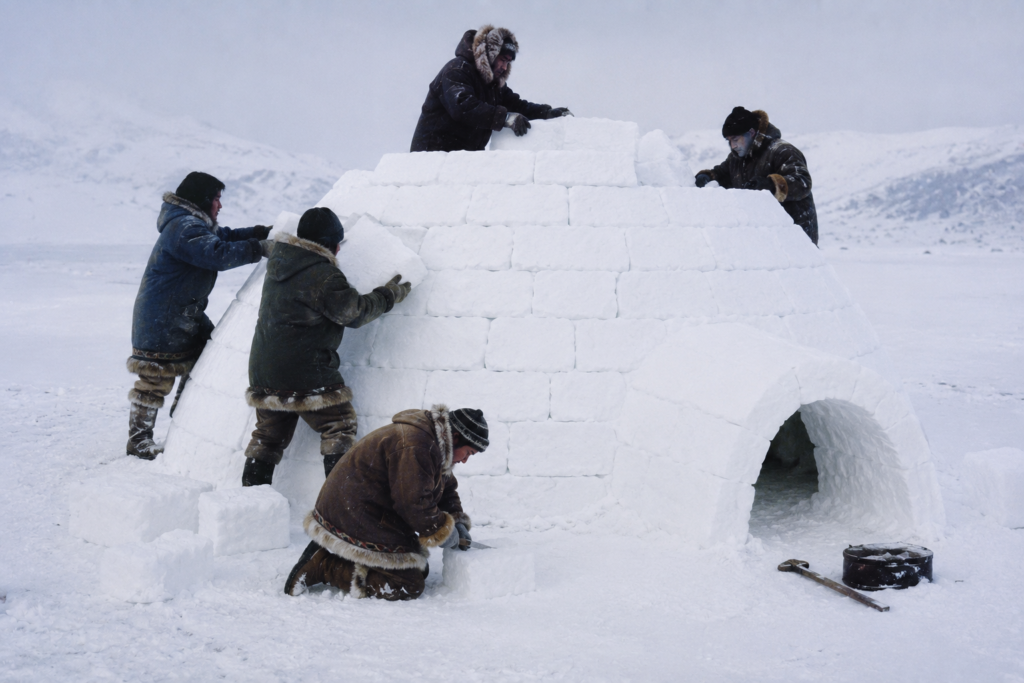
The familiar dome-shaped igloo, or iglu, was generally a temporary winter shelter rather than the permanent home of every Inuit community. Similar to building a tent for a temporary stay in nature, only much more insulated. Builders first select dense, wind-packed snow that can be cut into firm blocks. These are placed in a rising spiral, with each block angled slightly inward until the walls close into a dome. The curved structure distributes its weight through compression, while gaps are packed with loose snow.
A low drop-step entrance tunnel traps wind and excess cold air entering the dwelling. The fire pit is usually in the very centre and raised slightly off the frozen ground on a flat stone. A smoke hole, usually about 20–30 cm in diameter, is cut at the peak of the dome to allow carbon monoxide to exit the dwelling. Ventilation is based on the chimney effect, where smoke and hot air rise and exit the dwelling through the hole. Over the course of a few days, the snow on the inside of the igloo melts when the heat is increased and refreezes into a smooth glaze as the fire reduces. This helps increase the efficiency of ventilation and seals any cracks in the walls that may have occurred.
The sleeping platform is raised above the height of the entry tunnel so that colder air can settle below the occupied area, and the fire pit warms it. Since warm air rises, the warmed air around the platform provides a comfortable temperature for sleeping and household activities.
The thermodynamics are highly effective. Snow contains pockets of trapped air, which slow the movement of heat through the walls. The dome encloses considerable space with relatively little exposed surface, while its curved shape reduces direct wind pressure. Body heat and just a small oil lamp could warm the interior well above the outdoor temperature, usually to about 10°C and 15°C (roughly 50°F to 54°F). It provides a sheltered space in which people can remove some outer clothing, rest, and avoid direct exposure to wind and extreme cold.
Life in Inuit Communities Today
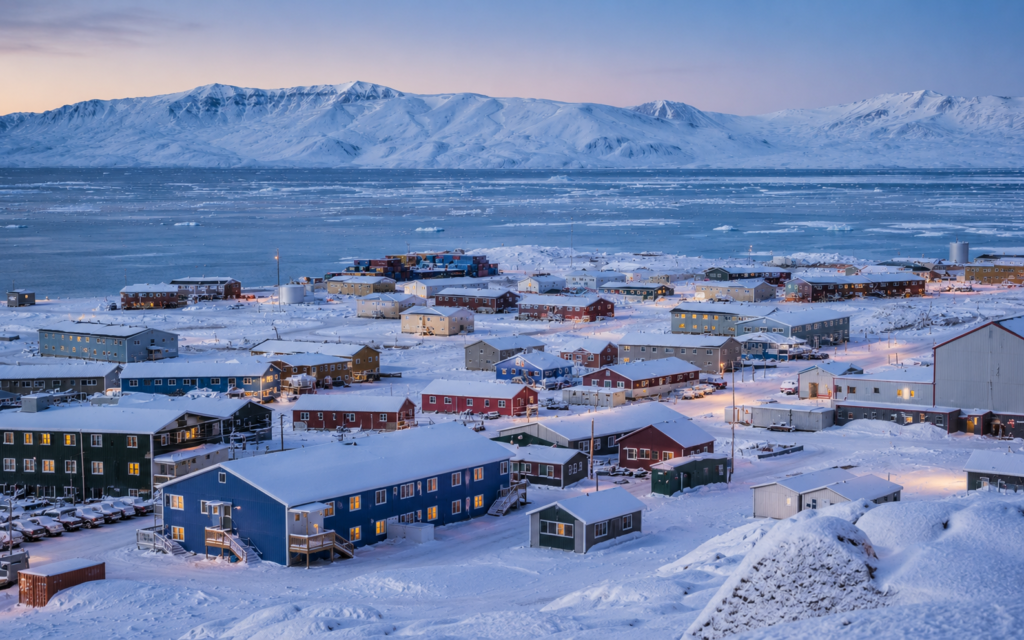
Most Inuit families today live in permanent communities with modern houses, schools, health centres, stores, internet access, and local government. Daily life combines wage employment, education, childcare, community events, hunting, fishing, and time on the land. Housing shortages remain severe in many places. Hence, it’s not unusual for several generations to share homes that were not built for large families.
Movement also combines modern machines with older knowledge. Cars, trucks, snowmobiles, and all-terrain vehicles are used within and around communities. Because most communities are not connected to the rest of Canada by all-season roads, people generally fly between them, while ships deliver fuel, vehicles, construction materials, and other heavy supplies during the summer.
Beyond the settlement, snowmobiles and sleds remain important for winter travel, while boats and ATVs are used when the snow and sea ice recede. The equipment keeps changing, but safe travel still depends on reading the weather and land conditions.
Dressing for Warmth Without Trapping Sweat
Traditional caribou clothing works as a complete insulation system. Caribou hair is hollow, trapping air both inside the hairs and between them. Winter clothing could include an inner layer worn with the fur facing the body and an outer layer with the fur facing outward. Parkas, trousers, mittens, socks, and boots protected the entire body. The garments were also made loose enough to trap warm air and allow ventilation during physical work. This is important because sweating can be dangerous: once activity stops, damp clothing loses insulation, and the moisture can freeze and cause hypothermia in the body.
Moving Enough, but Not Too Much
Movement generates body heat and helps maintain circulation during travel, hunting, shelter-building, and work with dogs and equipment. Remaining still for too long increases heat loss, especially through the hands, feet, and exposed parts of the face. But excessive effort creates a different risk by producing sweat. It’s vital to regulate pace, open or remove layers before becoming overheated, and put them back on before stopping. Companions also watch one another for numbness or changes in the appearance of exposed skin, because frostbite can progress before the affected person is fully aware of it.
Protecting the Eyes
Bright Arctic sunlight reflected from snow and ice can cause snow blindness in as little as one hour of unprotected exposure. Inuit snow goggles, known in some regions as iggaak, control glare by reducing the amount of light entering the eye through narrow horizontal openings. They can be carved from bone, antler, ivory, or wood and shaped closely to the face.
Carrying Heavy Loads Across Snow and Ice
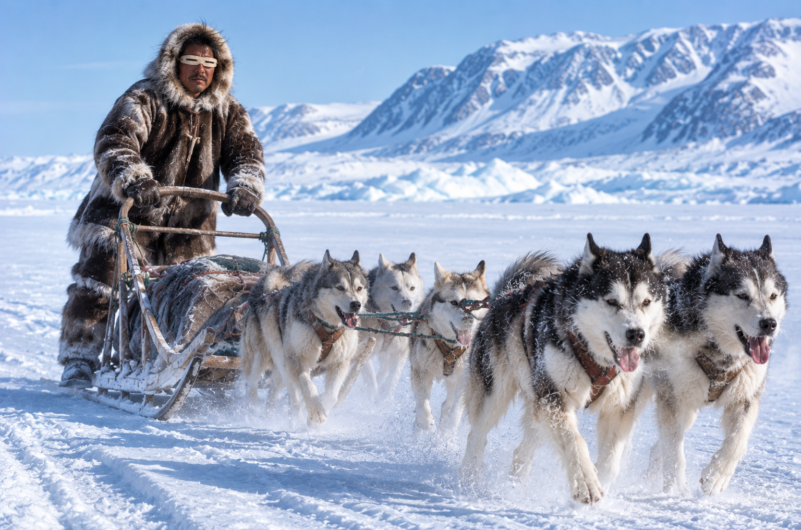
The traditional Inuit sled is called qamutiik. The qamutiik rests on two long, narrow rails called runners. These rails spread the weight of people and supplies over a larger area, helping the sled glide without sinking deeply into the snow. Its flexible frame can move easily over rough and fractured surfaces without snapping as a rigid structure would.
Sleds carry people, food, hunting equipment, skins, fuel, and other supplies over long distances. Dog teams supply the power, but successful travel also requires knowledge of harnessing, animal behaviour, ice conditions, route selection, and safe distribution of weight.
Qamutiit remain in use today, sometimes pulled by dogs but more often pulled by snowmobiles. Modern snowmobiles are surely faster and can cover longer distances in a single haul, but dog teams do not need gasoline or replacement engine parts. Experienced dogs can intuitively read and feel the terrain and ice conditions, alert the rider to danger, and defend him in an attack by wild animals. Also, based on the strength required for the pull, dogs can be added to the lineup to meet the demands of the job. So, depending on the situation, the rider chooses one over the other.
Dogs Are More Than Sled Power
Dogs are far more than a source of power for the sled. Inuit dogs are family members. They used to help move families and building materials across long distances, but today their role is more selective. Some hunters and travellers still use them on the land, while others keep teams for racing, cultural programs, tourism, and teaching younger generations traditional skills.
Dog teams sharply declined during the 1950s and 1960s. In Nunavik, police and government officials killed large numbers of Inuit sled dogs, often without meaningful consultation with their owners. The loss deprived families of transportation, access to hunting grounds, food security, and independence. In 2024, the Government of Canada formally apologized to Nunavik Inuit for its role in the killings and acknowledged the lasting damage they caused.
Dogs are powerful symbols of Inuit identity and independence. Their unconditional loyalty, intellect, strength, endurance, and ability to work in extreme cold made them essential for life in the Arctic. The relationship has always been practical but also deeply social and emotional.
Preserving Food Through the Seasons
Food was preserved according to the animal, season, weather, and needs of the community. Meat and fish could be frozen, dried in cold air, fermented, or stored in carefully constructed caches protected from animals and insects.
Caribou meat, for example, might be dried in autumn or placed under rocks for later use. These techniques allowed communities to preserve seasonal harvests without refrigeration, but this was not the only method. Practices varied across regions and were passed between generations through observation and participation, and eventually also evolved with access to modern appliances and technologies.
Restoring Relationships and the Work of Reconciliation
Over the past two decades, as physical evidence and that from cultural memory have been uncovered, Canada has apologized for multiple human and animal rights violations.
In addition to those already mentioned here, the federal government has also issued apologies for relocating Inuit families to unfamiliar and often inhospitable regions, including the High Arctic, Ennadai Lake, and Dundas Harbour, sometimes with inadequate supplies or broken promises of support. Another apology addressed the removal of Inuit tuberculosis patients to hospitals in southern Canada, where families were often left without information, and some patients died far from home.
These actions are now widely condemned in Canada as serious abuses of government power. Public institutions and many Canadians support reconciliation, although apologies are only a beginning. Inuit communities continue to seek practical improvements in housing, health care, language protection, infrastructure, and control over decisions affecting their homelands.
Health Care Across Great Distances
Health care in Inuit Nunangat is delivered through local nursing stations and health centres. Regular visiting teams of doctors, dentists, hygienists, and other specialists from the southern border regions of the country travel to Inuit communities to provide specialized care. Inuit patients also travel for medical care to larger northern or southern hospitals when treatment is unavailable locally.
Eligible Inuit also receive federal coverage for prescription medicines, dental and vision care, medical equipment, mental-health counselling, and transportation to appointments. Mobile clinics and fly-in services help reach remote communities, but distance, staffing shortages, weather, and limited facilities still make access slower and less consistent than in southern Canada.
For most Canadians, life in Inuit Nunangat remains geographically and culturally distant from daily experience in the country’s heavily populated south. The difference is so great that a visit by one to the other feels like visiting an entirely different country. That distance can make Inuit realities easier to overlook and slower to enter public understanding, policy, and services. It also helps explain why the relationship between Inuit communities and the rest of Canada has often been marked by delay, misunderstanding, and unequal access.
The abuses committed against Inuit communities do not reflect the values most Canadians claim today. There is now broad recognition that Inuit have lived in the Arctic for thousands of years and that their knowledge, traditions, and languages are not remnants of the past, but living parts of modern Canada. Respect requires more than acknowledgment, however. It means supporting Inuit authority over their communities, protecting their languages and ways of life, and ensuring that geography no longer determines the quality of housing, health care, education, or opportunity available to them. The same responsibility extends to Indigenous communities across the territories and the southern provinces alike.
How Santium Contributes to This Space
Santium provides specialized translation and cross-cultural research services focused on adapting and validating scientific, medical and technical content. We deliver translated materials that work as intended across languages and cultures through translation, linguistic validation, and subject-matter specialist engagement, preserving meaning, functionality, usability, and, where applicable, measurement integrity in real-world applications and settings.
Curious About the World’s Languages?
If you found this article interesting, follow me on LinkedIn and join our newsletter to receive future editions. In the Santium Language Series, I explore interesting traits of the world’s languages, from the most widely spoken to obscure, introducing their structure and word formation to cultural nuance and their role in social norms.
Stay connected and don’t miss the next edition!

|
Thank you for signing up. |


References
Crown-Indigenous Relations and Northern Affairs Canada. (2010). Government of Canada apologizes for relocation of Inuit families to the High Arctic.
Crown-Indigenous Relations and Northern Affairs Canada. (2019). Government of Canada’s apology to Qikiqtani Inuit.
Crown-Indigenous Relations and Northern Affairs Canada. (2019). Government of Canada apologizes to the Ahiarmiut.
Crown-Indigenous Relations and Northern Affairs Canada. (2025). Apology to Inuit families for the Dundas Harbour relocations.
Government of Canada. (2008). Statement of apology to former students of Indian residential schools.
Indigenous Services Canada. (2019). Apology for the federal government’s management of the tuberculosis epidemic in Inuit Nunangat.
Indigenous Services Canada. (n.d.). Non-Insured Health Benefits program for First Nations and Inuit.
Inuit Tapiriit Kanatami. (2018). Inuit statistical profile 2018.
Inuit Tapiriit Kanatami. (2019). National Inuit position on the federal Indigenous Languages Act.
Inuit Tapiriit Kanatami. (2019). Inuit Nunangat map.
Inuit Tapiriit Kanatami. (2020). National Inuit strategy on research.
Inuit Tapiriit Kanatami. (2022). Inuit Nunangat policy.
Inuit Tapiriit Kanatami. (n.d.). About Canadian Inuit.
Inuit Tapiriit Kanatami. (n.d.). Inuktut language initiatives.
Qikiqtani Inuit Association. (2013). Qikiqtani Truth Commission: Thematic reports and special studies, 1950–1975.
Statistics Canada. (2022). Indigenous population continues to grow and is much younger than the non-Indigenous population, although the pace of growth has slowed.
Statistics Canada. (2022). Housing conditions among First Nations people, Métis and Inuit in Canada from the 2021 Census.
Statistics Canada. (2025). Indigenous language families: Inuktut.

Monika Vance
Managing Director | SANTIUM
My work sits at the intersection of linguistics, scientific and medical translation, psychometric measurement, and multilingual operations, where terminology, usability, and regulatory context must align. I write about scientific and medical translations, psychometrics, languages, patient-centred research and the operational challenges that inevitably come with them. I also teach translators how to properly translate and validate complex psychometric instruments to hone their expertise in linguistic validation.