
Japanese is classified within the Japonic language family, which includes Japanese and the Ryukyuan languages spoken in Okinawa and the surrounding islands. Beyond that, its genetic relationships are disputed.
Japanese is spoken by roughly 125 million people, almost all of them in Japan. It is not a global lingua franca in the way English, Spanish or French are, but its cultural reach far exceeds its geographic footprint.
Anime, gaming, engineering, cuisine, and centuries-deep martial arts and literary traditions have made Japanese one of the top five most studied languages in the world by people with no ancestral connection to it. What draws many of them in includes the Japanese way of life, its highly organized society, economic stability, pristine aesthetic tradition, and the wabi-sabi philosophy of being.
The desire to learn the Japanese language is almost always cultural through exposure to something that captures deep interest. Anime and manga provide exposure to spoken rhythm, casual registers and Japanese humour. Gaming from Nintendo to FromSoftware immerses players in written Japanese through menus, dialogue, and narrative. For centuries, martial arts have been connecting people from all over the world with the country’s culture through its formal vocabulary and dojo etiquette. And Japanese cuisine has become globally mainstream, bringing food-specific terminology into daily use far beyond Japan.
The Japanese Writing System
The Japanese writing system is a learner’s highest hurdle. Why does it have three distinctly different writing scripts?
This is best explained as a story.
Japan has a long history. Human history of the Japanese archipelago goes back about 39 000 years, with the first major cultural period recorded to run from roughly 14 000 BCE to 300 BCE. This Jōmon culture is one of the longest continuous prehistoric societies anywhere.
About 1300 years ago, during the 4th–7th centuries, the Korean Peninsula served as the primary trading gateway between Japan and the Asian mainland. Then, the Korean kingdom of Baekje (southwestern Korea) had diplomatic and military ties with the Yamato court in Japan. The arrangement involved the exchange of various capital for military support to help Baekje in its wars against regional rivals. Korean scholars and monks brought mainland rice cultivation methods, medicine, pottery techniques, administrative models, intellectual and religious Buddhist texts, and Confucian philosophy, along with a plethora of industrial materials. Written content was provided in the classical Chinese writing system. By the 9th century, the missions stopped after Baekje was conquered and integrated into its enemies’ territories.
The Japanese language did not have its own native script until the 8th century, preserved in texts like the Kojiki (712 CE) and the Man’yōshū, a poetry anthology compiled around 759 CE. These were written in a logographic system called Man’yōgana, a modified set of Chinese characters representing Japanese phonology.
Over the following centuries, three syllabaries with separate functions emerged from these borrowed characters.
Kanji: The First Japanese Script
Kanji (漢字) literally means “Han character(s)”, in both singular and plural forms. They are the oldest part of the Japanese writing system and the only one that carries meaning in visual form.
They originated in China, developed over thousands of years from pictographic and ideographic roots. The early forms were drawings of things, such as 山 for “mountain” and 木 for “tree”. Notice that they resemble the objects they represent. By the time Chinese writing reached Japan, the characters had long since evolved into a standardized logographic system where each symbol embodied a specific meaning.
In the absence of its own native script, the entire classical Chinese language was used for Japanese official documents, religious texts, and scholarship. Over time, Japanese scribes began modifying Chinese characters to represent Japanese words and sounds, which formed the hybrid man’yōgana writing system. Man’yōgana was functional but cumbersome. Imagine writing English using Chinese characters based purely on how they sound (assuming you’re not literate in Chinese). By the end of the 8th century, roughly 970 different kanji were being used to represent just 90 Japanese sounds. It was chaotic and readable mainly by the person who wrote it.
Eventually, between the 9th and 12th centuries, kanji stabilized through division of labour. Kanji retained their role as meaning-carriers while katakana and hiragana emerged as simplified offshoots of man’yōgana, which removed the burden of using full kanji for phonetic purposes.
Over the medieval and early modern periods, kanji usage became deeply embedded in legal, religious, literary, and administrative writing. However, there was no centralized standard, and different domains and traditions used different character sets.
Standardization efforts began in 1922, and as of 2010, the modern Jōyō Kanji list was set as the government’s baseline for general literacy at 2,136 characters, but functional adult reading often requires more, and specialized fields push well beyond that. School curricula were standardized around the Tokyo dialect, and this became the basis for modern standard Japanese, known as 標準語 (hyōjungo), which literally means “standard-standard-language”.
Just for comparison, for English speakers accustomed to 26 letters that represent sounds, this is the single largest conceptual shift in learning Japanese. Each kanji character is a compressed packet of meaning without sound, and learning to read this script means building a visual vocabulary of thousands of logograms. Then there are the also phonetic logograms, katakana and hiragana.
Katakana: Created by Japanese Buddhist Monks
Katakana (カタカナ) began emerging in texts written by Buddhist monks in the late 7th century. Monasteries across Japan had sutras written in Chinese, but monks needed to read them aloud in Japanese. Chinese and Japanese have almost nothing in common grammatically, so reading a Chinese text in Japanese required constant mental rearrangement.
Monks began annotating the spaces between lines and in the margins of pages with small phonetic cues indicating Japanese word order, verb endings, and pronunciation. Full kanji did not fit in those tight spaces, so they used what is essentially shorthand notation. These extracted fragments represented the original character’s sound.
The word katakana itself describes the method: 片 (kata) means “partial” or “fragmented,” and 仮名 (kana) means “borrowed name.”
Here is an example of this extraction method:
The character カ (ka) was taken from the left side of 加 (Chinese ka). The character ニ (ni) came from the two strokes of 仁 (Chinese ni). This way, each fragment carried just enough of the parent kanji to cue the sound, with everything else stripped away.
The system proved so efficient that it spread beyond the monasteries. By the 9th century, katakana was consolidated into a standardized set of 46 base characters and entered wider use for scholarly annotation, technical notation, and the transcription of foreign words and sounds that didn’t map well to kanji.
Its role continued to evolve over the following centuries. In modern Japanese, katakana is used almost entirely to mark foreignness and emphasis. It is the script used for loanwords (コーヒー kōhī, “coffee”), foreign names (ロンドン Rondon, “London”), scientific terminology, and onomatopoeia (words that sound like the things they describe, e.g. “buzz”, “crack”, “splash”, etc.). It is also used for visual emphasis in advertising or manga in ways roughly equivalent to how English uses italics or capital letters to set a word apart from surrounding text. Its angular, sharp-edged strokes (a direct inheritance from the fragment-extraction method) provide this visual distinction.
Around the same time that katakana was emerging within the monasteries, another simplification of kanji was taking place at the imperial court. This one came from women.
Hiragana: Created by Women for Writing Down Their Thoughts
Hiragana (ひらがな) developed from cursive abbreviations of kanji during the Heian period (794–1185), when Japanese court culture had a gendered literary divide. Men were formally educated in kanji as it was the language of governance, law and scholarship. Women at court were largely excluded from this education. But literacy elevated social connections, and they also wanted to write their own personal letters, poetry, or record their thoughts in diaries.
Without formal education, kanji was too complex for daily use, and it also did not reflect the Japanese manner of speech. So, over time, the ladies simplified kanji into faster, more fluid forms. They took the cursive brushstrokes of kanji and reduced them until each shape represented only a single sound rather than a meaning.
Over generations, this modification process produced a complete phonetic syllabary that captured spoken Japanese exactly as it sounded.
Some of the most celebrated literature of the Heian period, including The Tale of Genji by Murasaki Shikibu, widely considered the world’s first novel, was written in hiragana. Shikibu’s contemporary from the same era, Sei Shōnagon, wrote The Pillow Book, a sharp, witty fictional collection that captured the psychological and social texture of aristocratic life, with a tempo and directness that kanji could not provide. Thus, Japan’s first native written script became the vehicle for its foundational literary tradition.
Hiragana vs. Katakana: Two Phonetic Scripts
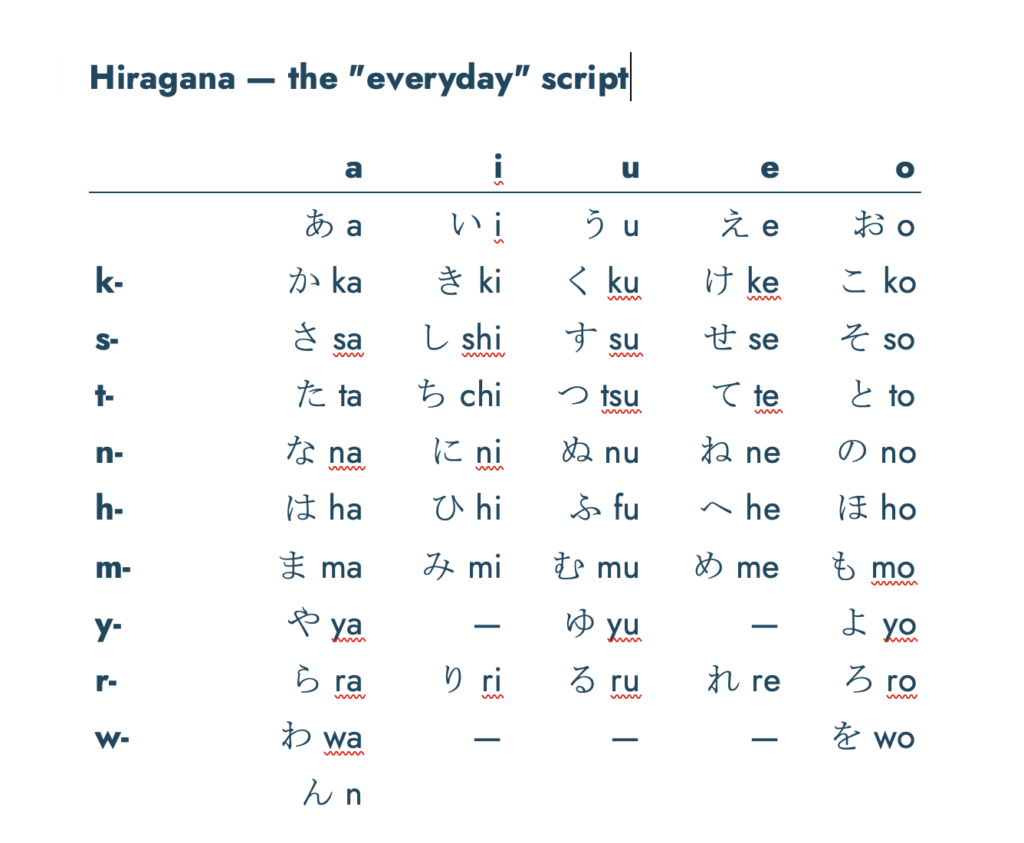
Let’s look at these scripts and see how they map to romanized sounds. Each character represents one mora, which is a unit of sound as a single beat of timing in spoken Japanese.
Hiragana is a syllabary of 46 base morae. It handles grammatical particles, verb endings, and native words not typically written in kanji. It is the first script Japanese children learn and serves as the connective tissue of every sentence.
Katakana mirrors hiragana phonetically but is used for foreign loanwords, scientific terminology, emphasis, and onomatopoeia. The word コンピュータ (konpyūta, “computer”) is written in katakana because it is borrowed from English. So is パン (pan, “bread”), borrowed from Portuguese in the 16th century.
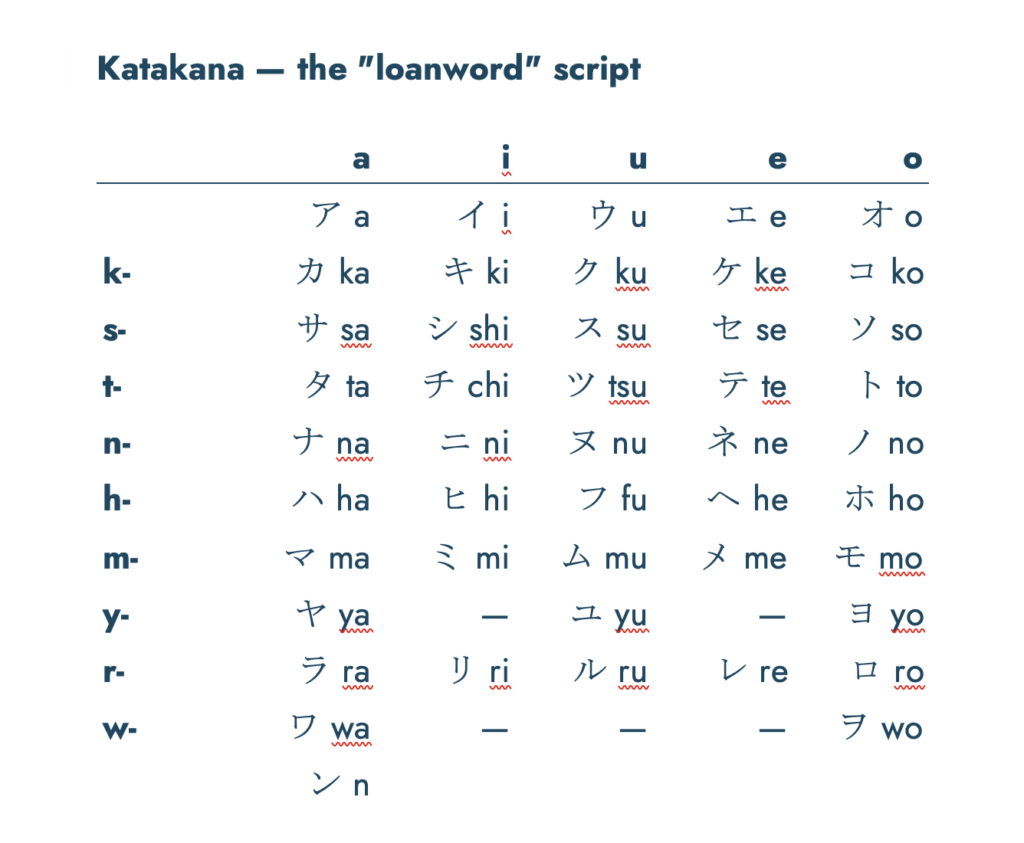
The dakuten ( ゛) and handakuten ( ゜ ) diacritical marks are added to certain hiragana and katakana characters to produce additional sounds, such as “g”, “b”, “p” and other sounds adopted from foreign languages.
For example:
- か ka can become が ga
- は ha can become ば ba or ぱ pa, etc.
With these modifications, the full hiragana and katakana sets cover every sound used in modern Japanese. Since katakana handles foreign loanwords, it has a larger inventory of these modified syllables than hiragana.
Acquiring Fluency in Japanese
Japanese is classified in the greatest difficulty category by the U.S. Foreign Service Institute, alongside Arabic, Mandarin, and Korean. FSI estimates roughly 2,200 class hours to reach professional proficiency.
The primary reason is its writing system, followed by its grammar and agglutinative word composition. However, it is highly regular once you understand the logic.
Spoken Japanese has a clean phonological inventory with five vowels (a, i, u, e, o), no consonant clusters and no tones. Pronunciation is one of the most accessible aspects of the language for English speakers.
Basic sentence construction follows predictable Subject-Object-Verb (SOV) patterns, and verb conjugation, while extensive, is almost entirely regular. Japanese has only two truly irregular verbs: する (suru, “to do”) and 来る (kuru, “to come”). Everything else follows rules.
For comparison, English has over 200 irregular verbs (go/went, eat/ate, buy/bought), and most European languages run into the hundreds as well.
To read this article in Japanese, a learner would need roughly 2,000 kanji, each with multiple readings and compound meanings. Hiragana and katakana can be learned in a few weeks. Kanji, by contrast, require years of sustained effort.
Here is the most interesting part:
The JLPT (Japanese-Language Proficiency Test) structures this into five levels, ranging from N5 (beginner, ~100 kanji) through N1 (advanced, ~2,000+ kanji). Most working professionals in Japan who use Japanese daily operate at N2 or N1. Many long-term foreign residents describe the experience of being conversationally fluent but functionally illiterate. That is, they’re able to discuss complex topics verbally but are unable to read the instructions on a medicine bottle.
That said, learners consistently report that Japanese has an internal logic that becomes satisfying once the initial disorientation fades. The grammar is strict but transparent. Politeness levels, once internalized, provide social precision that doesn’t exist in English. And the writing system, for all its difficulty, offers a kind of semantic density that packs an entire English phrase descriptively into a single word.
Measuring Verbal Fluency in Japanese
Another interesting and important aspect of the Japanese language is how neuropsychologists measure verbal fluency in native speakers. Verbal fluency testing offers a fast, sensitive way to evaluate executive functioning, lexical retrieval, and cognitive flexibility. These core brain processes are the first to break down in many neurological conditions. Clinically, it helps detect and differentiate disorders like Alzheimer’s disease, Parkinson’s disease, and frontotemporal dementia.
In English-language neuropsychology, verbal fluency is often tested using semantic categories and also the F-A-S letter fluency task, where examinees generate as many words as possible beginning with a given letter (F, A, S) within a time limit.
The letters F, A, and S were chosen because they produce a balanced number of valid words, neither too many nor too few, while minimizing verbal fluency testing rule violations and phonemic ambiguity. Early work done by Dr. Arthur Benton showed that these letters gave reliable and clinically useful results, so they became the standardized set for the English language.
This type of testing works for English and for many other languages with different stimulus letters, because it is alphabet-based and phoneme-driven. Japanese, however, doesn’t work like that.
Japanese lexical retrieval is organized around morae instead of individual phonemes, so verbal fluency testing is adapted accordingly. Instead of letters, Japanese speakers are typically given a kana sound, such as “か” (ka) or “し” (shi), and asked to produce as many words as possible that begin with that sound within 60 seconds. This is often referred to as phonemic fluency using kana cues.
So, those of you who translate or hire someone to translate verbal fluency tasks from English versions to Japanese, please pay special attention to this clinically important difference. Simply translating the text and leaving it at something like エフ (efu), エー (ē) and エス (esu) is an error that is likely to slip through unnoticed, because the translation would be technically correct.
Most translators and language service providers are not trained in verbal fluency testing rules. It is up to their customers to provide explicit instructions for adapting this task.
Politeness, Social Hierarchy and Cultural Context
The Role of Politeness
Politeness is an important Japanese cultural norm. Every interaction reflects an awareness of who you are speaking to, where you stand in relation to them, and what language style the situation calls for.
Two core concepts influence language style: uchi (内) and soto (外). Uchi refers to one’s in-group, such as family, close colleagues, or members of the same organization. Soto refers to the out-group, such as clients, outsiders, or anyone not considered part of that immediate circle. Speakers adjust how they present themselves and others based on which side of that boundary the listener belongs. People within the soto group are elevated and treated with greater formality, while those within uchi are approached more directly. Simultaneously, Japanese people tend to present themselves and their own group more modestly when addressing outsiders. It is their cultural way of projecting respect and maintaining clarity in distance in social relationships.
Indirectness and Shared Understanding
A large portion of meaning in Japanese is carried through context rather than explicit wording. Indirectness is an important cultural norm in Japanese communication. In English-speaking cultures, clarity in message is often achieved by stating things directly. For example, “I can’t do that,” or “I disagree.” A Japanese person would likely express these as “That’s a bit difficult”, or “There may be another way to look at it.” This approach is especially important in situations involving refusal or disagreement. It allows the listener to deduce the outcome through implication, without being confronted. This way, the relationship is maintained and balanced as neither side loses face.
Comfortable Silence and Situational Awareness
There is also a strong expectation of situational awareness, often described as “reading the air.” People are expected to pick up on subtle cues and adjust accordingly without everything being said explicitly. Silence is an important part of this type of communication.
In Japanese culture, silence carries meaning the same way as words do, and it’s natural for conversation to pause without pressure to fill the space. A pause can signal agreement, hesitation, or reflection. What was left unsaid is just as important as what was said. In English-speaking cultures, silence during conversation is perceived as awkwardness and is often filled quickly to keep the conversation moving.
In professional meetings with Western teams, Japanese speakers often appear quiet or hesitant to ask questions. Meetings in the Japanese context are mainly for confirmation, alignment and formalization, not for exploration. Exploration is handled through pre-meetings, internal conversations, or informal consensus-building. Speaking up in a formal group meeting can introduce risk by exposing gaps in understanding, challenging the speaker, or disrupting the flow of the interaction, so questions are often held back.
Japanese teams expect participants to come prepared, so raising basic or even critical questions during the meeting may signal to well-prepared peers that this expectation has not been met. Questions and issues requiring deeper discussion are noted and followed up on separately. When disagreement or uncertainty occurs, it tends to be handled indirectly or followed up privately to preserve professional integrity within the group.
To Be Continued...
In a future edition, we’ll look into how Japanese actually works. We’ll explore its grammar, sentence structure, and the logic behind its SOV word order. We’ll also learn some kanji and practical vocabulary you can start using right away.
We’ll also explore politeness levels, the role of context, and how the language handles nuance. Most importantly, we’ll connect all of this back to how Japanese is processed, learned, and measured—so you can see not just how to use the language, but how it functions in the mind.
If you’ve missed previous editions of the Santium Language Series, you’ll find them here – catch up!
How Santium contributes to this space
Santium’s work combines language, science, and measurement. Our focus is on translating words while also preserving conceptual integrity, contextual relevance, and functional equivalence across languages. Whether it’s clinical outcome assessments, scientific, technical or regulatory documentation, the goal is the same: ensure that what is being translated from one language is understood, relevant and functional in the same way in another.
Follow Santium to stay connected
If you found this article interesting, follow me on LinkedIn and join our newsletter to receive future editions. In the Santium Language Series, I explore interesting traits of the world’s languages, from the most widely spoken to obscure, introducing their structure and word formation to cultural nuance and their role in social norms.
Stay connected and don’t miss the next edition!

|
Thank you for signing up. |


References
Benton, A. L., Hamsher, K., & Sivan, A. B. (1994). Multilingual aphasia examination (3rd ed.). AJA Associates.
Frellesvig, B. (2010). A History of the Japanese Language. Cambridge University Press.
Hall, E. T. (1976). Beyond culture. Anchor Books.
Honna, N. (1995). English in Japanese society: Language within culture. Multilingual Matters.
Heinrich, P. (2012). The Making of Monolingual Japan: Language Ideology and Japanese Modernity. Multilingual Matters.
Ito, E., et al. (2004). Effect of orthography on the verbal fluency performance in schizophrenia: Examination using Japanese patients. Schizophrenia Research, 69(1), 15–22.
Japanese Ministry of Education, Culture, Sports, Science and Technology (MEXT). (2010). Jōyō Kanji table.
Kindaichi, H. (2011). The Japanese language. Tuttle Publishing.
Martin, S. E. (1975). A reference grammar of Japanese. Yale University Press.
Maynard, S. K. (1997). Japanese communication: Language and thought in context. University of Hawai‘i Press.
Nakagawa, Y., & Kudo, T. (2010). Verbal fluency test in Japanese: Normative data and clinical application. Japanese Journal of Neuropsychology, 26(3), 189–198.
Shibatani, M. (1990). The languages of Japan. Cambridge University Press.
Shinagawa, Y., et al. (2014). Language-specific cortical activation patterns for verbal fluency tasks in Japanese. Journal of Clinical and Experimental Neuropsychology, 36(4), 356–367.
Tanaka, S. (2004). Familiarity and imageability ratings for Japanese mora-initial words. Behavior Research Methods, Instruments, & Computers, 36(3), 531–547.
Yamadori, A. (2002). Verbal fluency in Japanese speakers: Effects of phonological and semantic cues. Neuropsychologia, 40(8), 1201–1210.

Monika Vance
Managing Director | SANTIUM
My work sits at the intersection of linguistics, scientific and medical translation, psychometric measurement, and multilingual operations, where terminology, usability, and regulatory context must align. I write about scientific and medical translations, psychometrics, languages, and the operational challenges that inevitably come with them. I also teach translators how to properly translate and validate complex psychometric instruments to hone their expertise in linguistic validation.