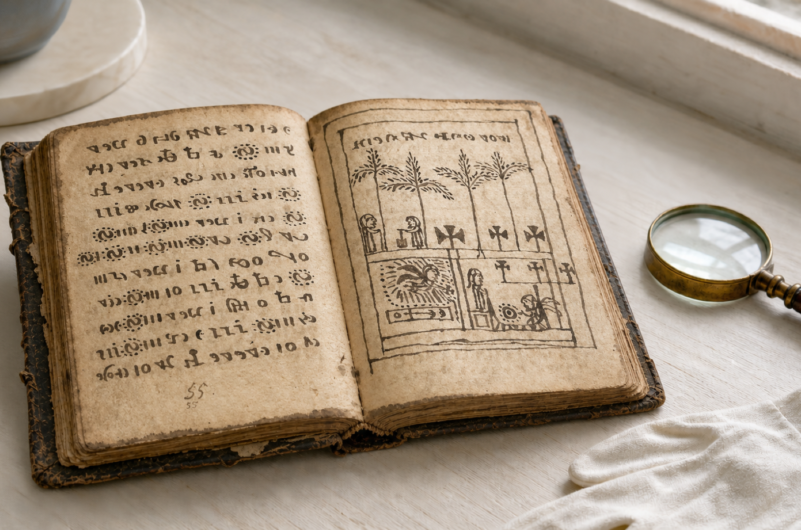
The manuscript is known as the Rohonc Codex, pronounced Rohonts Codex, and named after the town of Rohonc, now Rechnitz in Austria, where it was kept in the library of the Hungarian Batthyány family. In 1838, the family donated it to the Hungarian Academy of Sciences. By then, almost everything about its origin had already been lost.
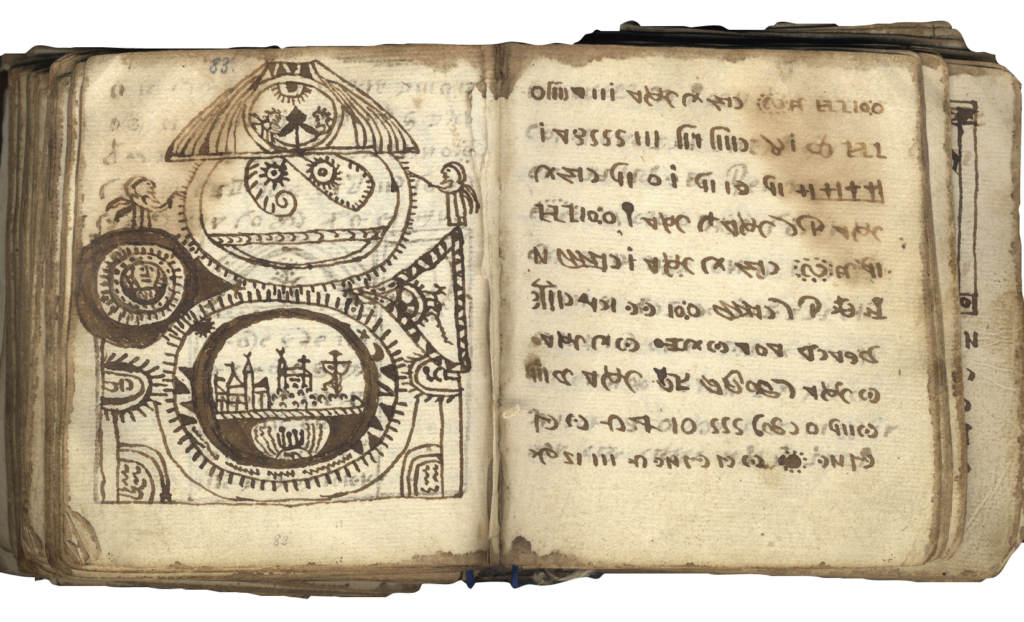
Its pages contain rows of unfamiliar signs alongside small illustrations of battles, fortified cities, religious ceremonies and scenes from what may be everyday life. Crosses, crescents and other religious symbols appear throughout. The script seems structured. Symbols repeat, patterns emerge and the text appears carefully organized. But structure does not necessarily mean language.
Its Unknown History
No reliable record identifies where the manuscript was made, who first owned it or how it was acquired into the Batthyány collection.
A 1743 library catalogue that belonged to Count Lajos Batthyány and accompanied the Batthyány libraries when they were donated to the Hungarian Learned Society in 1838, lists a duodecimo volume listed as “Hungarian prayers.” Its 12 x 10 centimetre size (5 x 4 inches) and possible subject matter could fit the Rohonc Codex, but the catalogue description is too general to confidently conclude that they are the same book.
The paper appears to be older than the codex’s first documented appearance in the 19th century. A watermark has been linked to paper produced in Venice, Italy, between 1529 and 1540. Paper can be unused for decades, or be deliberately aged to make a manuscript appear older. But the age of the paper does not necessarily match the age of the writing.
The ink and writing materials have been examined visually by researchers, including an American historical-document examiner and investigator, Joe Nickell. No obvious evidence of modern fabrication was identified. The manuscript may have been written not long after the paper was made, but this has not been confirmed through laboratory chemical analysis that would securely date the ink.
Even the direction in which the codex should be read is unknown. Several features suggest that the text runs from right to left, including the alignment of its lines and the apparent sequence of some illustrations. Yet without a confirmed language or at least a partial decipherment, this is only an assumption.
For nearly two centuries, scholars and amateur cryptographers have tried to decipher the Rohonc Codex. It has been described as a religious text, a historical chronicle, an encrypted manuscript and an elaborate 19th-century forgery.
A scholarly edition of it has since been published online by Department of Manuscripts and Rare Books at the Library of the Hungarian Academy of Sciences in Budapest. It is held there under shelf mark K 114.
Some have claimed to have translated it but none of their interpretations has been widely accepted.
Inside the Codex
The Rohonc Codex contains 224 leaves, or 448 pages. Most are filled with short lines of densely arranged symbols. Scattered throughout the text are 87 illustrations depicting what appear to be religious ceremonies, armed conflict, fortified settlements, executions, journeys and what appear to be scenes from the life of Christ.
Simple Illustrations of Recognizable Stories
The drawings are small and technically simple, but they are central to how the manuscript has been interpreted so far. Crosses appear frequently. So do crescent-like forms, suns and other symbols that have been associated with different religious traditions.
The illustrations appear to be overwhelmingly Christian. Crosses and crescent-like architectural ornaments appear together. Many of the drawings represent biblical events, especially the Gospels, and include the Passion of Christ, while the meaning of the remaining scenes is less certain.
Some researchers see evidence of a culture in which Christianity, Islam and other belief systems coexisted. Others caution that the symbols may not have had the same meanings back then as the meanings we associated them with now.
One image combines Jesus’s arrival in Jerusalem with the expulsion of the merchants. Another shows a tree-like or apocalyptic composition in which Jesus appears between Abraham and Moses. There are also scenes connected with parables, saints, the Virgin Mary and material outside the canonical Bible.
The less readily identifiable images depict fortified towns, churches, towers, armed figures, journeys, rulers and acts of violence. These have sometimes been interpreted as battles between different religious communities. Some could represent Jerusalem, Roman soldiers or episodes from the Passion rather than a military battle.
The tower decorations have been especially confusing scholars. Some buildings carry crosses, others crescent-shaped finials, balls, flags or geometric forms. Earlier researchers thought the crescents to be evidence of Islam or Eastern Christianity. A later count found crescents on only about 36 percent of the towers. They may simply have been the artist’s way of representing the architecture of the Holy Land.
The drawings also seem to borrow from several artistic traditions. Some compositions resemble late-antique and Byzantine religious art found in Italy, while the weapons, churches and mysterious Gothic forms look more Central European. Art historians have suggested that the artist was probably Central European but had encountered Italian religious imagery, directly or through copied models.
The Script
It is also not clear what the written symbols actually represent. Estimates of the number of distinct signs vary because it is difficult to determine if minor differences represent separate characters, variations of the same character or writing errors. Either way, the symbol inventory appears considerably larger than the alphabet of an ordinary European language.
This has led to several possibilities. The signs may represent complete words rather than individual sounds. They may form a syllabary, in which each symbol represents a syllable rather than a letter. Some could be numbers, punctuation marks or abbreviations. The script may also combine more than one of these functions.
There are signs of organization. Certain symbols recur in similar positions. Sequences repeat, and the text is divided into lines with apparent consistency. But pattern alone does not mean that this is a meaningful language. Any invented language can produce repetition and structure.
Even the relationship between the writing and the illustrations are uncertain. If the pictures describe the surrounding text, they could provide the clues needed to decipher it. But not necessarily, because they may have been added later, copied from other sources or designed to mislead those who were not meant to read it.
A Language, a Code or a Forgery?
Similarly to the Voynich Manuscript, theories about what the Rohonc Codex is can be grouped into three broad categories.
An Unfamiliar Language
Attempts to read it as language have produced significantly different results. It has been proposed as Hungarian, Romanian, Brahmi and an early South Slavic language, among others. The underlying problem is that researchers often approached deciphrement with a preferred language. Benedeck Láng describes these earlier attempts as being influenced partly by national and historical ideologies, instead of being borne from independently reproducible techniques.
Hungarian was the earliest assumption because the codex came from a Hungarian collection and was initially throught to be a possible relic of ancient Hungarian writing. The 1743 catalogue entry describing “Hungarian prayers” encouraged this interpretation. 19th-century researchers looked for connections with Old Hungarian script, while Attila Nyíri later proposed a Sumero-Hungarian reading. His method required turning pages upside down, assigning values by visual resemblance and rearranging letters to form words.
Romanian came primarily from Viorica Enăchiuc’s 2002 decipherment. She argued that the manuscript recorded an 11th-century Dacian form of Vulgar Latin and described conflicts involving the Vlachs, Hungarians and Pechenegs. Her reading identified Romanian place names and historical figures, but it assigned different values to the same symbols and produced a form of Romanian unattested anywhere else.
Mahesh Kumar Singh proposed that the script was an undocumented form of Brahmi and used it to produce a religious text in Hindi. The argument was based largely on perceived similarities between individual Rohonc signs and Brahmi characters.
South Slavic was proposed as a contextual possibility. The manuscript’s apparently East-Central European imagery and Christian content have led researchers to consider languages used in that region, including South Slavic varieties. Possible links with communities such as the Bogomils have also been suggested, but no accepted South Slavic reading exists.
A Codebook or a Cipher
The writing could also be a cipher. The Rohonc Codex has a much larger set of signs, while some appear only rarely. This is consistent with a homophonic cipher, in which several different symbols represent the same sound or letter. Such systems were used in early modern Europe to prevent readers from identifying a language through ordinary frequency analysis.
There is also a historical reason to consider encryption. The paper has been associated with 16th-century northern Italy, a period when ciphers were widely used in diplomacy, religious correspondence and political communication across Europe. Hungary and the surrounding regions were connected to these traditions.
Gábor Tokai and Levente Zoltán Király have developed the most substantial version of this argument. Their 2018 analysis infers that the writing is a code system in which symbol groups represent words and concepts. They identified apparent numerical expressions and used recurring biblical scenes to propose values for nearby groups. Their method has produced some consistent results, although it has not yet yielded a complete, independently accepted translation.
An Elaborate Hoax
Another possibility is that the codex was never meant to be read. It may have been created to look like an ancient religious or historical manuscript, so it could be sold as a mysterious linguistic and intellectual jewel. An unknown script would have made it difficult to challenge its authenticity because no buyer or scholar could verify what it said.
Forgery was the dominant explanation among late nineteenth-century Hungarian scholars.
Suspicion eventually settled on Sámuel Literáti Nemes, a 19th-century Hungarian antiquarian with a talent for finding precisely the historical objects that collectors wanted to discover.
Nemes travelled through Hungary and Transylvania acquiring manuscripts, maps, genealogies and antiquities for private collectors and cultural institutions. Some of his discoveries were genuine. Others were not. He created or circulated fabricated documents, including chronicles, maps, genealogical records and supposed examples of early Hungarian writing.
The timing made him an obvious suspect. The Rohonc Codex became known during the same period in which Nemes was active, when interest in recovering Hungary’s ancient literary and linguistic past was particularly strong. A manuscript written in an unknown script could appear to supply evidence of a lost Hungarian writing tradition while remaining conveniently impossible to verify.
The codex also resembles the kind of object associated with his work. Several of Nemes’s known forgeries were designed to fill gaps in the historical record or support claims about early Hungarian culture. Some combined invented writing with deliberately aged materials and historical imagery.
In 2010, Benedek Láng invited Nickell to examine the Rohonc Codex at the Library of the Hungarian Academy of Sciences. His role was to look for physical signs that might help determine if the manuscript was produced naturally in an earlier period or manufactured later as a forgery. The University of Kentucky, where he worked as a private investigator, described his approach as combining forensic examination with historical and textual research.
But there is no direct evidence that Nemes made the Rohonc Codex. No letter, sales record or witness connects him to it. His known fabrications were also considerably shorter. Producing this manuscript would have required a different level of effort, including hundreds of pages of writing and a system capable of maintaining at least the appearance of internal order.
Attempts to Read the Script
The Rohonc Codex attracted attention immediately after it was indexed at the Hungarian Academy of Sciences. Ferenc Toldy examined it around 1840, followed by linguist Pál Hunfalvy and Austrian palaeographer Albert Mahl. None could identify the script.
The manuscript was later sent to scholars outside Hungary. Josef Jireček and his son, Konstantin, studied 32 pages in Prague in 1884 and 1885. It was then examined by Bernhard Jülg, a professor of linguistics at the University of Innsbruck. Even the Hungarian painter Mihály Munkácsy took the codex to Paris between 1890 and 1892, hoping that someone there might recognize the writing.
For much of the 20th century, the assumption that the manuscript was a forgery discouraged further academic attention. Research continued largely through individual attempts, many of which began by selecting a language as a comparative baseline and attempting to assign values to the symbols.
A more systematic approach began with the structure of the text rather than its presumed language. In 1970, Ottó Gyürk identified what appeared to be numerical patterns and supported the conclusion that the codex should be read from right to left. Miklós Locsmándi later identified possible separators and recurring textual units.
Gábor Tokai and Levente Zoltán Király developed these observations independently before combining their work. Tokai approached the manuscript through its illustrations, looking for names, biblical references and numbers that might appear beside recognizable scenes. Király created a digital transcription and examined the distribution of symbols across the manuscript.
Their 2018 study argues that the writing is not an alphabet in which each symbol represents a sound. Instead, they believed that short groups of signs appear to represent complete words or phrases. They have proposed readings for numbers, biblical names, chapter divisions and recurring religious expressions. On their interpretation, the codex is a Catholic devotional book containing paraphrases of the New Testament, prayers, legends and allegorical material.
This is the most developed reading proposed so far. It has moved the discussion away from finding a lost alphabet and towards understanding a coded system. But much of the vocabulary and grammar has not yet been published in a form that allows the entire manuscript to be independently translated.
The codex may therefore be partly deciphered. But it is not fully read yet.
What Would Count as Decipherment?
The Rohonc Codex has no Rosetta Stone. It presents a problem without an external point of reference or comparison to a known language. There is no parallel text, no known key and no second manuscript that can confirm the meaning of an unfamiliar passage.
An undeciphered manuscript without any such reference points can be made to say almost anything if the interpretation and statistical analysis rules are flexible enough.
The British economist Ronald Coates’ famous adage comes to mind:
If you torture the data long enough, it will confess to anything.
Same applies to interpreting undeciphered scripts. A symbol can be assigned one value in one passage and another somewhere else. Words can be divided differently, inconvenient symbols can be ignored and illustrations can be used to suggest whatever meaning the reader would like to find.
But, a credible decipherment must impose limits that follow scientific principles.
The first requirement is consistency. Once a value has been assigned to a symbol or a group of symbols, it should continue to work in comparable contexts. Exceptions may occur, as they do in natural languages, but exceptions cannot be the method.
The second is coverage. Translating a few lines beside an familiar image is not enough. A proposed system must also explain pages without illustrations, repeated passages and sections whose subject cannot be guessed.
The third is prediction. A strong method should make it possible to anticipate what an unread passage contains before consulting the surrounding image or narrative. If every interpretation depends on knowing the expected answer first, the method may be recognizing patterns created by the researcher instead of the writer.
Finally, reading must be reproducible. Other people need access to the transcription, symbol values, grammatical rules and complete sequence of decisions. Under those conditions, they should be able to apply those rules to a new passage and independently arrive at substantially the same reading.
If you’d like to view the manuscript, you’ll find it here.
Thank you for reading!
How Santium Contributes to This Space
Santium provides specialized translation and cross-cultural research services focused on adapting and validating scientific, medical and technical content. We deliver translated materials that work as intended across languages and cultures through translation, linguistic validation, and subject-matter specialist engagement, preserving meaning, functionality, usability, and, where applicable, measurement integrity in real-world applications and settings.
Curious About the World’s Languages?
If you found this article interesting, follow me on LinkedIn and join our newsletter to receive future editions. In the Santium Language Series, I explore interesting traits of the world’s languages, from the most widely spoken to obscure, introducing their structure and word formation to cultural nuance and their role in social norms.
Stay connected and don’t miss the next edition!
About the Author
Monika Vance | Managing Director | SANTIUM
My work sits at the intersection of linguistics, scientific and medical translation, psychometric measurement, and multilingual operations, where terminology, usability, end-user experience, and regulatory context must align. I write about scientific and medical translations, psychometrics, languages, patient-centred research and the operational challenges that inevitably come with them. I also teach translators how to properly translate and validate complex psychometric instruments to hone their expertise in linguistic validation.

|
Thank you for signing up. |


References
Csapodi, C. (1973). A “Magyar Codexek” elnevezésű gyűjtemény (K 31–K 114). Magyar Tudományos Akadémia Könyvtára. https://real-eod.mtak.hu/87/
Hursán, S. (2023). Batthyány Lajos Ernő könyvtára (1743). Magyar Tudományos Akadémia Könyvtár és Információs Központ. https://doi.org/10.36820/karpatmed.2023.Hursan
Jerney, J. (1844). Némi világosítások az ismeretlen jellemű rohonczi írott könyvre. Tudománytár, 8, 25–36.
Király, L. Z. (2023). A Rohonci kódex teológiai karaktere: Közismert és idioszinkratikus mozzanatok azonosításával egy rejtélyes szerző kiléte felé. In R. Kiss & G. Lányi (Eds.), Hagyomány, identitás, történelem 2022 (pp. 363–376). Károli Gáspár Református Egyetem. https://doi.org/10.61376/hit.2022.kiraly.25
Király, L. Z., & Tokai, G. (2018). Cracking the code of the Rohonc Codex. Cryptologia, 42(4), 285–315. https://doi.org/10.1080/01611194.2018.1449147
Láng, B. (2010). Why don’t we decipher an outdated cipher system? The Codex of Rohonc. Cryptologia, 34(2), 115–144. https://doi.org/10.1080/01611191003605587
Láng, B. (2021). The Rohonc code: Tracing a historical riddle. Penn State University Press. https://doi.org/10.1515/9780271090269
Library and Information Centre of the Hungarian Academy of Sciences. (n.d.). Rohonc Codex [Digitized manuscript, K 114]. https://real-ms.mtak.hu/80/
Nickell, J. (1990). Pen, ink, and evidence: A study of writing and writing materials for the penman, collector, and document detective. Oak Knoll Books.

Monika Vance
Managing Director | SANTIUM
My work sits at the intersection of linguistics, scientific and medical translation, psychometric measurement, and multilingual operations, where terminology, usability, and regulatory context must align. I write about scientific and medical translations, psychometrics, languages, patient-centred research and the operational challenges that inevitably come with them. I also teach translators how to properly translate and validate complex psychometric instruments to hone their expertise in linguistic validation.