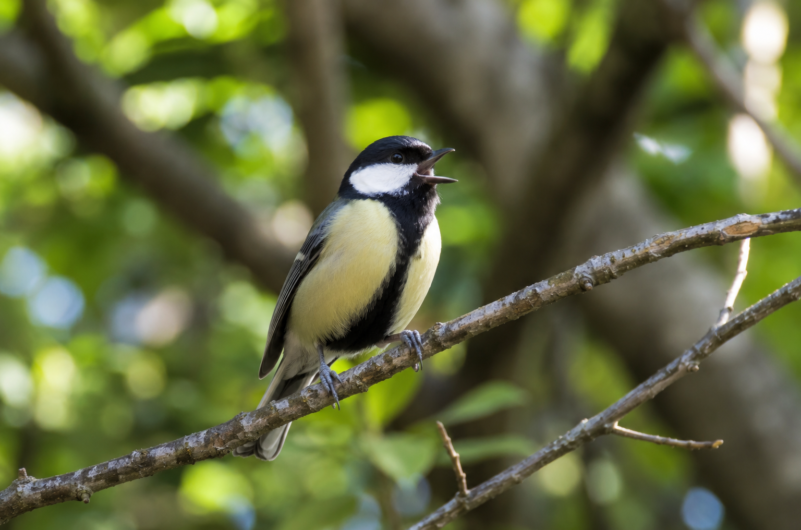
The shijukara, commonly known as the Japanese tit, is an ordinary bird found throughout much of Japan. Suzuki became curious about the wide variety of calls the bird makes and how others respond to them. The bird is very vocal and easy to observe. He continued to study this species through university and into his scientific career, wondering if the birds were communicating more than isolated messages.
Through years of careful observation and a series of elegant field experiments, Suzuki found that the birds responded differently when certain calls were combined in a particular sequence than when they were the same calls played in reverse. The birds responded as though they interpreted the sequence as a unified message. Reversed calls were interpreted as separate signals.
Does a sequence of bird calls resemble a human sequence of words…a sentence? If so, what are the birds saying?
Decoding the Vocabulary
Suzuki’s first challenge was to determine if individual calls meant anything at all. He spent years observing Japanese tits in their natural habitat, carefully recording the calls they made and the circumstances in which they occurred. Whenever the birds encountered a predator, discovered food, defended their territory, or interacted with members of their family, he noted which calls they produced and how nearby birds responded.
Eventually, patterns began to emerge. One particular call consistently caused other birds to scan the surrounding branches for danger. Another prompted them to fly toward the caller, often joining it in inspecting a potential predator such as an owl or a snake. Others appeared during routine social interactions between mates and family groups.
However, observation alone was not enough. Birds often respond to many things happening at the same time. To find out if individual calls carried meaning, Suzuki began conducting audio playback experiments. He recorded individual calls and played them back through hidden speakers while carefully observing how the wild birds reacted.
The responses were remarkably consistent. Birds searched for predators after hearing alarm calls, approached after hearing recruitment calls, and largely ignored recordings that were unrelated to the situation. By isolating the calls from everything else happening in the environment, Suzuki demonstrated that individual sounds conveyed specific information.
Then, after establishing the meaning of individual calls, he began to study the syntax.
Grammar: Call Order
Are the birds combining calls to create more complex messages?
To find out, Suzuki returned to playback experiments. He played recordings of two familiar calls in their natural order. The first was an alert call that warned nearby birds of potential danger. The second was a recruitment call that encouraged other birds to approach and investigate.
The response was immediate. The birds flew toward the calling bird while scanning the surrounding branches, as though they had been instructed to come and investigate a possible predator.
Then, Suzuki reversed the order of the very same calls. This time, the birds did not approach in the same way or search as they did before. The sounds were in a different order. This was the first convincing evidence that wild birds combine meaningful calls according to rules.
Granted, human language depends on more than words, but words must also appear in a specific order to allow a listener to understand what is being communicated. Suzuki’s experiments produced the first evidence ever recorded that birds follow a similar principle.
What Birds Say
Suzuki’s experiments allowed him to assign practical meanings to several Japanese tit calls. Notice the “call order” when compared to English.
Examples
The ABC call
Context: predator nearby
rapid chicka-chicka = “alert” or “scan for danger”
The birds fly around scanning branches and ground for predators.
The D call
Context: Caller wants others to come
repeated dee-dee-dee = “come here”
It causes nearby birds to approach the caller.
The ABC-D call
Context: stationary predator close-up
“Come here and scan for danger.”
The birds fly towards the caller while searching the surroundings
The birds also give a distinct single-note alarm call when they encounter a snake. This call causes listeners to look down and visually search for an elongated, moving object, often near the ground or along a tree trunk.
Suzuki tested this by moving a stick in a snake-like way after playing the call. The birds reacted to the stick as though looking for a snake, providing evidence that the call evokes a specific mental image rather than a general sense of alarm.
Raptor calls are associated with a hawk or other aerial predators, where birds look upward and take cover. Mobbing calls indicate the presence of an owl or a perched predator, where multiple birds gather and harass the predator. Nest recruitment D calls bring one mate to the nest. Contact calls maintain group cohesion while feeding. And territorial song calls signal courtship; mates attend and protect their breeding territory.
Not all actual meanings have been tested with high enough precision yet.
Rethinking the Origins of Language
Human language is built from simple ingredients. Individual words have meanings, but we rarely use them without combining them. We combine them into larger expressions, and the order in which they appear changes how we understand what is being said.
Consider the difference between “open the door” and “the door opens.” The same words are involved, yet they convey different ideas because they are arranged differently. Rearranging the words can also produce something that doesn’t make any sense at all. Linguists call this principle compositional syntax, where the meaning of a larger expression depends on both the meanings of its individual parts and the way those parts are combined.
Until Suzuki’s discovery, many scientists believed this ability was unique to human language. Animals were known to produce alarm calls, mating calls, territorial calls, and many other vocal signals, but these were generally thought to be independent messages rather than elements that could be combined according to grammatical rules.
Suzuki’s experiments disrupted that belief. The findings suggested that at least one of the fundamental principles underlying human language may have evolved long before humans did.
Listening More Attentively
Long before scientists began studying bird calls, humans had already imagined animals communicating with one another. Children across much of the world grow up with stories in which birds, lions, foxes, monkeys, turtles, and countless other creatures speak, argue, cooperate, deceive, and teach.
Some of the oldest examples appear in the Panchatantra, a collection of Indian animal fables dating back more than two thousand years. Similar traditions exist across cultures, from Aesop’s fables in ancient Greece to Indigenous oral traditions on every inhabited continent. We have long imagined animals possessing languages of their own.
For many Indigenous peoples, this was more than storytelling. Hunters, fishers, and foragers learned to pay close attention to the sounds animals made. Birds and horses warned of approaching predators. Ravens revealed the location of wild game. Honeyguides led people to wild beehives in exchange for beeswax. These observations became part of traditional ecological knowledge, accumulated over countless generations through attentive listening and vocal emulation.
Modern science is beginning to confirm many of these observations. It’s quite possible that sometime in history, people have already discovered animal languages. Animals communicate far more information than we once believed, and people who lived closely with the natural world learned to interpret at least part of that communication.
Toshitaka Suzuki’s achievement is, however, in its own category. He designed scientific experiments that allowed him to test the meaning of individual calls and whether birds combined them according to grammatical rules. His work transformed a long-held human intuition into evidence that could be examined, repeated, and challenged by other scientists.
The tiny shijūkara has since become one of the most studied birds in the emerging field of animal linguistics. Its calls are helping researchers explore how communication systems evolve and, perhaps, how the foundations of human language first began.
Next time you hear a bird song, look up and watch the show.
How Santium Contributes to This Space
Santium provides specialized translation and cross-cultural research services focused on adapting and validating scientific, medical and technical content. We deliver translated materials that work as intended across languages and cultures through translation, linguistic validation, and subject-matter specialist engagement, preserving meaning, functionality, usability, and, where applicable, measurement integrity in real-world applications and settings.
Curious About the World’s Languages?
If you found this article interesting, follow me on LinkedIn and join our newsletter to receive future editions. In the Santium Language Series, I explore interesting traits of the world’s languages, from the most widely spoken to obscure, introducing their structure and word formation to cultural nuance and their role in social norms.
Stay connected and don’t miss the next edition!
About the Author
Monika Vance | Managing Director | SANTIUM
My work sits at the intersection of linguistics, scientific and medical translation, psychometric measurement, and multilingual operations, where terminology, usability, end-user experience, and regulatory context must align. I write about scientific and medical translations, psychometrics, languages, patient-centred research and the operational challenges that inevitably come with them. I also teach translators how to properly translate and validate complex psychometric instruments to hone their expertise in linguistic validation.

|
Thank you for signing up. |



Monika Vance
Managing Director | SANTIUM
My work sits at the intersection of linguistics, scientific and medical translation, psychometric measurement, and multilingual operations, where terminology, usability, and regulatory context must align. I write about scientific and medical translations, psychometrics, languages, patient-centred research and the operational challenges that inevitably come with them. I also teach translators how to properly translate and validate complex psychometric instruments to hone their expertise in linguistic validation.