
Vietnam stretches along the eastern edge of mainland Southeast Asia, bordered by China to the north and Laos and Cambodia to the west, with a long coastline facing the South China Sea.
In the north, Ha Long Bay draws visitors with hidden lagoons and limestone karsts rising from calm, green water. Further inland, the mountains of Sapa are shaped into cascading rice terraces that follow the contours of the hills. In central Vietnam, lanterns light the river that runs through the historic town of Hoi An, while the Da Nang coastline offers long stretches of white sand comparable to some of the world’s most sought-after beaches. In the south, the Mekong Delta unfolds into a network of waterways where daily life takes place on the river, with boats replacing roads and floating markets supplying goods. Across the country, the landscape is varied, vivid, and offers scenic magic for photography enthusiasts.
Vietnam’s narrow, elongated shape has played a direct role in shaping regional identities, settlement patterns, and ultimately the way Vietnamese is spoken across the country.
The country’s cultural history is over 4,000 years long, when its early Austroasiatic roots formed the foundation of the population and its language. A millennium of Chinese rule (111 BCE–939 CE) left a deep imprint on vocabulary, governance and culture. Later, French colonial administration introduced new systems and infrastructure. The 20th century brought war, division, and reunification, followed by rapid economic development. Each phase added something tangible to the language.
Culturally, Vietnam is highly cohesive but regionally expressive. Confucian values shaped social hierarchy and communication norms, which still endure in how people address each other. Family structure, respect for age, and indirect communication styles are embedded in everyday speech. At the same time, regional accents and local identities remain distinct, especially between the north, central, and southern parts of the country.
Vietnamese is the official language and is spoken by roughly 90 million people in Vietnam, with several million more in diaspora communities across the United States, Europe, and Australia. It is the dominant language of education, media, and government, and it coexists with a range of minority languages spoken by ethnic groups throughout the country.
A Language Shaped by History and Contact
Vietnamese belongs to the Austroasiatic language family, which includes Khmer (Cambodian). Its vocabulary reflects the country’s history. At its core are native Austroasiatic words used in everyday speech, but much of the lexicon comes from long periods of contact with other cultures.
The deepest influence is Chinese. Over nearly a thousand years, Vietnamese absorbed a large body of Sino-Vietnamese vocabulary, especially for government, education, science and philosophy. Words like giáo dục (education) and bệnh viện (hospital) come from Chinese and still dominate formal language today.
During French colonial rule in the 19th and early 20th centuries, a new set of words entered the language, mainly tied to food, materials, and modern life. These were adapted phonetically and assigned tones: cà phê (café for coffee), phô mai (fromage for cheese), ga (train station, derived from gare).
More recently, English has added another layer, especially in technology and business, with words like internet, email, and marketing used directly or slightly adapted.
Foreign loanwords are fully integrated into Vietnamese and recognized in its national syllabus. They follow Vietnamese pronunciation, have assigned tones, and fit into its grammatical system. Vietnamese vocabulary moves dynamically between its native roots, Chinese-derived formality, French-era everyday terms, and modern English terminology.
From Chinese Influence to Latin Script
While under Chinese rule, Classical Chinese Hanzi script dominated writing and administration.
Then, for centuries, Vietnamese was written using Chữ Nôm, a complex logographic system based on Chinese characters, modified to represent native Vietnamese speech. While it allowed for greater expression, it was difficult to learn, and literacy remained low.
In the 17th century, European missionaries introduced a Latin-based writing system called Quốc Ngữ. It used familiar letters plus diacritics to represent tones and vowel quality. Unlike earlier scripts, Quốc Ngữ was phonetic and far easier to learn.
By the early 20th century, the Quốc Ngữ system replaced older scripts, playing a major role in expanding literacy and standardizing the language. This shift in moving from logographic systems to a Latin-based alphabet represents one of the most significant script transitions in linguistic history.
A Tonal Language With Unique Composition
Like the Chinese or Thai, Vietnamese speakers sing their words. Vietnamese is built on a series of six tones that are similar to those of Chinese languages, with their own, more melodic contours. Words are sung differently in different regions, but similarly enough for dialects to be largely mutually intelligible.
In tonal languages, tone and pitch form meaning. A single syllable, such as ma, can mean different things depending on which tone is used to sing it.
Before we look at its interesting vocabulary composition and grammar in a future post, let’s first explore its musical personality, which will help explain its lexical composition.
Tone Perception Across Vietnam
I have the pleasure of being in relatively regular contact with Vietnamese speakers. I’m a woman, and I like to get my nails professionally beautified every couple of weeks or so. My favourite salon is owned by a lovely Vietnamese lady, and nearly her entire team is of Vietnamese origin, with some technicians from Thailand, Cambodia and Laos. They talk and laugh constantly. To my ears, the language is exceptionally melodic, but also strikingly low and soft.
Over time, I have learned to loosely distinguish some of the tones, even though I do not understand what is being said. But the most intriguing thing about Vietnamese speech is its pitch and volume. A technician on one side of the busy salon can say something in what sounds like a mutter under the breath to my ears, and someone on the other side of the room responds, and the conversation continues at that volume. This is clearly a norm, and I’ve wondered about why the projection works at such a low level in a relatively noisy environment.
At first glance, it is tempting to explain this through pitch range. Unlike Chinese speakers, who speak on a pitch scale of approximately 5 points, Vietnamese can stretch up to 7, depending on dialect. That’s up to 4 musical notes higher. But this does not push the mid-range lower, because every speaker has a natural, comfortable speaking baseline – their mid-range – that can differ from person to person. To be understood in Vietnamese, depends on precise tonal movement, efficient use of pitch contour within the normative range, and voice quality instead of projection. Projection and volume are not needed.
Speakers of tonal languages have different perceptual training. English speakers, for example, rely heavily on volume, stress and rhythm for expression. Our ears are trained for projection and volume. Tonal speakers rely on pitch contour of the tone, timing and the quality of vocal pronunciation. From childhood, Vietnamese speakers learn to detect fine differences in tones, small timing differences and subtle voice quality cues. Together, these form distinct auditory signals for filtering speech from irrelevant noise.
In English, if the volume goes down too much, clarity in pronunciation also drops because we articulate through projection. Tonal speakers sing their words, and a song can be just as melodic at low volume as it can be at high volume.
Tone perception refers to the ability to interpret linguistic tone, where controlled patterns of pitch and voice quality carry the meaning of words. Pitch is a physical property of sound; a tuning frequency. Tone is a specific melodic pattern, or a contour, that forms words through tonal combinations. Voice quality refers to how well the vocal cords produce the right sound. Pitch height, contour, timing, and voice quality are equally important for Vietnamese comprehension. Without accurate tone perception, distinct words can blend into an unclear sound and meaning is lost.
There is also a cultural aspect. Vietnamese communication norms tend to favour more restrained vocal delivery, especially in everyday social settings. Combined with the tonal system, speech is controlled, efficient, and though remarkably quiet to foreign ears, it is deeply expressive.
Three Intelligible Regional Dialects
Vietnamese has many dialects categorized into three main regional groups:
Northern Vietnamese (Hanoi standard)
Tone perception in Northern Vietnamese depends on six clearly separated tones. Here, precise pitch contours combined with voice quality features such as creak, glottal breaks, and timing leave minimal reliance on context to resolve ambiguity. Each tone carries a distinct acoustic signature, and small deviations from proper delivery are immediately noticeable because they can change meaning.
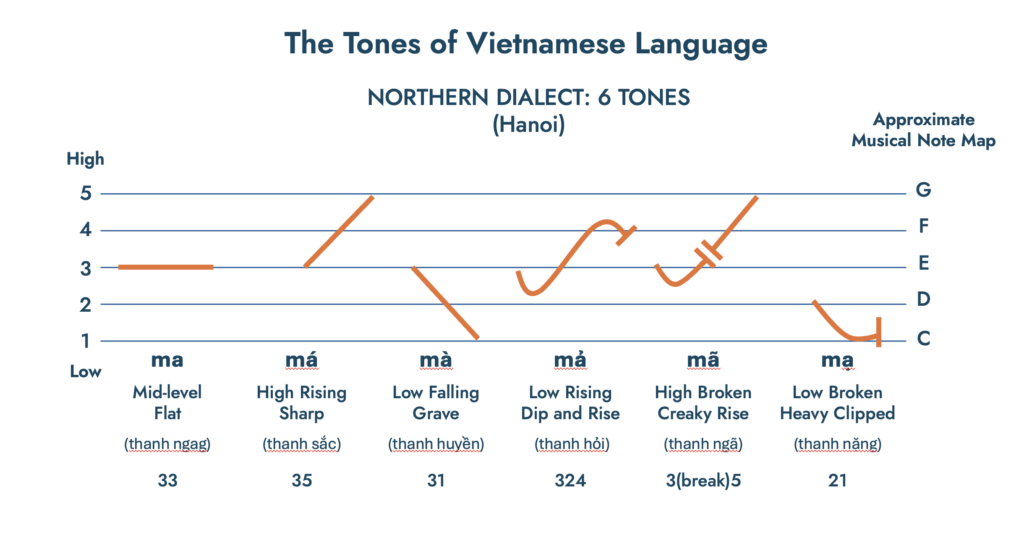
The Northern Sound System
The tone changes the meaning of the same syllable. The phonology changes from region to region, but in most cases, it remains intelligible.
Mid-level Tone
This tone is called thanh ngag, meaning “level” or “horizontal”.
In this tone:
ma = “ghost”
Ngang is the most neutral tone. It stays flat in the middle of the pitch range. The voice is smooth, with no tension or movement. To an English speaker, it sounds calm, even slightly “plain,” because there is no rise or fall. Similar to saying, “Okay” without emotion or emphasis.
High-Rising Tone
Called sắc, meaning “sharp” or “acute”.
In this tone:
má = “mother”
This tone starts in the middle of the pitch range and then smoothly rises. It is pronounced with tense phonation, sometimes even a creaky sound, throughout the duration of the vowel. It is similar to a surprised English speaker asking “What?”
Low Falling Tone
Called huyền, meaning “deep”, “hanging” or “low”.
In this tone:
mà = “but”
This tone begins mid and falls down to a low pitch, often sounding softer or more relaxed. In English, it resembles the downward pitch used in a calm statement or conclusion. For example, “Oh” when said with a falling tone, like you’ve just understood something.
Low Rising Tone
Called hỏi, meaning “to ask”.
In this tone:
mả = “grave” (noun)
This tone has a dip-and-rise contour. It starts mid, drops slightly, then rises again. The movement is relatively smooth but not as strong as sắc. It can sound somewhat hesitant or curved, like a gentle scoop in pitch rather than a sharp movement.
High Broken Tone
Called ngã, meaning “to stumble”.
In this tone:
mã = “horse” or “code”
This tone is unique because of its interruption. It begins mid, then includes a brief glottal break or tightening of the voice, followed by a rise. The result is a sound that sounds “broken” or slightly jolted before lifting upward.
Low Broken Tone
Called nặng, meaning “heavy”.
In this tone:
mạ = “rice seedling”
This is the lowest and most compressed tone. It starts low and drops quickly, often ending abruptly with a glottal stop. The sound is short, tight, and “heavy,” as if the voice is pressed down and cut off before it can fully resonate.
Central Vietnamese (Hue and surrounding regions)
Tone perception in Central Vietnamese is less sharply defined due to high regional variability. The full set of tones is used, but the acoustic distance between them is smaller. Central contours are often shortened, and voice quality cues such as glottalization are lighter and more inconsistent. As a result, listeners rely more on interpreting clustered signals through subtle timing differences, familiarity with local speech patterns, and lexical expectation.
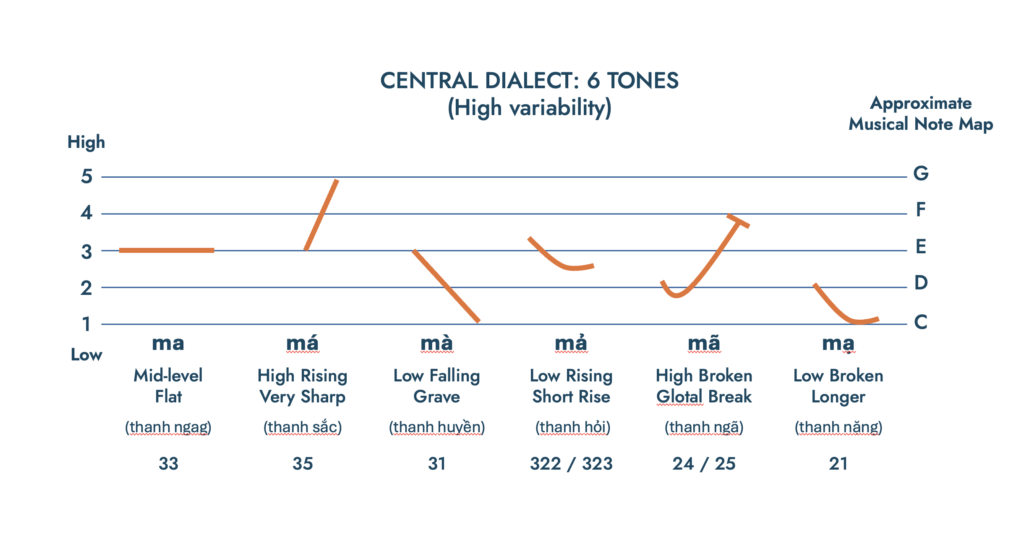
The Central Sound System
Central phonology is similar to Northern, with the following being the most common differences:
sắc
The Central variety of this tone is often steeper or more forceful rise. In some speakers, it reaches the high end faster and with more intensity than in the north.
huyền
Similar falling contour, but can sound slightly breathier or looser, especially in casual speech.
hỏi
The dip in this contour is typically shallower, and the rise is weaker or shorter. It may sound closer to a low, slightly rising contour rather than a clear dip-and-rise.
ngã
The defining glottal break is reduced or disappears. The tone often surfaces as a rising contour, which can make it perceptually closer to sắc, though still not identical.
nặng
Still low and falling, but often less abruptly cut off. The “heavy” glottal closure can be weaker or more sustained rather than sharply clipped.
ngang
Generally unchanged, though it may sound slightly lower or more relaxed depending on the speaker.
Southern Vietnamese (Ho Chi Minh City and surrounding regions)
Tone perception in Southern Vietnamese is functionally simplified. The merger of hỏi and ngã reduces the system to five working tones, and voice quality cues are largely minimized. Since fewer tones are used in this region, ambiguity is resolved through context at the sentence level. This produces a smoother, more fluid, but less limited perception model.
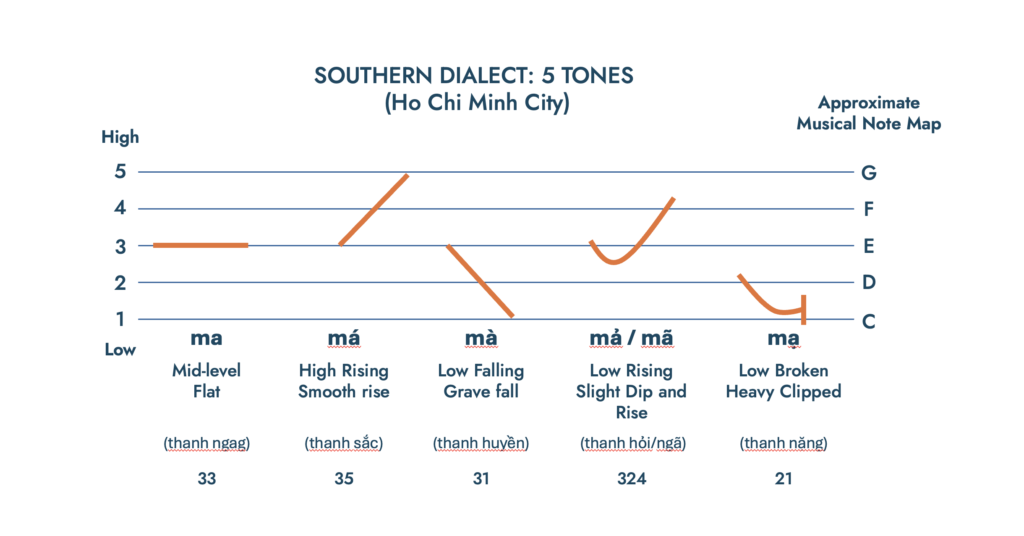
The Southern Sound System
Aside from the merger of hỏi and ngã, the phonology of this dialect group also carries relatively minimal differences from the Northern dialect.
sắc
Still rising, but the contour is smoother and less sharp. The rise tends to sound more glided.
huyền
Remains falling, but often softer and more relaxed, with less contrast in pitch drop compared to the north.
hỏi / ngã
These two tones are merged in everyday Southern speech. Only a single tone with a dip-and-rise contour is used without the glottal break that defines ngã in the north. It is slightly shorter than the northern variety.
nặng
Still low and falling, but less abruptly cut off. The strong northern glottal stop is softer and slightly more fluid.
ngang
Generally unchanged, though it often sounds more level and relaxed, contributing to the overall smoother quality of Southern speech.
Vietnamese Pronunciation of English
Returning to my favourite salon, I must admit that for a long time I had a very difficult time understanding what the ladies were asking me. I know the routine: go pick your colour and sit down. But once I was a regular, conversation opened up beyond the scope of work, and I found myself feeling bad about having to keep asking her to repeat what she said. Not just because they speak lower than the volume my ears are accustomed to, but also because their pronunciation of English words sounded incomplete.
Gradually, I learned that Vietnamese speakers, when speaking in English, continue to apply the rules of their own sound system to a language that was not designed for that.
Vietnamese has a tightly controlled syllable structure, with few consonant clusters and a small set of allowable endings. English, on the other hand, groups multiple consonants together, especially at the beginning and end of words.
So when my technician says, “Please, go pick your colour”, I hear:
Plee go peek yo cola.
She says it in a sound system that follows this sequence:
plee = rising (35)
go = flat (33)
peek = flat (33)
yo =dip-rise (324)
cola = low broken (21)
Other approximate examples of shortened syllable pronunciation that get modified to fit Vietnamese phonology:
towel → tao-oh
wash hands → wot hen
chair → che
text → tek or tét
desk → dét
shape → sếp (the “sh” sound sounds like a soft s)
shellac → seh-lak
street → suh-treet
From these examples, it’s clear that there is also a difference in sound inventory. Certain English sounds, such as “th” in think or this, do not exist in Vietnamese, so speakers naturally substitute the closest available sound: z for northern speakers and t or d for others. The “sh” sound also doesn’t exist, along with others.
Apparently, the same thing happens in reverse when English speakers attempt Vietnamese and other tonal languages, and flatten, misplace or exaggerate tones.
Now that I understand the differences between English and tonal languages a little better, I have a much deeper respect for the learning curve tonal language speakers face when learning English. The challenge certainly includes vocabulary and grammar, but the most difficult part is phonological.
When we learn a new language, we have a foreign accent when we speak it. It’s a trace of our linguistic system as we map unfamiliar sounds onto the closest equivalents of our native phonology. To learn English, Vietnamese speakers must adapt to an entirely different way of encoding and perceiving sound.
To Be Continued...
In the next Vietnamese edition, we’ll move beyond sound. We’ll explore some of its vocabulary, grammatical structure, and the linguistic culture that defines how Vietnamese people communicate through politeness and unspoken understanding in an environment that places great value on relationships.
If you’ve missed previous editions of the Santium Language Series, you’ll find them here – catch up!
How Santium contributes to this space
Santium provides specialized language services focused on scientific, medical and technical content. We focus on delivering translated materials that work as intended across languages and cultures through translation, linguistic validation and subject-matter specialist review, preserving meaning, function, usability, and measurement integrity in real-world applications.
Follow Santium to stay connected
If you found this article interesting, follow me on LinkedIn and join our newsletter to receive future editions. In the Santium Language Series, I explore interesting traits of the world’s languages, from the most widely spoken to obscure, introducing their structure and word formation to cultural nuance and their role in social norms.
Stay connected and don’t miss the next edition!

|
Thank you for signing up. |



Monika Vance
Managing Director | SANTIUM
My work sits at the intersection of linguistics, scientific and medical translation, psychometric measurement, and multilingual operations, where terminology, usability, and regulatory context must align. I write about scientific and medical translations, psychometrics, languages, and the operational challenges that inevitably come with them. I also teach translators how to properly translate and validate complex psychometric instruments to hone their expertise in linguistic validation.