
Today, let’s switch gears a little. Until now, we’ve been learning about spoken languages and if you’ve been following previous editions of this series, you’ve probably noticed that spoken languages, despite lexical, grammatical and pronunciation differences, also have a lot in common. Every language has a patterned logic, which makes it learnable.
Not all languages have sound systems. Deaf people can’t hear sound, so they cannot learn to imitate the sound of speech as well as hearing people can. Instead, they’ve created their own ways to communicate needs, affection and ideas, along with complex scientific and artistic concepts through forming icons with their hands, supported by body movement and precise culturally-bound facial expressions worthy of admiration in the dramatic arts.
We’ll begin with the American Sign Language to continue the comparison between English and other languages, and then move to some other examples of sign languages, to give you at least a surface idea of how they differ.
A Brief History of Sign Languages
Natural sign languages emerged wherever groups of Deaf people interacted with each other and also had to communicate with hearing people. Some modern sign languages were born in educational institutions. One of the most influential moments occurred in 18th-century France, when Abbé Charles-Michel de l’Épée established the first public school for Deaf students in Paris.
Nearly a millennium later, in 1817, Thomas Hopkins Gallaudet and Laurent Clerc founded the American School for the Deaf, when Clerc brought Old French Sign Language with him to America. It mixed with existing local sign systems used by Deaf communities in the United States and Canada.
Simultaneously, other teachers from the Paris school for the Deaf travelled to spread Old French Sign Language (LSF) to other parts of the world where it influenced the creation of the Irish, Italian, Russian, Dutch, Arabic, Brazilian and many other sign languages.
Today, linguists estimate there are over 300 distinct sign languages worldwide.
A Little Island Shaped American Sign Language (ASL)
One of the most unusual linguistic stories in the world comes from Martha’s Vineyard, a charming island off the coast of the State of Massachusetts in the United States.
From the 17th through the 19th centuries, the island had an unusually high rate of hereditary deafness. Geographic isolation contributed to a genetic mutation resulting from a small reproductive gene pool. In some villages, 1 in 25 residents was deaf, and in certain areas the ratio was even higher.
In this highly inclusive tight-knit community, sign language was a part of everyday life. Hearing children grew up learning both spoken English and signing, much like bilingual communities speak different languages today. On this island, both Deaf and hearing people worked and lived alongside of each other and because everyone signed, deafness did not carry the same stigma and social limitations found elsewhere. Here, residents used a local sign language called Martha’s Vineyard Sign Language.
This made Martha’s Vineyard one of the earliest documented examples of full linguistic accessibility.
When the American School for the Deaf opened in 1817 in Hartford, in the nearby State of Connecticut, many of its first students came from Martha’s Vineyard. At the school, three signing systems came together: Martha’s Vineyard Sign Language, Old French Sign Language brought by Laurent Clerc, and various home-grown sign languages used by deaf students from other towns.
Over time, other regional influences blended and evolved into what is known today as the American Sign Language (ASL).
By the late 19th century, transportation improved and island residents began migrating and having children with people from the mainland. The genetic trait responsible for the high rate of deafness gradually declined, and the unique signing island community disappeared.
Independent Linguistic Systems
One of the most common misconceptions about sign languages is that they represent spoken language through gestures. In fact, sign languages are independent linguistic systems with their own vocabulary, grammar, and structure. They do not render their spoken counterparts word-for-word. Instead, they have lighter “word” density, but organize meaning through a layered system of simultaneous elements: hand shape, movement, location, orientation and facial expression. You’ll see a few examples shortly.
Facial expressions, head movements, and body postures function as core grammatical markers. Raised eyebrows can signal a yes/no question, furrowed brows often mark WH-questions (who, what, where, when, why, which and how), and head movements can indicate negation or emphasis, and substitute intonation and punctuation in spoken languages. Body movements indicate things like position or who is talking. These features occur in symphony with the manual signs, creating a multi-layered grammatical system.
Because sign languages use visual cues and space instead of sound, their grammar often develops in ways that differ significantly from its general populations’ spoken languages.
How ASL Resembles Mandarin Chinese
An interesting example of the difference from its spoken counterpart is how the structure of American Sign Language resembles that of Mandarin Chinese.
Example:
“I bought a book and read it.”
English typically follows a Subject-Verb-Object pattern:
English: I bought a book.
ASL tends to use a Topic–Comment structure, where the topic of the sentence is introduced first and then information about it follows:
ASL: Book – I buy.
Mandarin Chinese often also follows the Topic-Comment pattern, where the topic is introduced first with a comment describing what happened to it after:
Hanzi: 这本书,我买了。
Pinyin: Zhè běn shū, wǒ mǎi le.
Literal translation: This book, I bought.
Both languages rely heavily on context. Unlike in spoken English, once the topic of the conversation was introduced in ASL, there is no reason to reintroduce it. The “listener” already knows what is being discussed. The signer refers back to the book simply by pointing to its location or whatever movement was used to establish its presence, and then sign:
I – read.
A Mandarin speaker will say it like this:
Hanzi: 看了。
Pinyin: Kàn le.
Literal translation: Read it.
Neuropsychological Aspects
From a neuropsychological perspective, sign languages engage the same core language networks in the brain as spoken languages, particularly areas in the left hemisphere such as Broca’s area and Wernicke’s area. This demonstrates that human language is fundamentally a cognitive system, and not something tied exclusively to speech.
However, sign language processing also recruits regions associated with spatial cognition and motion processing, reflecting the visual modality of the language. Research in neuropsychology and cognitive neuroscience shows that signers often develop strong abilities in visual attention, spatial memory, mental rotation and tracking movement in space.
These abilities are useful because sign languages rely heavily on visuospatial organization and simultaneous visual information. They organize meaning through iconic visuals and spatial relationships instead of sound.
Spatial structure is part of grammar. A signer may establish people or objects in locations around the signer’s body.
For example:
Person A → left
Person B → right
Later in the conversation, the signer simply points back to those locations to refer to them again, or if the signer is paraphrasing Persons A and B, s/he may move into those locations to emphasize who is speaking.
This spatial indexing also functions similarly to pronouns in spoken languages.
Together, these findings reinforce an important principle: human language is modality-independent. Whether expressed through sound or through visual space, the brain organizes language using the same underlying cognitive architecture.
Comparing Signs Used Around the World
Although sign languages are independent languages with their own grammar and vocabulary, some everyday expressions can be compared across systems to illustrate both shared visual logic and linguistic diversity. Using American Sign Language as a baseline makes these comparisons easier to understand.
In all sign languages, pointing is done with the index finger. Linguists call this deixis or indexing. Indexing functions as a pronoun system.
Below are several simple phrases that highlight how different sign languages structure the same idea.
Example 1: “I love you.”
In ASL, the sign for this phrase is a single sign and particularly famous because it combines three letters – I + L + Y – from the American manual alphabet:
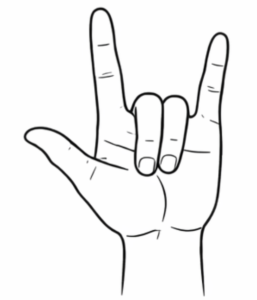
This sign has become a global pop-culture symbol, but linguistically it belongs to ASL.
The chest is universally associated with feelings, hence many sign languages independently developed heart-centred gestures for love, affection and sincerity.
Most other sign languages express this phrase with three gestures:
British Sign Language (BSL)
BSL typically expresses the phrase sequentially:
ME + LOVE + YOU
point to chest + arms cross chest + point outward
French Sign Language (LSF)
Very similar structure as BSL and it is also shared in Brazilian, Dutch and other variants.
ME + LOVE + YOU
point to chest + hand over heart + point outward
Japanese Sign Language (JSL)
The Japanese word for “love” (愛 / ai) and the sign-language gesture actually connect to very old East Asian metaphors about the heart and mind being the same concept.
In Japanese communication, expressions of strong affection are often less direct than in some other countries and softened, and this cultural tendency appears in signing as well. Because of this, the sign corresponding to “like” frequently carries the meaning that foreigners might interpret as “love”, especially in interpersonal contexts. However, the sign for “love” often involves a firmer contact with the chest and a stronger facial expression.
ME + LIKE + IT/YOU
point to chest + open hand on chest with slight outward movement + point outward
Example 2: “Hello”
American Sign Language (ASL):
open hand near the temple + move outward slightly
Description:
• Hand is open with fingers together
• Palm faces outward
• Hand touches or hovers near the temple
• It moves outward slightly away from the head
Conceptually this mirrors a casual spoken greeting like “hi.”
In British Sign Language, the greeting is often closer to a small wave.
open hand → small outward wave
Description:
• Palm faces outward
• Hand is held near shoulder height
• A small side-to-side motion functions as the greeting
It resembles the way hearing people wave hello.
In French Sign Language, the sign for hello often uses a gesture near the mouth.
Gesture:
fingers together near mouth → move outward
Description:
• Fingertips begin near the lips
• Hand moves forward and slightly outward
• Palm rotates outward as it moves
This greeting historically relates to the spoken French greeting bonjour.
In Arabic Sign Languages, the greeting typically references the spoken greeting “salaam.”
Gesture:
flat hand touching chest → slight outward movement
Description:
• Right hand touches the chest
• Hand moves outward slightly
• Facial expression usually conveys warmth
The gesture reflects the cultural greeting meaning “peace.”
In Japanese Sign Language, the greeting often resembles a small bow combined with a hand gesture.
Gesture:
open hand near the side of the face → slight downward motion
Description:
• Hand begins near the cheek or temple
• Small downward or outward motion accompanies the greeting
• Often paired with a slight bow
This reflects Japanese greeting etiquette.
In Brazilian Sign Language, a common greeting resembles a casual wave.
Gesture:
open hand near forehead → small outward wave
Description:
• Palm faces outward
• Hand begins near the forehead
• A small outward motion signals greeting
This gesture is similar to greetings used in several Latin American sign languages.
Even though sign languages are not universal, greetings often look similar because they reflect natural human gestures for acknowledging another person.
The Global Sign Lingua Franca
ASL: How are you?
Range of Communication and Limits
Sign languages can convey extremely complex ideas. Universities around the world offer lectures and academic discussions entirely in sign language.
However, there are practical constraints.
Some fields require the creation of new specialized terminology, especially in science and technology. When a standardized sign does not exist, interpreters may rely on:
• finger-spelling
• newly agreed technical signs
• explanatory signing
Communication also depends on visual access, which shapes how conversations unfold.
If you’ve missed previous editions of the Santium Language Series, you’ll find them here – catch up!
How Santium contributes to this space
Lorem ipsum dolor sit amet, consectetur adipiscing elit. Ut elit tellus, luctus nec ullamcorper mattis, pulvinar dapibus leo.
Follow Santium to stay connected
If you found this article interesting, follow me on LinkedIn and join our newsletter to receive future editions. In the Santium Language Series, I explore interesting traits of the world’s languages, from the most widely spoken to obscure, introducing their structure and word formation to cultural nuance and their role in social norms.
Stay connected and don’t miss the next edition!
|
|
Thank you for signing up. |
Monika Vance
Managing Director | SANTIUM
My work sits at the intersection of linguistics, scientific and medical translation, psychometric measurement, and multilingual operations, where terminology, usability, and regulatory context must align. I write about scientific and medical translations, psychometrics, languages, and the operational challenges that inevitably come with them. I also teach translators how to properly translate and validate complex psychometric instruments to hone their expertise in linguistic validation.