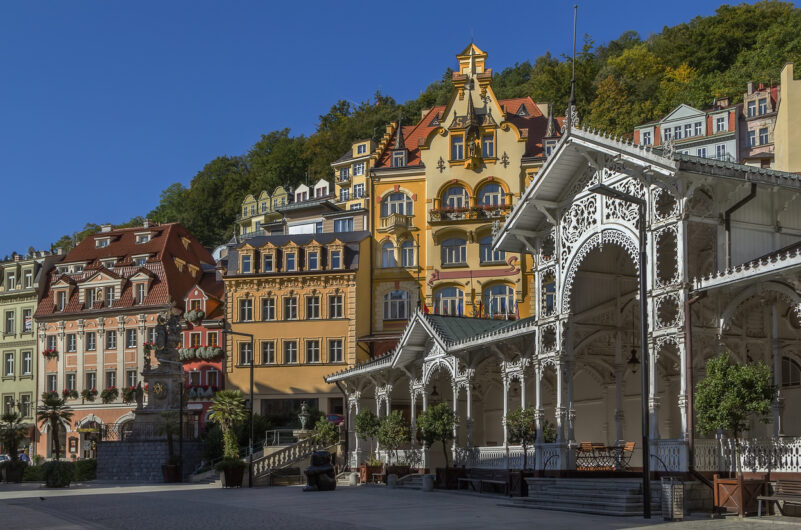
Czech is spoken in the Czech Republic, or Czechia, located in the heart of Europe. Czech Republic is probably best known around the world for its beers, especially Pilsner Urquell and Budvar, the original Budweiser. Sadly, the bottled and canned versions just don’t do it justice. Nothing beats getting it freshly brewed at the right temperature, with the right pressure and the bartender’s nearly cult-like pouring precision at a local Czech beer pub!
Czech belongs to the West Slavic branch of the Indo-European family, alongside Polish and Slovak. It developed from Old Slavic varieties spoken in Bohemia and Moravia and was first written down extensively in the Middle Ages. After flourishing in the 14th–15th centuries, when Czech was used in administration, literature, and theology, its public role weakened under Habsburg rule as German language gained dominance during the 19th century era of the Austro–Hungarian Empire.
The modern language is largely the result of the Czech National Revival during the late 18th–19th centuries, a deliberate effort by linguists and literary writers to standardize grammar, expand vocabulary, and re-establish Czech as a full-fledged cultural and scientific language. Many “formal” or bookish words in today’s Czech come from this period, which explains why modern Czech is more conservative and structurally intact than many neighboring languages.
What makes Czech distinctive
During a recent conversation with my cousin Andrea, who lives in the beautiful Czech town of Karlovy Vary, she said, “Jsme upovídaný národ”, which literally means “We are a (very) talkative nation.” There was subtle humor in it, but fundamentally there was also truth in it, though this may not be immediately observable to a foreigner in a one-on-one interaction.
Czechs may appear reserved at first contact, especially when compared to Southern Europeans, or Canadians. But once in a trusted environment, at home, among friends, or in their neighbourhood pub, they are deeply conversational. Conversation becomes vibrant, animated, detailed and often driven by debate or humor-infused banter.
The reputation of Czech language among linguists rests on three things:
Extreme Expressive Range
Czech can compress meaning with almost mathematical efficiency. At the same time, it can stretch into layered, emotionally textured phrasing without losing grammatical control.
Because Czech encodes grammatical relationships through endings rather than strict word order, speakers can rearrange elements for emphasis without losing precision in message. For example, changing word order can subtly shift focus, emotional weight, contrast and irony. In this context, English often needs additional words (“actually,” “even,” “precisely,” “only then”) to achieve the same nuance. Czech does this through position and inflection alone.
At the same time, Czech can be strikingly direct. Short sentences with minimal pronouns and tightly inflected verbs can sound sharp, even blunt. This is one reason Czech legal and technical writing, for example, is densely rich without being verbose. In conversation, however, the same system allows expressive layering of registers through use of diminutives, aspect shifts, and modal particles, all inside a single sentence.
It’s a highly efficient language that is also emotionally warm whenever speakers want it to be.
Productive Morphology
Changing meaning only with prefixes and suffixes
Czech can say a lot without saying much. Czech uses prefixes and suffixes by rule. A base verb can generate multiple related actions: direction, completion, repetition, intensity, entry and exit movement, success and failure nuance. These are features that English usually expresses with entire phrases.
Visual example for prefixes:
psát = to write (imperfective, present tense)
Now add prefixes:
napsat = to write down / to complete writing (perfective, action is finished)
přepsat = to rewrite
zapsat = to record / write into (a register)
podepsat = to sign (literally “write under”)
vypsat = to fill out / write out / issue (e.g., a form)
dopsat = to finish writing
sepsat = to compile / draft (formally)
Same root, one word instead of two or three as in English, different prefix and entire semantic shift. Suffixes work the same way.
Diminutives
Diminutives give Czech its emotional power. They are deeply embedded in adult communication. They encode size or attitude, depending on context. A noun can shift tone from neutral to affectionate, ironic, polite, sarcastic, or softened simply through a suffix. This makes Czech socially highly calibrated. Even a slight morphological shift can change emotion, attitude and how the statement lands.
Compressing long words into faster colloquial forms
Formal Czech includes structurally dense vocabulary, with long names or compound formations comparable to German. In everyday speech, however, speakers rarely use these full forms. Instead, they create shortened variants, such as new nouns, adjectives, and verbs, built for speed and social ease. In English, the closest comparison to this is Australian slang. Here are some examples:
Czech
Staroměstské náměstí (Old Town Square) → Staromák
Národní třída (National Boulevard) → Národka
Karlovo náměstí (Charles’ Square) → Karlák
Václavské náměstí (Venceslav Square) → Václavák
Australian English
Afternoon → arvo
University → uni
Service station → servo
Barbeque → barbie
McDonald’s → Maccas
Because Czech slang shortenings follow recognizable morphological rules, once you know the base word, the colloquial version becomes obvious, and often slightly humorous.
Register Flexibility: Spoken and Written
Spoken Czech shifts effortlessly between formal, neutral, and colloquial registers, often in a single sentence.
At the top sits Standard Czech (spisovná čeština). This is the language of law, medicine, academia and official communication. It is codified and taught explicitly in schools. Grammar is tightly controlled and morphology is precise through Czech’s rich lexicon.
In the middle lies neutral everyday Czech, which is still grammatically standard, but stylistically lighter. This is the register of business emails, educational materials, workplace communication, and most public-facing writing that is professional in tone but warmer and not entirely formal.
Then there is common Czech (obecná čeština), the dominant spoken variety. It simplifies certain endings, shifts vowel patterns, and incorporates expressive shortenings. It signals familiarity and social ease laced with warmth and an appropriate degree of intimacy. However, common Czech rarely appears in writing, except for shortened words. While Czech speakers happily use chat abbreviations, emojis, and informal vocabulary, it is relatively rare for them to respell standard words to reflect colloquial pronunciation.
For example, the standard written form černý (“black”, pronounced tchernee) is unlikely to be written as černej (slang “black”, pronounced tchernay), even though the latter reflects the spoken pronunciation in common Czech. For comparison, in English, phonetic spelling to reflect speech, such as “gonna,” or “wanna”, has been normalized and frequently appears in informal writing. In Czech, this kind of orthographic relaxation is less widespread outside very casual contexts.
Writing System and Sound-Letter Logic
Czech uses the Latin alphabet with diacritics, such as háček ˇ (“hook”) and čárka ´ (“line”). Unlike English, Czech spelling is remarkably phonemic: words are pronounced almost exactly as written.
Special letters such as č, š, ž, ř, ě, ů encode sounds that English doesn’t have in writing but some exist phonemically: č=”tch”, š=”sh”, ě=”ye” or ů=”ooh”. The infamous ř – a raised alveolar trill – has become a linguistic calling card of Czech and is famously difficult for learners. One can get by with just saying “shr” – in the end, it’s the intended effort that matters most! Czechs will get it. They will also likely complement you for trying.
Mutual Intelligibility: Who understands whom?
Czech sits within the West Slavic branch of languages, and its closest linguistic relative is Slovak. The relationship between Czech and Slovak is unusually tight, structurally, historically, and socially.
For most Czechs, Slovak is immediately understandable without formal study. The reverse is equally true. Vocabulary differs in places, pronunciation shifts slightly, and certain grammatical forms vary, but the underlying structure remains close enough that comprehension comes naturally.
Decades of shared statehood under Czechoslovakia reinforced this familiarity through media, education, and everyday exposure. As a result, Czech–Slovak mutual comprehension remains one of the clearest examples of passive bilingualism in Europe: two populations speaking different standard languages while understanding each other effortlessly.
Polish sits further away. It is also West Slavic, and written Polish is often partially intelligible to Czech readers. Shared roots and similar word formation patterns allow educated guesses. Spoken Polish, however, presents greater difficulty for Czechs living further away from the Polish border. Pronunciation diverges more sharply, and without exposure, comprehension drops significantly.
Beyond Polish, intelligibility declines quickly. South Slavic languages such as Slovenian, Croatian or Serbian, and East Slavic languages such as Ukrainian or Russian, share deeper Indo-European ancestry, but the surface differences in phonology, vocabulary, and grammar are large enough that spontaneous understanding is rare.
Formal Address: Plural as respect
Using plurals
Czech still preserves a clear distinction between informal and formal address. Speakers use the informal singular form of “you” (ty) with friends, family, and close colleagues, and the formal plural form of “you” (vy) when addressing someone formally.
This practice, known as vykání, immediately signals respect, distance, or professionalism. Generally, once a person becomes an adult, the address automatically switches from ty to vy.
English has no equivalent. In English, respect must be conveyed indirectly through tone or word choice. But similar systems exist in German (du/Sie), French (tu/vous), Spanish (tú/usted), Russian (ty/vy), and many other languages. Czech belongs to a broader European tradition in which grammar reflects social hierarchy and familiarity.
The shift from vy to ty is never assumed. It must be explicitly negotiated: “Můžeme si tykat?” (“May we use informal address?”). Moving too quickly to ty can be perceived as presumptuous, even insulting, while staying with vy is not uncommon. Czechs navigate this boundary by instinct with timing encoded into the situation and purpose of the relationship.
Formal address for professionals
Czech culture historically places value on education and earned credentials. Doctorate, masters and engineering titles are formally conferred and socially recognized. Using the professional title in direct address is common and often expected in initial interactions.
For example:
“Dobrý den, pane doktore.”
“Good afternoon, Doctor.”
Though modern Czech society is less rigid than it was decades ago, this tradition still holds with older generation professionals, whether retired or not. It signals respect and recognition of qualification.
Foreigners Learning Czech
Despite its turbulent political history, Czechia is and always has been a place where foreigners – some from distant parts of the world – settled for political, familial or economic reasons. To obtain permanent residency in Czechia, foreigners must demonstrate conversational fluency in Czech.
Foreigners learning the language commonly describe it as difficult at first, even “brutal”, then it suddenly becomes logical, then you realize how much meaning is unpacked into one word, that humor hits differently because of the linguistic mechanics behind it, and that putting the effort into learning their language earns respect with Czechs, which in turn comes with warm social inclusion.
For native speakers, the Czech language may be globally insignificant, but it’s distinctly theirs; it is a source of understated pride expressed through vibrantly social linguistic entertainment.
Curious about how the world’s languages work?
If you found this article interesting, follow me on LinkedIn or subscribe to our newsletter. In our language series, I explore interesting traits of the world’s languages, from the most widely spoken to obscure, introducing their structure and word formation to cultural nuance and their role in social norms.
Stay connected and don’t miss the next edition!
How Santium contributes to this space
Czech’s sharp register distinctions, dense morphology, and strong expectations for formal correctness make it unforgiving in professional contexts—especially in medicine, life sciences, engineering, and regulated documentation. Santium contributes to this space by delivering domain-specialized Czech translations that respect not just terminology, but register, audience, and functional intent.
Our workflows align Czech language use with regulatory expectations, clinical practice, and real-world usability—whether the content is patient-facing, technical, or scientific. By combining subject-matter expertise with linguistically precise Czech delivery, Santium ensures translations perform as intended in both formal systems and real-world use.
References
Banerjee, M. (2008). Studies on irony and language in Czech literature.
Čermák, F. (2011). Czech: The Language Situation. Cambridge University Press.
Dankovičová, J. (1999). Czech. In IPA Handbook. Cambridge University Press.
Karlík, P., Nekula, M., & Rusínová, Z. (2016). Czech Encyclopedic Dictionary of Linguistics. Masaryk University.
Kundera, M. (1986). The Art of the Novel. Grove Press.
Macura, V. (1995). The Mystifications of a Nation: The “Czech Dream”. University of Wisconsin Press.
Naughton, J. (2005). Czech: An Essential Grammar. Routledge.
Pynsent, R. B. (1994). Questions of Identity: Czech and Slovak Ideas of Nationality and Personality. Central European University Press.
Short, D. (1996). Czech and Slovak. In B. Comrie (Ed.), The World’s Major Languages. Routledge.
Slobin, D. I. (Ed.). (1985). The Crosslinguistic Study of Language Acquisition. Lawrence Erlbaum.
Sussex, R., & Cubberley, P. (2006). The Slavic Languages. Cambridge University Press.
Townsend, C. E., & Janda, L. A. (1996). Common and Comparative Slavic. Slavica.

|
Thank you for signing up. |



Monika Vance
Managing Director | SANTIUM
My work sits at the intersection of linguistics, scientific and medical translation, psychometric measurement, and multilingual operations, where terminology, usability, and regulatory context must align. I write about scientific and medical translations, psychometrics, languages, and the operational challenges that inevitably come with them. I also teach translators how to properly translate and validate complex psychometric instruments to hone their expertise in linguistic validation.